
Tag: body alignment

  • Secrets to Avoid Knee Surgery: 6 Months of Results

    Secrets to Avoid Knee Surgery: 6 Months of Results

    Imagine standing up from a chair and feeling a sharp pain shoot through both knees. Now imagine that happening every single day — getting out of bed, climbing stairs, walking to your car. Simple things that used to be automatic suddenly feel like obstacles.

    If you are searching for ways to avoid knee surgery, you are not alone. Thousands of people face this difficult decision every year — weighing costs, recovery time, and the uncertainty of whether surgery will truly solve the problem.

    This is the story of one man who found a different path — and what he did to avoid knee surgery may surprise you.

    avoid knee surgery naturally with body care
    Many people search for ways to avoid knee surgery before making a final decision.

    When Knee Surgery Seemed Inevitable

    He had already been through surgery once before — a neck disc procedure five years earlier. He remembered the recovery. The weeks of limitation. The uncertainty of wondering whether it had truly worked. Now, facing the possibility of surgery on both knees, those memories came rushing back.

    His doctor had found significant cartilage wear in both joints. The recommendation was clear: consider surgical intervention. The estimated cost exceeded 10 million Korean won, and he had no insurance to cover it. But the financial stress, as heavy as it was, was not even his biggest fear. What kept him awake at night was a quieter, harder question:

    What if I go through all of this — and I am still not better?

    He desperately wanted to avoid knee surgery — but did not know if that was even possible.

    One Question That Changed Everything

    When he came to our center, I did not tell him surgery was wrong. I told him something simpler: it will still be there in six months. There was still time to try to avoid knee surgery — and that window was worth using.

    Before closing a door that big, I suggested we try opening a few smaller ones first. Not as a cure. Not as a miracle. But as an honest attempt to understand what his body was capable of when given the right conditions.

    We focused on what is often overlooked in conversations about joint pain: the whole body, not just the joint. Posture. Movement patterns. The way tension accumulates in the body over years of daily habits. And something we work with deeply at our center — what we call unconscious nervous system management (KSNS), a method of helping the body release deeply held patterns of strain and imbalance.

    Real knee and body care in practice — the kind of consistent daily effort that can help avoid knee surgery over time.

    He came in regularly. More importantly, he went home and practiced every day — without fail.

    6 Months of Consistent Care: What Actually Happened

    There were no dramatic turning points. No single moment where everything clicked. Progress in the body rarely works that way.

    But over weeks and months, something shifted. Walking became less of a calculation and more of a comfort. He stopped mentally bracing himself every time he stood up. He started doing things again — things he had quietly stopped doing without even realizing it.

    By the end of six months, he made a decision. Not surgery. Not yet. Maybe not ever. He had found a real way to avoid knee surgery — at least for now.

    Years have passed since then. He is still walking. Still active. Still living the life he was afraid he might have to give up.

    Can You Really Avoid Knee Surgery Through Conservative Care?

    avoid knee surgery through exercise and alignment
    Consistent daily movement and body alignment can make a meaningful difference.

    I want to be honest, because honesty matters more than a feel-good story.

    His experience is not a guarantee. Knee cartilage wear is a real, serious condition, and surgery is sometimes genuinely necessary and the right choice. Every body is different. Every situation is different.

    However, what his story offers is a question worth sitting with before making a major decision:

    Have I fully explored what my body can do — with the right support, the right habits, and enough time?

    Conservative approaches that may help some people avoid knee surgery or delay it include:

    • Improving overall body alignment and posture
    • Developing healthier movement patterns in daily life
    • Consistent low-impact exercise and stretching routines
    • Nervous system regulation and stress reduction practices
    • Building body awareness through guided self-care programs

    None of these are substitutes for professional medical evaluation. However, they can play a meaningful role in how your body feels and functions over time. Research also suggests that gut health may influence joint inflammation — if you are curious, you may find this related article helpful: Probiotics and Joint Pain: The Gut-Joint Connection You Need.

    What to Consider Before Making Your Decision

    If you are currently facing a recommendation for knee surgery, here are a few questions worth asking your doctor or healthcare provider. According to Mayo Clinic, conservative treatments are often the recommended first step before considering surgical options for knee osteoarthritis:

    • Is this surgery urgent, or is there time to try conservative care first?
    • What are the realistic outcomes with and without surgery?
    • Are there specific exercises or therapies that could help in the meantime?
    • What does recovery look like, and how will it affect my daily life?

    Taking a few months to explore movement-based approaches, body alignment work, and lifestyle adjustments is not giving up on surgery. It is simply making sure you have given yourself every reasonable opportunity to avoid knee surgery before taking that step.

    A moment of stillness and healing — sometimes the body needs peace as much as movement. (432Hz Healing Music by LumiGenesis)

    Final Thoughts

    Sometimes the most important thing is not the decision itself. It is making sure you have given yourself every reasonable chance before you make it.

    That simple shift in perspective — surgery will still be available later — made a meaningful difference for one person. It may be worth considering if you are facing a similar crossroads today.

    Knee discomfort can have many causes, and there is no single solution for everyone. But for many people, the desire to avoid knee surgery is a powerful motivator to explore what the body can do with the right care. Whether you eventually choose surgery or not, maintaining good movement habits, improving body balance, and staying physically active can play an important role in your long-term well-being.

    If you would like to learn more about body alignment approaches and self-care programs, feel free to explore the resources on this site or reach out directly.
  • How to Fix Severe Teenager Chronic Muscle Stiffness: No.1

    How to Fix Severe Teenager Chronic Muscle Stiffness: No.1

    Most parents assume that severe teenager muscle stiffness, postural tension, and chronic circulation problems are adult concerns — the inevitable toll of decades spent at a desk.

    young person neck stiffness
    Chronic muscle stiffness in teenagers is no longer rare — it now appears at the same intensity once seen only in adult office workers.

    ​But what happens when a fifteen-year-old walks through your door carrying the same physical burden as a forty-five-year-old office worker? This is exactly what we encountered recently in our assessment, revealing a deeply concerning trend in teenager muscle stiffness.

    ​”His Shoulders Feel Like Stone”

    ​A high school freshman recently came in with his mother. She was calm, but clearly worried.

    ​”His shoulders feel like stone. Even when he lies down, his body posture looks uncomfortable.”

    ​At first glance, he appeared to be simply another tired student — the kind whose exhaustion reads as ordinary in environments where academic pressure begins before sunrise and ends well after midnight.

    ​But as we began a careful postural and muscular assessment, the picture became far more complex. This wasn’t just temporary fatigue; it was a severe case of developmental teenager muscle stiffness.

    ​His daily routine told the real story:

    • ​Heavy Backpack: A heavy bag carried every day across both shoulders.
    • ​Prolonged Sitting: Six to eight hours of seated study, often with the head pushed forward.
    • ​Gaming Habits: Evening gaming sessions lasting two to three hours, body hunched toward the screen.

    ​This is not an unusual schedule for high school students today. In fact, it is almost universal. What was unusual was how completely his body had adapted to it — and how it accelerated his physical degradation.

    ​Posture Assessment: Identifying Teenager Muscle Stiffness

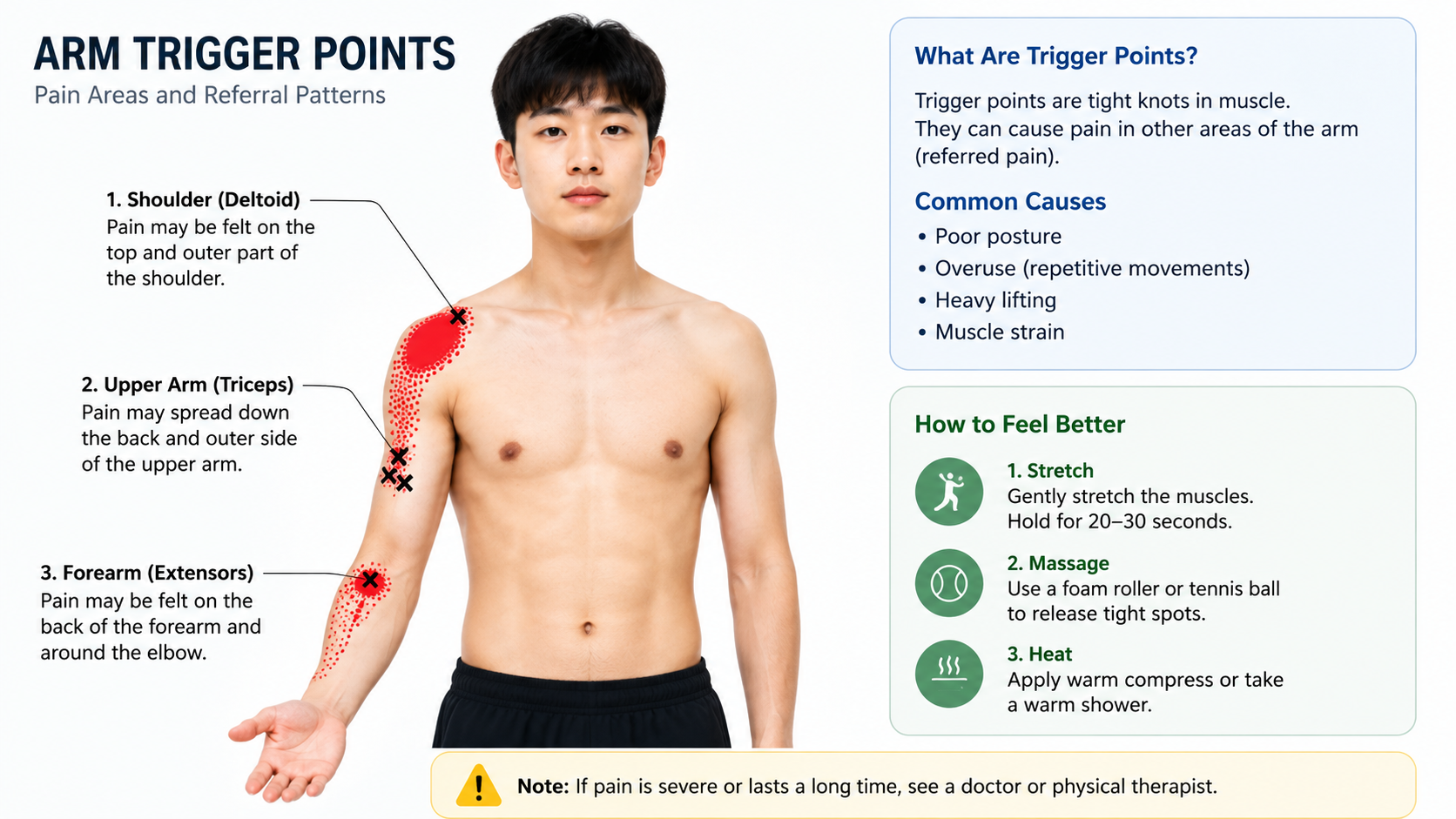
    trigger point map for teenager muscle stiffness — pectoralis deltoid biceps infraspinatus
    Key muscle trigger points commonly activated
    in teenagers with chronic muscle stiffness —
    including the pectoralis major, deltoid,
    biceps brachii, and infraspinatus.

    ​When we observed his posture lying flat on the treatment bed, several indicators of advanced teenager muscle stiffness immediately stood out.

    ​The arms and shoulders were in a state of chronic contraction. Not simply “tight” in the way a muscle feels after exercise — but hardened, with individual muscle groups compressed together and resistant to movement. The right forearm, in particular, felt dense and immobile around the biceps and triceps region. The tissue had lost its natural pliability.

    ​This is a condition sometimes described in clinical body work as myofascial densification — where layers of muscle and connective tissue lose their ability to slide and glide freely against each other, creating a sensation of thickness and restriction that goes beyond ordinary soreness.

    ​The lower body told a parallel story of compensation. His left foot had fallen outward passively, with the outer ankle bone resting against the bed without any muscular control holding it in neutral alignment. This kind of passive external rotation suggests that the stabilizing muscles of the hip, lower leg, and foot were no longer maintaining their baseline tone — a common compensatory pattern when the upper body is chronically overloaded with heavy tension.

    ​In body balance assessment, we rarely look at one region in isolation. The human body communicates systemically, especially when dealing with chronic teenager muscle stiffness.

    ​Why the Body Responds to Teenager Muscle Stiffness

    According to Mayo Clinic, chronic muscle tension
    that persists beyond normal fatigue requires
    professional assessment. The human muscular system
    is designed around a fundamental principle:
    tension and release.

    ​The human muscular system is designed around a fundamental principle: tension and release.

    ​Muscles contract to create movement and maintain posture, then release to allow recovery and circulation. When this cycle is disrupted — by prolonged static postures, chronic psychological stress, or insufficient movement — the system defaults to a state of sustained contraction.

    ​For teenagers, the compounding factors are significant. The table below breaks down how modern daily habits lead to systemic physical lockdown:

    • ​Heavy backpack load: Forward head posture, upper trapezius compression
    • ​Prolonged desk sitting: Hip flexor shortening, thoracic rounding
    • ​Gaming / screen posture: Anterior shoulder drift, neck extensor fatigue
    • ​Academic stress: Elevated cortisol, systemic muscle guarding
    • ​Low movement volume: Reduced fascial hydration, circulation stagnation

    ​None of these factors alone would cause serious dysfunction. Together, sustained over months and years during a period of active skeletal and muscular development, they create the perfect storm for chronic teenager muscle stiffness.

    ​The Clinical Session: Releasing Teenager Muscle Stiffness

    ​1. Tension Release Through Traditional Cupping Therapy

    ​Traditional cupping therapy was applied to the forearm, shoulder, and clavicle region. This approach uses localized suction to decompress compressed tissue layers, encourage circulatory movement, and interrupt sustained muscular contraction patterns.

    ​After the session, darker reaction marks appeared across the treatment area — a common response in cases of long-term muscle tension and reduced local circulation, well-recognized in traditional East Asian body care traditions.

    ​The student’s immediate feedback was telling:

    “My arms feel lighter now. My shoulders move more easily.”

    ​This is not simply a subjective impression of relaxation. When compressed tissue is decompressed and circulation is encouraged to flow through areas that have been chronically restricted by teenager muscle stiffness, the perceived weight and resistance in the limbs decreases noticeably within the same session.

    ​2. Foot Reflex and Neurological Movement Management

    ​Foot reflex techniques and non-conscious neurological balance management were also applied to the lower extremities.

    ​This component of clinical posture care is essential but often overlooked. The feet are not simply the foundation of standing posture — they are a continuous feedback system sending postural signals upward through the kinetic chain at all times.

    ​When the feet lose their stability and grounding, the body compensates by increasing muscular tension throughout the lower leg, thigh, hip, and eventually the lumbar and thoracic spine. This compensation travels upward, contributing to shoulder and neck tension that appears, on the surface, to be entirely unrelated to the feet.

    Addressing the lower body was not secondary.
    It was essential to solving his upper body
    stiffness. For a deeper look at how foot
    health affects whole-body posture, see our
    guide on ingrown toenails and postural
    imbalance.

    ​The Upward Chain: Why Foot Instability Reaches the Shoulders

    ​One of the most important concepts in body care is understanding how tension travels through connected systems. When the feet are unstable, the body recruits muscular compensation from progressively higher regions, amplifying the overall teenager muscle stiffness:

    • ​[Feet & Ankles] — Instability & passive external rotation
    • ​[Calves] — Gastrocnemius and soleus overactivation (Compensatory bracing begins)
    • ​[Thighs] — Quadriceps and hamstring tightening (Upward muscle tightening)
    • ​[Hips & Pelvis] — Chronic hip joint compression (Joint compression)
    • ​[Lower Back] — Lumbar muscle guarding (Spine protection guarding)
    • ​[Shoulders & Neck] — Severe stiffness, tension, and persistent pain (Final visible stress point)

    ​By the time a patient notices shoulder stiffness, the pattern may have originated much further down the body — sometimes months or years earlier.

    ​This is why treating only the area of complaint rarely produces lasting results. Comprehensive body balance management works across the full kinetic chain to eradicate teenager muscle stiffness at its source.

    ​Teenager Muscle Stiffness: A Rapidly Growing Modern Pattern

    ​The case described above is not exceptional. Over recent years, posture clinics have seen a consistent, alarming increase in teenagers presenting with physical tension patterns that were previously associated almost exclusively with working-age adults.

    ​The modern lifestyle factors driving this shift are structural and hard to avoid:

    • ​Screen time — smartphones, tablets, and computers now occupy several hours of most students’ evenings.
    • ​Postural monotony — hours in the same seated position without adequate movement breaks.
    • ​Load imbalance — heavy school bags carried asymmetrically over developing spines.
    • ​Sleep disruption — late-night studying and blue light screen use reducing restorative rest.
    • ​Movement poverty — physical education reduced in favor of intense academic preparation.

    ​Many students normalize their discomfort because it has been present for so long. They say: “I’m just tired from studying,” or “My shoulders are naturally stiff.” These rationalizations are understandable — but they delay the recognition that the body is desperately asking for professional attention.

    432Hz healing music for deep relaxation
    and muscle tension relief.

    ​Why Early Intervention for Teenager Muscle Stiffness Matters

    ​Adolescence is a period of rapid musculoskeletal development. The patterns established during these years — postural habits, muscular tension tendencies, and movement preferences — tend to persist and deepen into adulthood.

    ​This is both a major challenge and a powerful opportunity.

    ​When chronic tension patterns are identified and addressed early, during a period when the body retains high adaptive capacity, the potential for meaningful improvement is significant. Correction becomes exponentially more difficult with each year that compensatory patterns are allowed to consolidate into adult bone and muscle structures.

    ​Early body balance care for teenager muscle stiffness is not a luxury. It is proactive maintenance of a physical system that is still in the process of forming itself.

    ​Appropriate interventions may include:

    1. ​Postural awareness education — learning what neutral alignment feels like and how to return to it.
    2. ​Targeted stretching and mobility work — particularly for the hip flexors, thoracic spine, and upper trapezius.
    3. ​Load management — reassessing backpack weight and carry method.
    4. ​Movement integration — regular breaks to interrupt prolonged static postures.
    5. ​Professional body balance assessment — when tension has already become chronic.

    ​A Final Thought on Whole-Body Balance

    ​At the end of the session, the student sat up and rotated his shoulders slowly. The heavy stiffness that had settled into his upper body so gradually that he had stopped noticing it — was, for the moment, completely gone.

    ​His mother watched quietly, then asked: “Why didn’t we seek help sooner?”

    ​It is a question worth sitting with — not just for this family, but for anyone caring for a young person today. The body keeps a strict record of everything it carries. It is worth paying attention before the record becomes a permanent burden.

  • 3 Essential Pillars of Posture Correction You Need to Know

    Posture correction starts with understanding that proper posture is not determined by bones alone

    1. Protein: The “Silent” Fix for Muscle Recovery

    ​Most people think of protein only for bodybuilders. But for posture, protein is the raw building material your body uses to repair the muscles that hold you upright.

    • ​Your muscles feel tight immediately after treatment.
    • ​You experience chronic fatigue in your lower back or neck.
    • ​It feels “exhausting” to sit up straight.
    • Many people assume that posture is purely a skeletal issue. However, without the right biological support, your skeletal system cannot maintain its alignment. Amino acids from protein are the foundational building blocks for muscle fibers. For those engaged in corrective therapy, increasing protein intake isn’t just about fitness; it’s about providing your body with the tools it needs to “hold” the new, corrected position.
    Posture Correction Therapy at Haim Body Balance Center
    Expert posture correction and muscle balance therapy in South Korea.

    2. Muscle Balance: The Foundation of Alignment https://soletobody.com/probiotics-and-joint-pain-the-gut-joint-connection/

    • The Result: One shoulder sits higher, the pelvis tilts, and your walk becomes uneven.
    • The Solution: Correction isn’t just about “strengthening.” It’s about restoring balance so your muscles stop fighting each other.
    • Muscle imbalance often creates a “tug-of-war” within the body. When one group of muscles is chronically overworked, it becomes shortened and tight, while the opposing muscles become overstretched and weak. True posture correction focuses on releasing the tight tissues and activating the dormant ones. This balanced tension is what allows the spine to sit naturally without constant conscious effort.
    • Achieve better balance through professional posture correction.

    3. The “Auto-Pilot”: Your Nervous System

    ​This is the most overlooked part of posture. Your body has an Automatic Nervous System Regulation that controls your balance without you thinking about it.

    ​When you walk, stand, or sit, your nervous system is constantly:

    • Scanning: Detecting your position via sensory nerves.
    • Reacting: Sending signals to muscles to keep you upright.
    • Stabilizing: Preventing you from falling.
    • Protein: Provides the raw materials to repair muscle tissue.
    • Muscle: Acts as the structural foundation to support your frame.
    • Nervous System: Acts as the commander for automatic coordination.
    • ​This neural retraining is the secret to lasting posture correction.

    ​If this system is inefficient, your brain “forgets” how to hold a good posture. This is why you “slouch” the moment you stop thinking about your back.

    For effective posture correction, balance is the key factor. We specialize in posture correction to help your body feel better. Posture correction is a journey of consistency.

    Think of your nervous system as the software that runs your body’s hardware. If the software has “bugs” (inefficient movement patterns), the hardware will eventually break down. Neuromuscular re-education is the process of teaching your brain to recognize what a balanced posture actually feels like. By improving this sensory feedback loop, you can achieve automatic stability that lasts even when you aren’t paying attention to how you sit.

    4. The Synergy: Why They Must Work Together

    ​To achieve a pain-free body, you need all three pillars working in harmony. If one is missing, the others will eventually fail.

    Example: Even if you strengthen your muscles, they will quickly become tight again if your nervous system keeps using inefficient movement habits.

    For effective posture correction, balance is the key factor. We specialize in posture correction to help your body feel better. Posture correction is a journey of consistency.

    • Posture correction is the first step to a healthy life. We are experts in posture correction. Try posture correction today

    Practical Habits for a Balanced Body

    Posture Correction

    ​Long-term posture improvement comes from consistent daily habits:

    1. Prioritize Protein: Include a clean protein source in every meal to support muscle recovery.
    2. Avoid Static Positions: Set a timer to move or stretch every 30 minutes.
    3. Stay Hydrated: Water is essential for both muscle elasticity and nerve signaling.
    4. Posture correction is the first step to a healthy life. We are experts in posture correction. Try posture correction today
    5. Listen to Your Body: Recurring stiffness is a signal that your system needs a check-up.

    Conclusion

    ​Posture correction is not a single event; it is a continuous process of nourishing your muscles and retraining your nerves. When you support your body with proper nutrition and movement, it will naturally find its healthy, balanced alignment.

    At Haim Body Balance Center, we focus on this integrated approach to ensure your physical alignment is supported by healthy muscle recovery and a responsive nervous system. Our goal is to provide lasting relief that transforms your daily life and movement efficiency.

    • Your journey toward perfect posture correction starts here.

    Are you struggling with recurring shoulder or back pain? Let’s discuss your experience in the comments below!

  • Foot Imbalance And Back Pain: The Hidden Cause Most People Ignore (7 Simple Fixes)

    foot imbalance back pain posture correction
    Foot imbalance changes body alignment and can be a hidden cause of chronic back pain and posture problems.

    Introduction

    Many people live with back pain caused by Foot Imbalance for years.
    They try stretching, massage, or medication, but the pain keeps coming back.

    In my 12 years of working with clients who suffer from chronic discomfort, I have seen one common pattern:
    the real problem often starts from the feet.

    Your feet are the foundation of your body.
    When that foundation becomes unstable, the rest of the body must compensate — especially the spine.
    Understanding this connection can be the first step toward long-term recovery.


    The Real Problem: A Weak or Uneven Foundation

    Most people focus only on the area where they feel pain.
    For example, if the lower back hurts, they treat the back.
    However, the body works as a connected system.

    When the left and right feet are not balanced, weight is distributed unevenly.
    Over time, this imbalance can affect:

    • Ankles
    • Knees
    • Hips
    • Pelvis
    • Spine

    The spine is then forced to stabilize an already unstable system.
    This leads to tension, fatigue, and eventually chronic pain.


    Signs That Your Feet May Be the Cause

    You may not feel pain in your feet, but they can still be the source of your problem.
    Here are common signs I observe in my daily work:

    • Back pain improves temporarily but returns quickly
    • One leg feels stronger or more stable than the other
    • Shoes wear out unevenly
    • You feel stiff in the morning
    • Pain increases after standing or walking
    • You have been told you have poor posture

    If two or more of these signs apply to you, your body’s foundation may need attention.


    A Different Approach: Restoring Balance

    Traditional approaches often focus only on muscles — stretching or strengthening them.
    While helpful, this addresses only part of the problem.

    A more effective approach is to restore balance in the body’s natural movement system.
    When the feet become stable and balanced, the body can support itself more efficiently.

    In my experience, clients often notice:

    • Improved stability
    • Better coordination
    • Reduced tension
    • More comfortable movement
    • Improved posture

    These changes usually happen gradually but consistently.

    You can also read our article about chronic pain recurrence to better understand why pain often comes back.


    Three Simple Principles for Long-Term Recovery

    Through years of practical work, I have found that lasting improvement follows three basic principles:

    1. Start with the Foundation
    Always check foot balance and weight distribution first.

    2. Improve Stability Before Strength
    A stable base allows muscles to work more efficiently.

    3. Stay Consistent
    Small, regular adjustments create lasting results.

    These principles do not require complicated equipment.
    They require correct understanding and consistent practice.


    Conclusion

    Chronic pain should not be ignored or simply managed.
    It should be understood.

    If you have been focusing only on the area of pain, you may have been missing the true source of the problem.
    Your body is a system, and every system depends on its foundation.

    When your feet are balanced, your body can move more naturally, and your spine no longer needs to struggle to keep you upright.


    About the Practitioner

    This article is based on over 12 years of practical experience working with people who experience posture imbalance and chronic discomfort.

    If you are living in South Korea and would like to learn more about improving body balance and daily comfort, understanding your foundation is the first step toward better movement and long-term well-being.Can Foot Imbalance Cause Back Pain?
    12 Years of Practical Experience from a Body Balance Specialist

    Introduction

    Many people live with back pain for years.
    They try stretching, massage, or medication, but the pain keeps coming back.

    In my 12 years of working with clients who suffer from chronic discomfort, I have seen one common pattern:
    the real problem often starts from the feet.

    Your feet are the foundation of your body.
    When that foundation becomes unstable, the rest of the body must compensate — especially the spine.
    Understanding this connection can be the first step toward long-term recovery.


    The Real Problem: A Weak or Uneven Foundation

    Most people focus only on the area where they feel pain.
    For example, if the lower back hurts, they treat the back.
    However, the body works as a connected system.

    When the left and right feet are not balanced, weight is distributed unevenly.
    Over time, this imbalance can affect:

    • Ankles
    • Knees
    • Hips
    • Pelvis
    • Spine

    The spine is then forced to stabilize an already unstable system.
    This leads to tension, fatigue, and eventually chronic pain.


    Signs That Your Feet May Be the Cause

    You may not feel pain in your feet, but they can still be the source of your problem.
    Here are common signs I observe in my daily work:

    • Back pain improves temporarily but returns quickly
    • One leg feels stronger or more stable than the other
    • Shoes wear out unevenly
    • You feel stiff in the morning
    • Pain increases after standing or walking
    • You have been told you have poor posture

    If two or more of these signs apply to you, your body’s foundation may need attention.


    A Different Approach: Restoring Balance

    Traditional approaches often focus only on muscles — stretching or strengthening them.
    While helpful, this addresses only part of the problem.

    A more effective approach is to restore balance in the body’s natural movement system.
    When the feet become stable and balanced, the body can support itself more efficiently.

    In my experience, clients often notice:

    • Improved stability
    • Better coordination
    • Reduced tension
    • More comfortable movement
    • Improved posture

    These changes usually happen gradually but consistently.


    Three Simple Principles for Long-Term Recovery

    Through years of practical work, I have found that lasting improvement follows three basic principles:

    1. Start with the Foundation
    Always check foot balance and weight distribution first.

    2. Improve Stability Before Strength
    A stable base allows muscles to work more efficiently.

    3. Stay Consistent
    Small, regular adjustments create lasting results.

    These principles do not require complicated equipment.
    They require correct understanding and consistent practice.


    Conclusion

    Chronic pain should not be ignored or simply managed.
    It should be understood.

    If you have been focusing only on the area of pain, you may have been missing the true source of the problem.
    Your body is a system, and every system depends on its foundation.

    When your feet are balanced, your body can move more naturally, and your spine no longer needs to struggle to keep you upright.


    About the Practitioner

    (toc)

    This article is based on over 12 years of practical experience working with people who experience posture imbalance and chronic discomfort.

    If you are living in South Korea and would like to learn more about improving body balance and daily comfort, understanding your foundation is the first step toward better movement and long-term well-being.

    Final Thoughts from 12 Years of Experience

    Healthy feet create a stable body, and a stable body supports a healthier life.

    Many people live with discomfort for years without understanding the root cause.
    From my practical experience, improving foot balance is often the first step.
    With proper guidance and consistent care, better movement and comfort are possible.

    Foot imbalance is one of the most common hidden causes of back pain in daily life.

    For more information about chronic pain and posture, you can visit the World Health Organization (WHO) website.

    https://www.who.int

    Foot imbalance and back pain are closely related, and correcting foot imbalance is often the first step to improving posture and reducing back pain.

    You can also read our article about chronic pain recurrence to understand why pain often comes back.

    Foot imbalance is a common cause of back pain that many people overlook in daily life.

    Correcting foot imbalance early can reduce back pain, improve posture, and support long-term body balance.