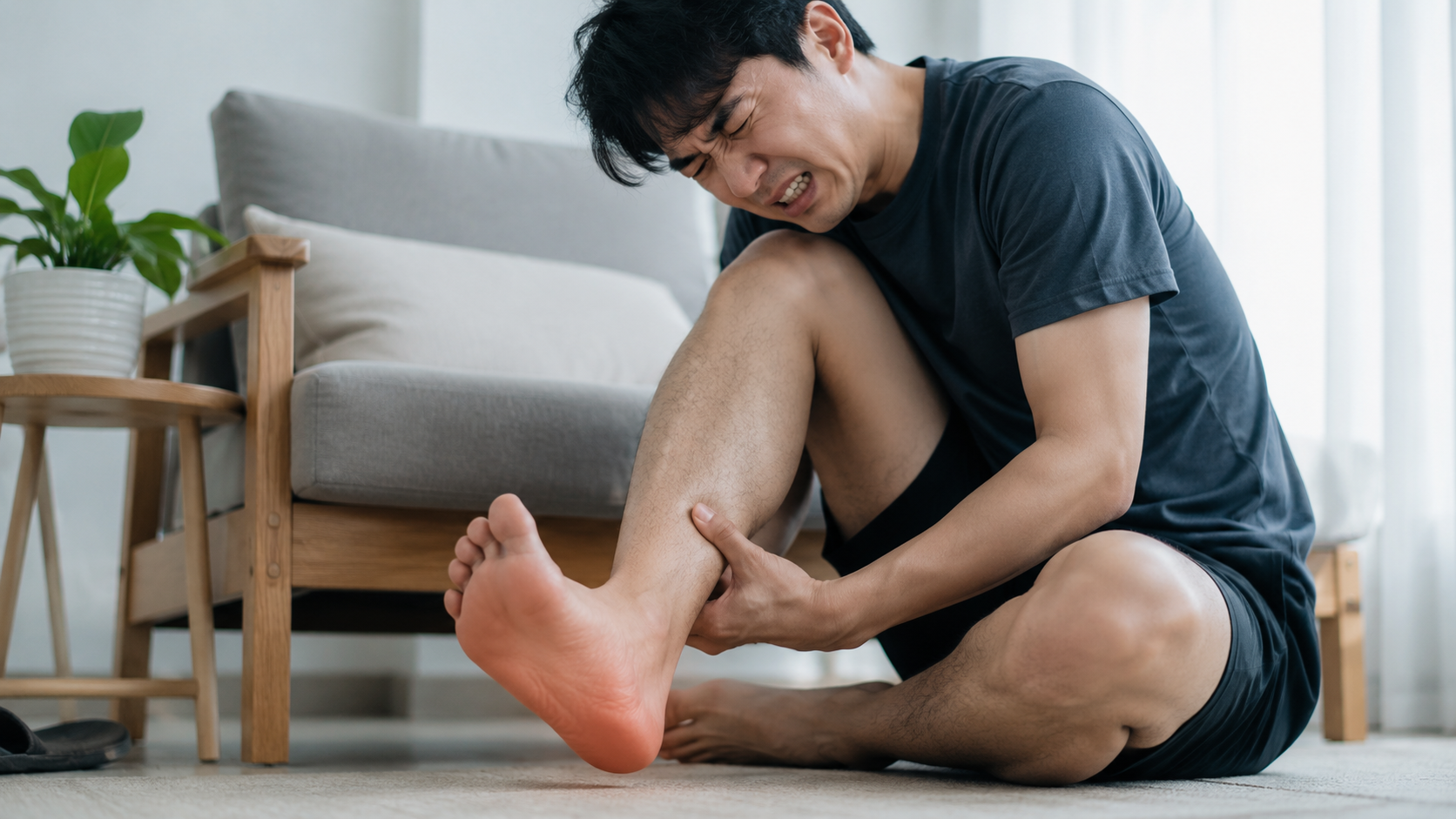
Tag: heel pain

  • How to Stop Plantar Fasciitis in 4 Sessions

    How to Stop Plantar Fasciitis in 4 Sessions

    “I Just Want to Walk Without Fear” — One Woman’s Journey Back from Chronic Plantar Fasciitis

    By Haim Body Balance Center | Body Alignment & Foot Health


    If you’ve ever woken up in the morning and dreaded the moment your feet touch the floor — you already understand more than most doctors do about what plantar fasciitis really feels like.

    It’s not just pain. It’s that creeping fear before you even stand up. The way you test the floor with one foot, bracing for the sharp stab in your heel. The way it makes you feel like your own body has become the enemy.

    If this sounds familiar, this story is for you.


    She Had Tried Everything — and Nothing Worked

    Detailed medical-style infographic showing toe nerve lines, plantar nerve pathways, and foot balance connections with colorful nerve mapping from toes to lower body. The image explains how toe movement, footwear, posture, and walking patterns affect balance, circulation, nerve function, and plantar fasciitis-related pain.
    Toe Nerve Lines and Foot Balance Pathways — Understanding how toe pressure, walking posture, and nerve flow influence whole-body stability and plantar fasciitis recovery
    Professional Plantar Fasciitis Treatment using Sbonsdo Method at Haim Center
    Applying the Sbonsdo Method to restore natural foot alignment and relieve pain.

    A woman in her early 60s came to our center after years of struggling with severe heel and foot pain.

    She wasn’t someone who had ignored her body. Quite the opposite.

    Many people are discovering the power of plantar fasciitis natural recovery through proper body alignment.

    She had already visited orthopedic clinics. She had tried Korean medicine hospitals. She had gone to alternative medicine centers. At one hospital, she was formally diagnosed with plantar fasciitis and advised to invest in custom orthotic insoles — nearly ₩350,000.

    She wore them faithfully. She followed every recommendation.

    But something strange kept happening.

    Instead of feeling lighter, her body felt more uncomfortable. More unstable. More exhausted.

    She wasn’t getting better — and she couldn’t understand why.

    When I asked her what she wanted most, she didn’t say “I want to run again” or “I want to hike.”

    She said something quietly that has stayed with me:

    “I just want to go shopping comfortably with my older sister again.”

    Such a simple wish. And yet it felt completely out of reach.

    Plantar Fasciitis Natural Recovery: The Real Problem Wasn’t Just in Her Heel


    During our consultation, one pattern became clear almost immediately.

    Because she was petite in height, she had worn tight, narrow high heels for most of her adult life — well into her early 50s. Decades of her toes being compressed. Decades of her body quietly adapting to an unnatural position.

    What happens to the body after years of this?

    • The toes lose their natural freedom of movement
    • The foot’s natural arch mechanics begin to collapse
    • Pressure distribution across the foot shifts — and stays shifted
    • The calves, pelvis, and lower body begin unconsciously compensating
    • The nervous system starts running in a chronic protective tension mode

    This is the part that most treatments miss.

    Plantar fasciitis is rarely just about the heel.

    In many chronic cases, the inflamed tissue is almost like a symptom of a deeper story — a story of collapsed foot mechanics, restricted movement, unstable walking patterns, and a nervous system that has been quietly guarding the body for years without anyone noticing.

    At Haim Body Balance Center, we work with an approach called KSNS-based Sbonsdo management — a method focused on restoring unconscious nerve balance and overall body alignment, not just treating the painful spot.


    📺 Watch: How the Sbonsdo Method Works for Foot Pain Recovery

    A fundamental look at Plantar Fasciitis through
    https://www.google.com/search?q=KSNS+Sbonsdo+Kim+Se-yeonthe KSNS/Sbonsdo Method, focusing on nerve response and natural alignment.

    👉 Tip for WordPress: Paste the YouTube video URL directly into the block editor on a new line, and WordPress will automatically embed it. Or use the YouTube block and enter the URL there.


    Four Sessions. One Remarkable Change.

    Rather than aggressive stimulation or forceful manipulation, we focused on four key areas over her sessions:

    1. Unconscious nerve balance care for the lower body — calming the protective tension patterns that had built up over decades
    2. Foot pressure restoration and toe mobility work — giving her toes back the movement they had lost
    3. Gentle gait correction — retraining how her feet made contact with the ground
    4. Natural weight distribution while walking — helping her body find its own balance again

    At the same time, we made two important lifestyle recommendations:

    ✅ Wide Toe-Box Shoes

    Shoes that allow the toes to spread naturally — not compress. This sounds simple, but it’s one of the most powerful changes you can make.

    ✅ Soft, Flexible Soles

    Reducing excessive impact while supporting natural foot movement — not locking the foot into a rigid structure.

    And perhaps most importantly — we worked on how she walked. The posture, the heel strike, the way weight transferred from one foot to the other.

    After just four sessions, she was walking nearly 8,000 steps comfortably.

    Her heel pain had decreased significantly. But more than that — the fear was gone. That cautious, bracing, morning-dread feeling had eased.

    And she came back to tell us:

    “Now I think I can finally go shopping with my sister again.”


    Why Does This Keep Happening to So Many People?

    If you’ve been dealing with plantar fasciitis for months or years, there’s something important to understand:

    Chronic foot pain is often a whole-body balance problem — not just a local inflammation problem.

    The standard treatment path — rest, orthotics, anti-inflammatories, cortisone injections — focuses on managing the pain signal. And sometimes that helps, short-term.

    But if the underlying patterns aren’t addressed:

    • The collapsed foot mechanics continue
    • The unconscious nerve guarding continues
    • The compensations traveling up through the knees, hips, and lower back continue
    • The pain returns — sometimes in different places

    This is why so many people cycle through treatments, feel temporary relief, and then find themselves back where they started.

    Recovery isn’t about forcing the heel to stop hurting. It’s about restoring the conditions where the body no longer needs to hurt.


    Your Feet Are the Foundation of Everything

    When balance collapses at the feet, the effects don’t stay at the feet.

    Tension travels upward. The knees compensate. The hips tilt. The lower back tightens. The shoulders follow. Even the nervous system shifts into a subtly elevated stress state — always bracing, always guarding.

    Sometimes what looks like a foot problem is actually the body’s way of saying: something in the whole system has been off for a long time, and it finally reached a breaking point.

    And sometimes, recovery begins not with harder treatment — but with gentler, smarter restoration.

    Natural movement. Balanced walking. Healthy foot function. A nervous system that finally feels safe enough to let go.


    Could This Be Your Story Too?

    If you recognize yourself in any part of this — the morning heel pain, the years of tight shoes, the treatments that helped a little but never quite resolved it — you’re not alone, and you’re not imagining it.

    The body has a remarkable capacity to recover when it’s given the right conditions.

    Your goal doesn’t have to be running a marathon.

    Maybe it’s walking through a market without wincing. Maybe it’s standing comfortably at a family gathering. Maybe it’s going shopping with someone you love.

    Those goals are worth taking seriously. And they are absolutely achievable.


    Experience deep relaxation and mind-body balance with this 432Hz healing music by LumiGenesis. Perfect to listen to while focusing on your recovery journey.

    📍 Haim Body Balance Center

    Location: Yangsan, Gyeongnam, South Korea
    Specialization: Body alignment, foot health, reflexology, KSNS-based unconscious nerve management
    Experience: 12 years of clinical practice

    Appointments available — contact us for consultation.


    • How Foot Imbalance Leads to Chronic Pain Throughout the Body
    • What Are Wide Toe-Box Shoes — And Do They Really Help?
    • Understanding the Unconscious Nervous System and Chronic Pain

    Tags: plantar fasciitis, heel pain, foot pain relief, body alignment, toe box shoes, chronic foot pain, natural recovery, KSNS, Sbonsdo, foot health, Yangsan, Haim Body Balance

    Starting your journey toward plantar fasciitis natural recovery is the first step to pain-free walking.

    Healthline: Guide to Foot Pain and Recovery
    Haim Body Balance Center Insights

  • Amazing Ultimate Foot Pain Relief Recovery: 3 Best Ways

    Amazing Ultimate Foot Pain Relief Recovery: 3 Best Ways

    • Ultimate Foot Pain Relief Recovery: 3 Reasons It Returns

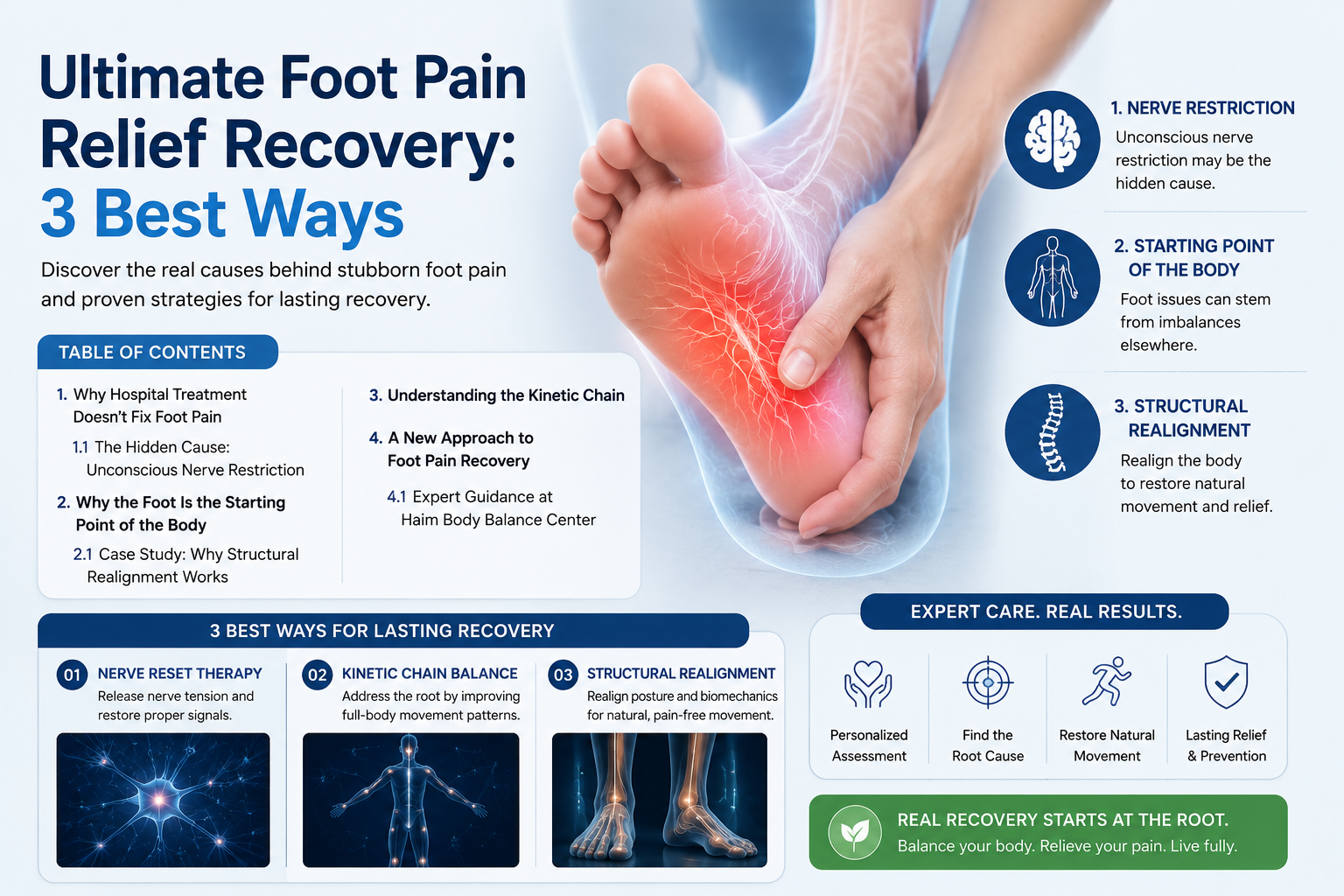
    Foot pain is a common struggle for many. Often, even after treatment, the pain returns because the symptoms were addressed rather than the root cause. Real recovery requires a deeper look at your body’s foundation and how it communicates through the nervous system.

    Why Hospital Treatment Doesn’t Fix Foot Pain

    Foot Pain Treatment and Unconscious Nerve Management
    Professional alignment care at Haim Body Balance Center focuses on restoring unconscious nerve flow.”

    Most hospital treatments focus on reducing pain symptoms.
    Medication, injections, or physical therapy may help temporarily,
    but they do not solve the root cause of foot pain.

    That is why many patients experience repeated foot pain
    even after months or years of treatment.

    The Hidden Cause: Unconscious Nerve Restriction

    Foot pain is often connected to imbalance in the body.
    Left and right body alignment becomes uneven,
    and unconscious nerve flow becomes restricted.

    ​Most treatments offer only temporary relief because they ignore the unconscious nervous system. Our bodies maintain balance through a network of nerves that function without our conscious effort. When structural imbalance occurs, these nerves become restricted or “trapped.”

    When this happens, circulation is blocked,
    and pressure builds up in specific areas of the foot,
    causing pain.

    Why the Foot Is the Starting Point of the Body

    Foot pain relief and unconscious nerve management at Haim Body Balance Center
    A healthy foot arch is the foundation of full-body alignment. Correcting the skeletal structure starts from here.

    Case Study: Why Structural Realignment Works

    ​Many clients visit Haim Body Balance Center after trying various treatments for years. One common case involved a runner who suffered from chronic heel pain for over two years. Traditional physical therapy only provided temporary relief.

    ​Upon analysis, we discovered that the issue wasn’t the heel itself, but a collapsed medial arch causing a twist in the ankle alignment. This physical shift was compressing the unconscious nerves, preventing natural recovery. By focusing on structural realignment and nerve flow management, the client was able to return to running without pain within a few weeks. This is the power of addressing the root cause.

    Understanding the Kinetic Chain

    ​In corrective management, we talk about the ‘Kinetic Chain.’ Your body is a series of interconnected segments. The feet are the first link. If the first link is weak, the force of every step travels incorrectly through your joints. Proper body alignment ensures that the mechanical stress of movement is distributed evenly, protecting your spine and nervous system for the long term.

    Professional Guidance for Health Care

    ​Finding effective foot pain relief often involves understanding the common causes related to your lifestyle. While standard physical therapy can help, it is crucial to receive personalized analysis for long-term recovery. Please note that this information is for educational purposes and should not be taken as direct medical advice. If you are seeking a sustainable solution, professional corrective management is the key to your overall health care and structural well-being.

    A New Approach to Foot Pain Recovery

    ​Instead of focusing only on temporary pain relief, it is crucial to check the overall body balance. At Haim Body Balance Center, we identify hidden imbalances starting from the feet. Our goal is to improve circulation, restore natural movement, and support a more comfortable daily life through expert alignment care.

    How to Support Your Body Alignment at Home:

    1. Check Your Shoes: Worn-out soles can worsen body imbalance. Replace shoes that show uneven wear on one side.
    2. Barefoot Walking: Whenever possible, walk barefoot on natural surfaces to stimulate the sensory nerves in your soles.
    3. Arch Stretching: Gently stretch your toes and arches every morning to improve circulation and wake up your nervous system.

    ​While these tips help, persistent pain requires professional analysis to identify the hidden structural cause.

    Expert Guidance at Haim Body Balance Center

    ​At Haim Body Balance Center, we look beyond the pain to find hidden imbalances starting from your feet. With over 12 years of clinical expertise in Yangsan, I focus on the connection between your skeletal structure and the nervous system. True wellness is about restoring harmony to your entire body.

    ​For more information, please check the Autonomic Nervous System and visit the Haim Body Balance Center for expert care.

  • 4 Best Ways to Fix Foot Pain in the Morning

    Foot pain in the morning can make your first steps a struggle. You open your eyes, ready to start the day. But the moment your feet hit the floor, a sharp, stabbing sensation shoots through your heel. By the time you reach the kitchen, it’s mostly gone. Sound familiar?

    ​After 12 years of clinical experience in body alignment and foot health, I can tell you: this pain isn’t a coincidence—it’s a signal. Today, I’m breaking down why this happens and how you can fix it before you even get out of bed.

    What Happens to Your Feet While You Sleep?

    ​While you sleep, your body enters a repair mode. Your feet rest in a naturally pointed-downward position. This causes the soft tissues and the plantar fascia to gradually shorten and tighten during those hours of inactivity.

    ​The moment you stand up, those shortened tissues are suddenly forced to stretch. This sudden stretching is why foot pain is at its peak during your very first steps.

    4 Reasons Why Foot Pain Is Worse in the Morning

    Effective stretches for morning foot pain relief.
    1. Plantar Fascia Tightening: When you rest, the thick band of tissue under your foot contracts. Taking your first steps causes sharp pain as it suddenly stretches.
    2. Reduced Circulation & Fluid Buildup: Blood flow slows during sleep, and inflammatory fluids can accumulate. Standing up increases pressure on these sensitive tissues.
    3. Body Alignment Problems: If your pelvis, spine, or hips are misaligned, the weight load on your feet becomes uneven. This creates tension that you feel the moment you stand.
    4. Nerve Sensitivity After Inactivity: Nerves in your feet become more sensitive after long periods of stillness. This tension is often connected to patterns in the lower back.

    What You Can Do Before Your First Step

    ​Don’t let your first step be a painful one. Try these before standing up:

    • Flex and Point: Slowly move your feet up and down 10 times.
    • Towel Stretch: Loop a towel around the ball of your foot and gently pull for 20–30 seconds.
    • Ankle Circles: Rotate each ankle 5 times in each direction.
    • Don’t Walk Barefoot: Keep supportive slippers right beside your bed.

    Final Thoughts: Listen to Your Body

    ​If you wake up in pain every morning, your body is asking for more than just a quick stretch—it’s asking for balance.

    ​At our center, we approach foot pain not as an isolated symptom but as part of the whole body’s alignment pattern. Persistent pain may indicate chronic postural imbalance or nervous system dysregulation.

    Don’t let your first step be a struggle. Let us help you find your balance again.

    Why Professional Guidance Matters for Foot Pain

    ​Many people try to endure foot pain by using temporary fixes like pain relievers or generic insoles. However, if the root cause is a structural misalignment, these methods only mask the symptoms. When your pelvis is tilted or your spine lacks proper balance, your feet are the first to suffer the consequences of uneven pressure. Over time, this leads to chronic conditions like plantar fasciitis or even secondary pain in the knees and lower back.

    ​At Haim Body Balance Center in Yangsan, we provide a comprehensive analysis of your body’s alignment. Our 12-year clinical expertise allows us to see beyond the localized pain and address the entire kinetic chain. By restoring your body’s natural balance and improving nervous system function, we help you achieve long-term recovery.

    Summary for Long-Term Relief

    ​To summarize, managing morning foot pain requires a two-step approach: immediate bedside stretches to wake up the tissues and a long-term strategy to correct your posture. Remember, your body is an interconnected system. A healthy step starts with a balanced body. If you are tired of waking up in pain, it is time to look deeper into your body’s alignment. Let us help you walk with ease and confidence again.

    ​For more information on foot health, you can check the Mayo clinic Guide