Tag: Joint Health

  • Can Thick Foot Calluses Really Destroy Your Walking Balance?

    Can Thick Foot Calluses Really Destroy Your Walking Balance?

    He almost gave up walking comfortably.

    A man in his 50s walked into our center looking defeated. His knees had been giving him trouble for months. Friends pushed him toward surgery. One doctor mentioned stem cell injections. Another suggested a knee replacement consultation.

    And that tesitation changeed everything

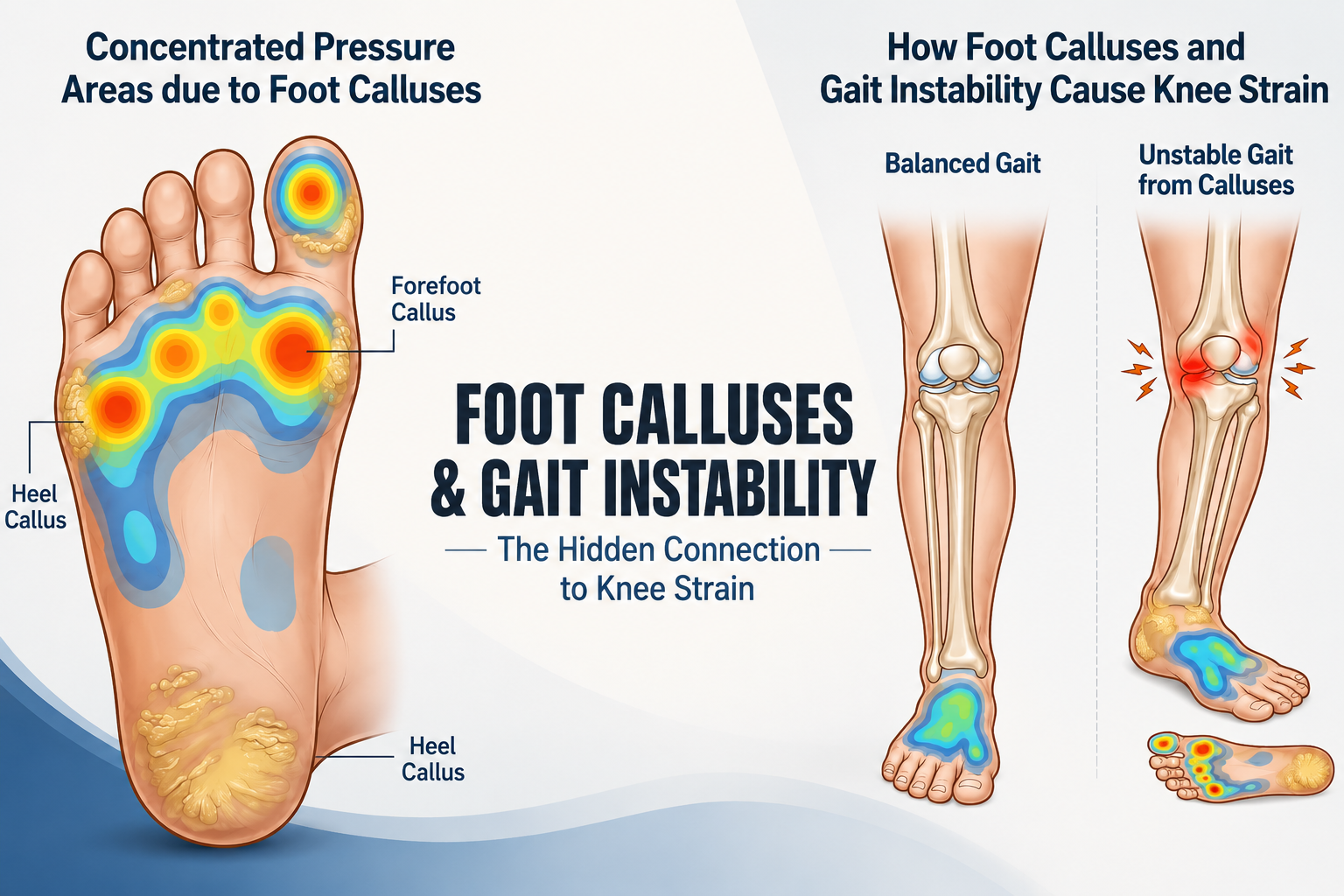
    Anatomical diagram showing how foot calluses cause gait instability and knee strain."
    Impact of persistent foot calluses on walking balance and knee joint health.
    A closer look at how foot conditions influence overall body alignment

    What Foot Calluses Do to Your Walking Balance

    When he walked across the room, we did not look at his knees first.

    We looked at his feet.

    The bottom of both feet told a story that years of medical appointments had missed. Thick, uneven foot calluses covered specific areas. The left foot looked completely different from the right. Certain zones had absorbed enormous pressure — day after day, year after year.

    He had spent decades in sales. Long hours. Hard floors. Dress shoes that offered almost nothing in support.

    His feet had adapted. Unfortunately, adaptation and health are not always the same thing.

    How Uneven Foot Calluses Destroy Walking Balance

    Most people treat foot calluses as a cosmetic issue.

    At our center, we see them differently.

    Calluses form where pressure repeats. When one area of the foot consistently absorbs more load than it should, the skin thickens as protection. The callus is not the enemy. It is the messenger.

    Think of a car with uneven tire pressure. The stressed tire wears faster. Eventually, the entire vehicle suffers.

    The same principle applies to the human body. Uneven foot pressure travels upward. The ankles adjust. The knees compensate. The hips shift. The spine responds.

    By the time a person feels knee discomfort, the pattern has usually been building for years.

    Rebuilding Walking Balance from the Ground Up

    Foot callus removal and improved walking balance with better leg alignment
    Foot pressure changes can influence leg alignment and overall walking balance.

    We did not promise quick results.

    We focused on awareness first. Footwear choices. Daily walking habits. How his feet contacted the ground with each step. Reducing tension in overworked muscles. Rebuilding movement confidence gradually.

    Week by week, something shifted.

    His steps became smoother. His legs felt less tired at the end of the day. Stairs that had felt uncertain began to feel manageable again.

    And then something unexpected happened.

    The thick foot calluses that had built up over many years began to soften. Not because we treated the skin. Because the pressure patterns underneath were finally changing.

    The Hidden Link Between Foot Calluses and Daily Life

    Most people spend years focusing on their knees, hips, and back.

    Very few people look down.

    Yet the feet carry every single step. They absorb impact. They communicate with the nervous system. They shape how the entire body moves.

    When the foundation is uneven, everything above it works harder than it should.

    We see similar patterns regularly at Haim Body Balance Center. People arrive focused on one painful area. When we examine the whole movement chain — starting from the feet — a different picture often emerges.

    “Experience soothing healing music as you focus on your foot health and balance improvement.”

    ​How Uneven Foot Calluses Destroy Your Walking Balance

    ​Most people treat foot calluses as a cosmetic issue. They grab a pumice stone, file them down, and go about their day. But if you have persistent, uneven foot calluses, your feet are telling a story about your mechanics.

    ​When your feet develop thick patches of hardened skin, it isn’t just about the skin—it’s about the pressure. These foot calluses often develop because your body is compensating for poor arch support or structural imbalances in your gait.

    ​The Hidden Connection: Calluses and Gait

    ​When you have an uneven gait, your foot doesn’t strike the ground uniformly. This creates “pressure hotspots.” Over time, the body builds thick foot calluses as a defense mechanism to protect those specific areas. By ignoring the cause, you aren’t just letting the foot calluses grow; you are allowing your body to continue walking in a way that puts unnecessary strain on your ankles, knees, and hips.

    ​What You Should Do

    1. Analyze your footwear: Wear shoes with proper arch support to distribute pressure evenly.
    2. Consult a specialist: If foot calluses are recurring, see a podiatrist to check for biomechanical issues.
    3. Stretch and Strengthen: Focus on foot intrinsic muscles to improve your overall walking stability.

    A Final Word

    This client did not need surgery.

    He needed someone to look at the right place.

    If you have been dealing with uneven shoe wear, tired legs, unstable walking, or unexplained knee discomfort, your feet may be worth a closer look.

    At Haim Body Balance Center, we specialize in reading the body’s signals — starting from the ground up.

    Sometimes the answer has been beneath your feet all along.

  • How to Fix Chronic Pain: 5 Hidden Signs in Your

    If you’ve been dealing with recurring knee, back, or shoulder chronic pain for months—or even years—this article may explain something your doctors haven’t mentioned yet. (1)

    ​Have you ever met someone who says: “I’ve had injections, medicine, physical therapy, and endless exercises… but the chronic pain always comes back.” (2) At first, it sounds strange. If the treatment was successful, why does the body continue to struggle with this persistent chronic pain? (3)

    ​Over 12 years of working with clients, I have observed this exact pattern repeatedly. It is the defining hallmark of chronic pain sufferers who have already tried every conventional treatment available. (4) When we looked closer, almost all of them shared a common, overlooked physical foundation in their feet.

     chronic pain.
    How big toe range of motion affects your body’s center of gravity and triggers chronic pain.

    ​Many of these individuals showed specific signs in their feet:

    • ​Weak big toe grip strength
    • ​Toes that could not bend or splay properly
    • ​Stiff, unstable ankles and weak foundation
    • ​Difficulty balancing their weight while walking
    • ​Muscles that fatigued quickly and caused tension up the body

    ​Surprisingly, most of these individuals could not bend their toes anywhere close to the angle required for a healthy walking stride, which directly triggers chronic pain. (5)

    ​The Problem Most People Never Notice: The “Invisible Brake”

    Most people assume that chronic pain begins exactly where it hurts.

    • ​Knee pain? It must be a knee problem.
    • ​Back pain? It must be a spine issue and not related to the feet.
    • ​Shoulder pain? It must be a joint issue.

    ​But the human body does not work in isolated pieces; it operates as a continuous kinetic chain from your feet to your head. Your feet are the literal foundation of your entire body. When your toes lose their natural strength, your body doesn’t just stop moving—it begins compensating silently, which eventually leads to severe chronic pain.

    ​This compensation acts like an invisible brake system inside your body. When your brain no longer trusts the stability of your feet and ankles, your nervous system automatically triggers muscle tightness as a protective mechanism. This protective tension travels upward from the base, radiating through your calves, knees, hips, and lower back, creating systemic chronic pain.

    ​Over time, this compensation becomes your body’s default movement pattern. You treat the symptoms upward, while the real root of the chronic pain—your dysfunctional feet—remains completely unaddressed.

    ​Why Temporary Relief From Chronic Pain Fades

    ​Many people feel genuinely better after getting a massage or taking medication for chronic pain. (9) These treatments are excellent for reducing localized inflammation in the short term. However, if your underlying movement mechanics in your feet remain unchanged, the mechanical stress will keep returning to the same spots, causing the same chronic pain. (10)

    ​Think of it like driving a car with the parking brake slightly engaged. No matter how often you treat the car, the strain will eventually cause a breakdown. When your muscles stop functioning naturally, your nervous system keeps holding onto tension patterns. This is why so many people experience the frustrating cycle of: “It gets better for a few days… and then the soreness returns.”

    ​5 Chronic Pain Signs Found in Your Feet (11)

    Clinical analysis of a 60-year-old patient overcoming severe jaw pain and autonomic imbalance by restoring big toe nerve circulation.

    ​How do you know if your body’s stiffness is secretly originating from the ground up? People with this pattern almost always display these five warning signs in their feet:

    ​1. Weak Toe Grip Strength in Your Feet

    ​If you try to grip the floor with your bare toes, it feels difficult. Your toes might feel “numb” to the ground or lack the strength to actively stabilize you against postural stress.

    ​2. Locked or Unstable Ankles

    ​Your ankles feel stiff, restricted, or click constantly. Without strong alignment, your ankles lose stability, and this instability travels upward to cause muscle strain.

    ​3. Uneven Weight Distribution on Your Feet

    ​When standing still, you naturally shift almost all of your body weight to one side. If you look at the soles of your old shoes, you will notice highly uneven wear patterns caused by unbalanced steps.

    ​4. Chronic Calf Tightness Connected to Posture

    ​Your calf muscles feel like tight bands of steel. No matter how much you stretch them, they tighten right back up because your lower posture is not supporting your weight properly.

    ​5. Rapid Fatigue While Standing on Your Feet

    ​Standing in one place for more than 10 minutes feels exhausting. Your lower back begins to ache, and your body feels heavy because your alignment has lost its natural shock absorption.

    ​Interactive: The 3-Second “Big Toe” Test

    How improper big toe movement triggers chronic pain
    Why proper big toe movement is critical to preventing compensatory chronic pain in your knees, hips, and lower back.

    ​Want to test your foundation right now? Try this simple test while sitting or standing barefoot:

    1. ​Keep your feet flat on the floor.
    2. ​Try to lift only your big toe while keeping the other four toes pressed firmly into the ground.
    3. ​Now, try the reverse: press your big toe down and lift the other four toes.

    ​If your toes refused to move independently, your brain has lost proper connection to your lower muscles. This is a classic sign of compensatory tension traveling up your body to create long-term strain.

    ​Rebuilding the Foundation: 3 Simple Steps for Better Feet

    ​True recovery is not just about silencing discomfort temporarily; it’s about making your nervous system feel safe again by restoring basic function to your lower body. To break the cycle of compensation, you must restore your foundation.

    ​Here are three simple exercises to start waking up your lower body:

    ​1. Toe Splitting & Splaying

    ​Spend 2 minutes daily manually spreading your toes apart with your fingers to restore the natural width of your stride. This gives you a wider, more stable base to prevent posture issues.

    ​2. The Towel Curl (Strengthening the Foundation)

    ​Place a small towel flat on the floor. Using only your toes, slowly scrunch and pull the towel toward you. This rebuilds the intrinsic arch muscles and reduces mechanical stress.

    ​3. Slow Ankle Circles

    ​Sit with your leg crossed and slowly rotate your ankle in the largest circle possible. This improves mobility from the ground upward, relieving the tension that causes back tightness.

    ​Final Thoughts: Look to Your Feet

    ​Persistent discomfort is a messenger, but it doesn’t always tell you where the crime was committed. Sometimes, your aching lower back is simply tired of working overtime to compensate for a foundation that went offline years ago.

    ​By restoring natural movement to your feet and toes, you allow your entire kinetic chain to relax. You might just find that when your foundation finally learns to support you, the rest of your body can finally let go of the chronic pain. (12)

    Bible Meditation RAIN & 528Hz THE TRUE LIGHT

    Want to learn more about body balance and posture? Visit our Home for more insights.