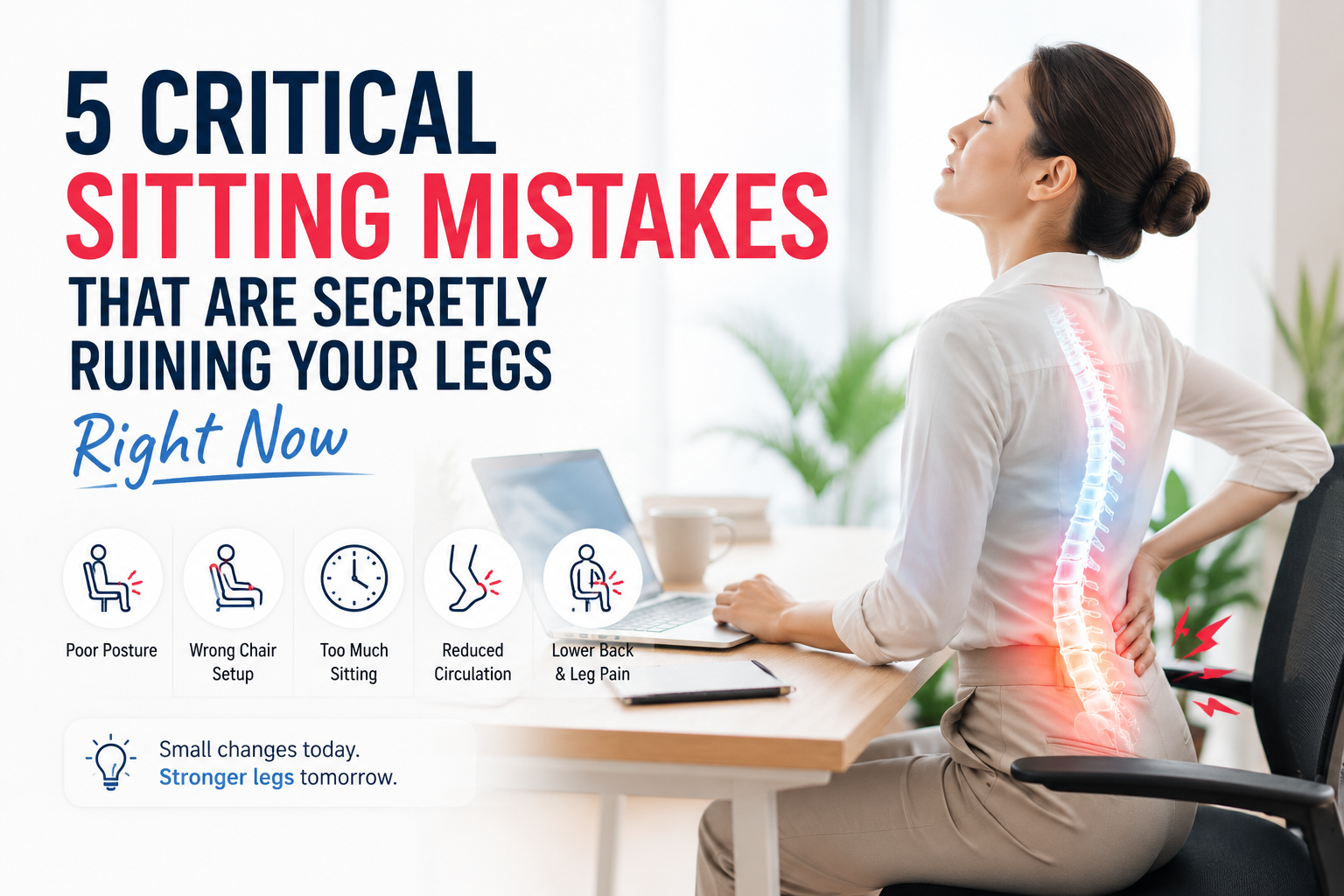
Picture this: You wake up at 7:00 AM, ready to crush your day.
Unconsciously, you might be making critical sitting mistakes that silently damage your body.

You swing your legs out of bed, but the moment your feet hit the floor, a blinding, white-hot agony rips through your right calf.
It feels like your muscle is violently wringing itself out like a wet towel. You gasp, clutching your leg, waiting for the “charlie horse” to pass.
But here’s the kicker—the cramp fades, but the nightmare doesn’t.
When you try to stand, your right calf feels completely fossilized. It’s rock-hard, heavy, and throbbing, as if someone overnight snuck into your room and replaced your muscle with a 10-pound sandbag. Walking feels like dragging an anchor.
You immediately open TikTok or Google. “Is it a magnesium deficiency?” “Should I eat a banana?” Hold that thought.
If you’ve recently transitioned into a lifestyle where you’re glued to a desk for 5 to 6 hours a day, that rock-hard leg isn’t just an annoying cramp.
Whether you’re a 20-something college student cramming for finals, a hardcore gamer climbing the ranks, a remote software developer, or a seasoned professional adapting to long hours of deep digital work—these physical issues are often triggered by daily sitting mistakes related to your chair.

The Anatomy of the Leg Anchor: Sitting Mistakes Explained
To understand exactly what is happening inside your body, let’s dissect this sudden, terrifying symptom using a strategic framework: PASONA (Problem, Agitation, Solution, Opportunity, Narrow Down, Action).
1. Problem: The Sudden “Sandbag” Calf
The immediate crisis is two-fold: a sudden, excruciating nighttime or early-morning muscle spasm (cramping) followed by a persistent, heavy, tight, and rock-hard sensation in just one leg.
Unlike normal fatigue that affects both limbs equally after a long run, this structural imbalance targets one specific side, refusing to relax even hours after the initial cramp has subsided.
2. Agitation: The Hidden Danger of the Seat
Here is where it gets dangerous. When you experience a symptom this intense, your first instinct might be to grab a foam roller and violently massage the knot, or pop three magnesium supplements and wait it out.
Stop right there. If this stiffness is caused by an underlying vascular or neurological issue, aggressive massaging can turn a silent condition into a life-threatening emergency.
When you sit continuously for 5 to 6 hours a day, the edge of your chair acts like a physical dam, pinching the deep veins and nerves running behind your knees and through your glutes. Over a period of 3 months, these daily sitting mistakes and mechanical stresses silently accumulate.
If a blood clot (Deep Vein Thrombosis, or DVT) has formed in that stagnant environment, aggressively massaging the calf can break that clot loose. From there, it travels straight to your lungs, causing a pulmonary embolism—a sudden medical emergency.
Alternatively, that “sandbag” feeling could mean a lumbar nerve is being severely pinched by a compressed spinal disc or a suffocated piriformis muscle in your hip, throwing your lower-body nervous system into a chronic state of emergency. Dismissing these posture-induced sitting mistakes as a simple “lack of vitamins” wastes critical diagnostic time.
3. Solution: Medical Evaluation Over Self-Diagnosis
The absolute, non-negotiable solution is professional clinical verification. You must look past the surface symptom (the cramp) and investigate the structural and vascular plumbing of your leg.
- Vascular Ultrasound: To check the deep veins for any signs of blood pooling or clotting.
- Neurological and Orthopedic Assessment: To verify if a hidden lumbar disc compression or pelvic misalignment is sending distorted, continuous electrical signals to your calf muscle, forcing it to lock up.
4. Opportunity: Transforming Your Workspace into a High-Performance Lab
The silver lining? This terrifying wake-up call is your body’s ultimate warning system, forcing you to redesign how you live, work, and move before permanent structural damage occurs.
By identifying the exact root cause, you can stop these harmful sitting mistakes and optimize your workspace. You will shift from a sedentary, stagnant posture to an active, dynamic flow that boosts both vascular health and cognitive focus.
5. Narrow Down: Who is Most at Risk?
This condition specifically targets individuals who have undergone a sudden, drastic shift in their daily habits within the last 90 days.
If you went from an active lifestyle to sitting continuously for over 5 hours without breaking, or if you are over 60 managing unconscious nerve pathways, your vascular and nervous systems are highly vulnerable to sudden posture-induced shocks.
6. Action: Your Immediate 3-Step Survival Guide
Don’t wait for tomorrow. Take these three immediate steps right now to protect your leg and correct those daily sitting mistakes:
- Elevate and Rest: Lie down and prop your right leg up on a few pillows so it rests slightly above the level of your heart. This uses gravity to naturally drain stagnant fluid and ease structural pressure. Do not massage it forcefully.
- Schedule a Clinical Scan: Book an appointment with an orthopedic, neurological, or vascular specialist. Explicitly tell them: “I recently shifted to sitting 5-6 hours a day for the past 3 months, and now my right calf is chronically hard and heavy like a sandbag.”
- Implement the 50-5 Rule: For every 50 minutes of desk work, set a hard alarm to stand up for 5 minutes. Pump your ankles up and down actively to force your calf muscles to act as a natural pump, sending blood straight back to your heart.
Why Magnesium Isn’t the Magic Bullet Here
It is incredibly common to blame muscle cramps on a lack of magnesium or hydration. While electrolytes are vital for nerve signaling, a nutritional deficiency is systemic—meaning it affects your entire body. If your body lacked magnesium, both of your calves, your eyelids, and your hands would be twitching or cramping randomly.
When the crisis is strictly localized to your right calf, and when it leaves behind a heavy, compressed, stone-like tightness, the cause is mechanical, not nutritional. It is a physical structural blockage born from the exact angle, pressure, and duration of your seated posture.
Listen to your body’s alarm system. Step away from the desk, elevate that leg, and get it checked by a professional. Your health, your mobility, and your longevity depend entirely on correcting the minor sitting mistakes you maintain today.
To explore more professional insights on maintaining your body alignment and preventing posture-induced Sitting Mistakes, visit our main resource hub at https://soletobody.com and start your journey toward a balanced, pain-free life today.