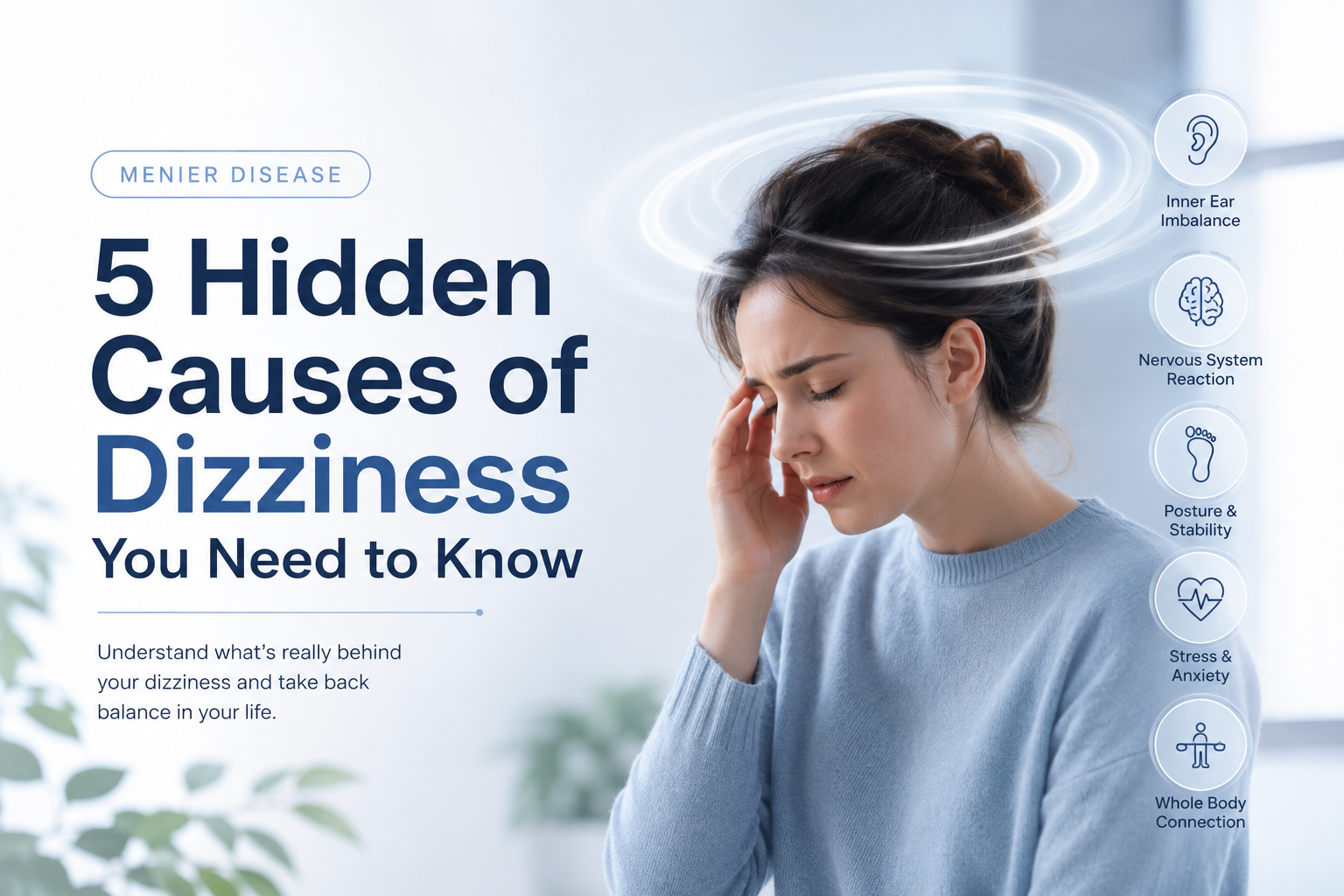
Living with Meniere’s disease often feels like living in a state of constant betrayal. One moment you are fine, and the next, the world is spinning, your ears are ringing, and you are left feeling physically and mentally shattered. Most medical advice focuses strictly on the inner ear—diuretics, low-salt diets, or injections. But for many, these treatments only scratch the surface because they ignore a fundamental truth: the ear does not exist in isolation from the rest of the body.
After years of clinical observation in body alignment and unconscious nerve management, a clear pattern emerges. Meniere’s is often the “final alarm” of a body that has been struggling with imbalance and nervous system exhaustion for a very long time.
The “Flu-Like” Weight of Chronic Dizziness

If you suffer from Meniere’s, you likely recognize a specific set of symptoms that doctors rarely mention:
- A body that feels heavy, as if you are coming down with the flu.
- Waking up exhausted, no matter how many hours you slept.
- A persistent “brain fog” that makes simple mental tasks feel draining.
- A sense of anxiety that lingers even when you aren’t dizzy.
These aren’t “side effects”—they are evidence that your Autonomic Nervous System is stuck in a defensive, high-stress state. When the brain feels that the body is physically unstable, it shifts into a “fight or flight” mode. Over time, this constant state of alert exhausts your lymphatic system and stagnates circulation, leading to that heavy, toxic feeling in your limbs.
The Foundation: It Starts at Your Feet
We often think of balance as something happening in the head, but balance actually begins at the soles of your feet. Your feet are the primary sensors sending data to your brain about where you are in space.

When the feet become tense or the arches collapse, the “data” sent to the brain becomes distorted. To compensate, the muscles in your calves, thighs, and eventually your neck and shoulders tighten up to “hold” you in place. This chronic tension restricts blood flow and lymphatic drainage. When the fluid in your body cannot circulate properly, the delicate pressure balance in the inner ear (which is central to Meniere’s) can become the ultimate casualty.
The Unconscious Nervous System Reaction
In many cases of chronic dizziness, the body has “remembered” stress. During evaluations, we often see that even light pressure on the toes or the base of the neck triggers a sharp, over-sensitive reaction. This is the unconscious nervous system protecting a body it perceives as being in danger.
If your brain doesn’t feel “safe” on the ground, it will remain in a state of neurological static. This static manifests as the ringing in your ears (tinnitus), the pressure (aural fullness), and the eventual vertigo.
A Path Toward True Stability
To truly address Meniere’s and chronic dizziness, we must look beyond the ear. True recovery involves recalibrating the body from the ground up:
- Restoring Foot Balance: Softening the tension in the soles allows the brain to receive “clear” signals of stability.
- Releasing Lower Body Stagnation: Clearing tension in the calves and pelvis encourages lymphatic flow, removing the “heavy” flu-like feeling.
- Calming the Nervous System: Through specialized body alignment, we signal to the unconscious mind that the body is supported and safe.
- Improving Circulation: When blood and lymph move freely, the body can naturally regulate the fluid pressures that affect the inner ear.
Conclusion: Listen to Your Whole Body
Meniere’s is not just a diagnosis; it is a message. It is your body’s way of saying that the system is overloaded and out of sync.
If you are tired of just “managing” symptoms and want to understand why your body feels the way it does, it is time to look at your overall balance. When we stabilize the foundation and calm the nervous system, the world often stops spinning because the body finally feels like it is standing on solid ground again.
True healing begins when we stop looking at the ear and start looking at the person.Meniere’s Disease: 5 Hidden Causes of Dizziness You Need to Know
Learn More about Balance Health:
For further professional resources on vestibular disorders and Meniere’s health, you can visit VEDA (Vestibular Disorders Association).