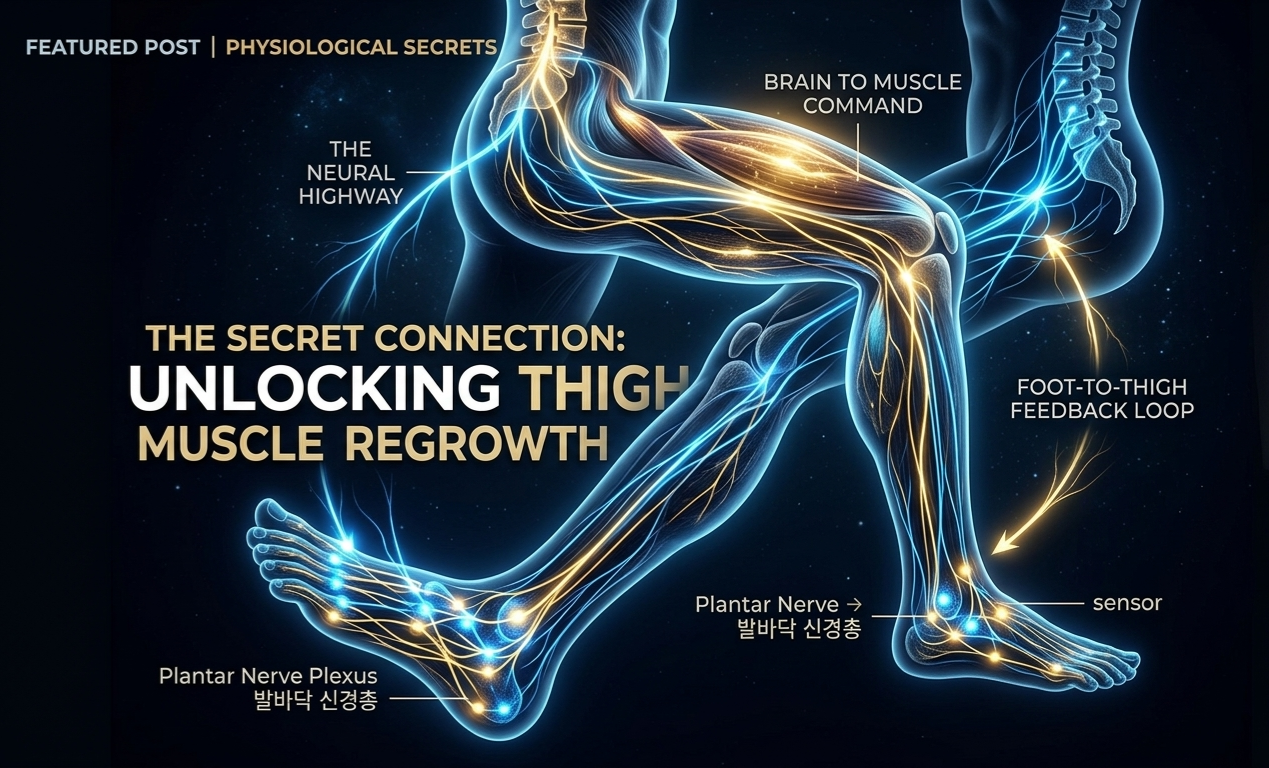
The Day the Strength Disappeared
Imagine waking up, stepping out of bed, and realizing your shrinking thigh muscle feels weaker than ever.
For years, my client—a passionate tennis player who spent his weekends sprinting across courts—noticed a strange, subtle shift. His left knee felt slightly unstable. Then, his lower back began to ache. He did what anyone would do: he ignored it, pushed through the pain, and trained harder.
But the human body has a quiet, non-negotiable way of forcing us to listen.
One afternoon, while changing into his sports gear, he looked down. His left quadricep—the massive muscle above the knee—was flattening out. It was losing its shape, its density, and its power. He spent the next twelve months on a relentless quest. He did heavy leg extensions, swallowed massive amounts of protein, received deep tissue massages, and underwent multiple cortisone injections. The result? Nothing. The left thigh kept shrinking.
A shrinking thigh muscle that refuses to respond to exercise is more common than you think — and the cause is often hidden deep in the nervous system.

Secret 1: Your Brain is Halting the Signal (The Survival Lock)
The first hidden secret to recovering lost muscle mass is understanding that a shrinking thigh muscle is rarely a muscle problem; it is a neurological command.
When you exercise a weak muscle and it refuses to grow, you are trying to force electricity through a cut wire. In my clinical experience with body alignment, I often see the nervous system act as a protective governor.
When a joint, a ligament, or a nerve pathway is chronically overloaded, the brain makes an unconscious decision: To protect this person from a catastrophic injury, I must cut the power to the shirnking thing muscle.
This is not a malfunction. It is a brilliant survival mechanism. Your brain quietly dampens the motor unit activation to your thigh. No matter how many squats you perform, if the brain has locked the gate from the source, the muscle fibers will never receive the signal to contract and grow.

Secret 2: The Source is in Your Shoes (The Forgotten Foundation)
The second secret is the one that conventional treatments miss entirely: The neurological brake holding back your shrinking thigh muscle is almost always located in your foot.
When this client came to our center, we didn’t look at his thigh first. We looked at how his feet interacted with the earth.
Underneath the human foot lies a complex web of unconscious nerves—what the Sbonsdo (KSNS) framework recognizes as the body’s primary balance and safety sensors. Over years of wearing tight, rigid shoes and sustaining micro-injuries on the tennis court, this client’s big toe and lateral foot arch had lost their natural reflex responses.
Because the foot was no longer properly sensing the ground, the ankle became unstable. To prevent the knee and hip from collapsing, the nervous system locked down the calf and threw the “emergency brake” directly onto the left thigh. You cannot fix a roof by staring at the ceiling while the foundation is sinking. To unlock the thigh, we had to fix the ground contact patterns first.
Recommended Reading: How Chronic Pain Instantly Shuts Down Your Nervous System
Secret 3: Release Precedes Growth (Take Your Foot Off the Brake)
The third and final secret is a paradigm shift in physical recovery: The body does not need more force; it needs safety. Traditional rehabilitation tells you to fight the weakness—to push, lift, and strain. But if the nervous system is in a state of chronic guarding, adding more force only triggers a deeper protective lockdown.
Our work at the center was not about building strength through effort. It was about using precise, non-invasive nerve management to restore the unconscious reflex signals in his feet and ankles. We were not stepping on the gas pedal; we were simply taking the foot off the brake.
The shift happened with shocking speed. Once the safety sensors in his foot felt stable, the brain realized the threat was gone. The unconscious protective guard lowered.
For the first time in years, during a simple standing assessment, he gasped. “I can feel the bottom of my foot, and my thigh suddenly feels warm.” That warmth was blood flow, neurological connection, and life returning to a dormant muscle chain. Within weeks of restoring this balance, his left thigh finally began to fill out and grow again.
Is Your Nervous System Guarding Your Body?
If you are trapped in a cycle of chronic pain, structural asymmetry, or muscle loss that defies all training, stop fighting your body.
The human body is an beautifully interconnected chain. An imbalance in the toe shifts the ankle; a frozen ankle disrupts the knee; a guarded knee shuts down the shrinking thigh muscle.
Recovery doesn’t begin with heavier weights. It begins from the ground up, by listening to the quiet, unconscious signals of the nervous system and giving the body the balance it needs to feel safe again.
- Learn more about the physiological mechanisms of muscle atrophy on Wikipedia.
What Happens Inside the Nervous System When a Muscle Stops Growing
Most people assume that a shrinking thigh muscle means the muscle itself is damaged or diseased.
But in many cases, the muscle tissue is completely intact.
The real problem is the signal — or rather, the absence of it.
Think of your nervous system like an electrical grid.
Every muscle in your body needs a clear, uninterrupted signal from the brain to contract, grow, and stay strong.
When that signal is blocked, the muscle simply waits.
It does not atrophy because it is broken.
It atrophies because it is not receiving the command to stay active.
This is called neurological inhibition — and it is far more common than most people realize.
In cases of chronic pain, overuse injury, or long-term postural imbalance, the brain can begin to “mute” certain muscles as a protective strategy.
The body is not giving up.
It is trying to protect itself from further damage.
The problem is that this protective response can last long after the original injury has healed.
The nervous system stays in defense mode.
The muscle stays silent.
And no amount of exercise can override a signal that is not being sent.
Why the Foot Is the Starting Point
One of the most overlooked connections in the human body is the relationship between the foot and the thigh.
When the foot loses proper ground contact — due to flat arches, overpronation, or years of improper footwear — the entire movement chain above it begins to compensate.
The ankle stiffens.
The calf tightens.
The knee shifts.
The hip rotates.
And the thigh muscle, caught in the middle of this chain reaction, slowly loses its normal activation pattern.
This is why treating only the thigh rarely works.
The shrinking thigh muscle is often the last symptom in a long chain of imbalance that started much lower — sometimes as low as the sole of the foot.
Restoring foot balance is not just about comfort.
It is about re-establishing the neurological foundation that allows the entire leg to function naturally again.
How to Rebuild a Shrinking Thigh Muscle
Recovery is not always about exercising harder.
In many cases, restoring balance, improving walking mechanics, and increasing normal muscle activation can help the body move more efficiently.
As movement quality improves, the thigh muscle often becomes more active during everyday activities.
This process may help support better strength, stability, and confidence over time.