Table of Contents
Most parents assume that severe teenager muscle stiffness, postural tension, and chronic circulation problems are adult concerns — the inevitable toll of decades spent at a desk.

But what happens when a fifteen-year-old walks through your door carrying the same physical burden as a forty-five-year-old office worker? This is exactly what we encountered recently in our assessment, revealing a deeply concerning trend in teenager muscle stiffness.
”His Shoulders Feel Like Stone”
A high school freshman recently came in with his mother. She was calm, but clearly worried.
”His shoulders feel like stone. Even when he lies down, his body posture looks uncomfortable.”
At first glance, he appeared to be simply another tired student — the kind whose exhaustion reads as ordinary in environments where academic pressure begins before sunrise and ends well after midnight.
But as we began a careful postural and muscular assessment, the picture became far more complex. This wasn’t just temporary fatigue; it was a severe case of developmental teenager muscle stiffness.
His daily routine told the real story:
- Heavy Backpack: A heavy bag carried every day across both shoulders.
- Prolonged Sitting: Six to eight hours of seated study, often with the head pushed forward.
- Gaming Habits: Evening gaming sessions lasting two to three hours, body hunched toward the screen.
This is not an unusual schedule for high school students today. In fact, it is almost universal. What was unusual was how completely his body had adapted to it — and how it accelerated his physical degradation.
Posture Assessment: Identifying Teenager Muscle Stiffness

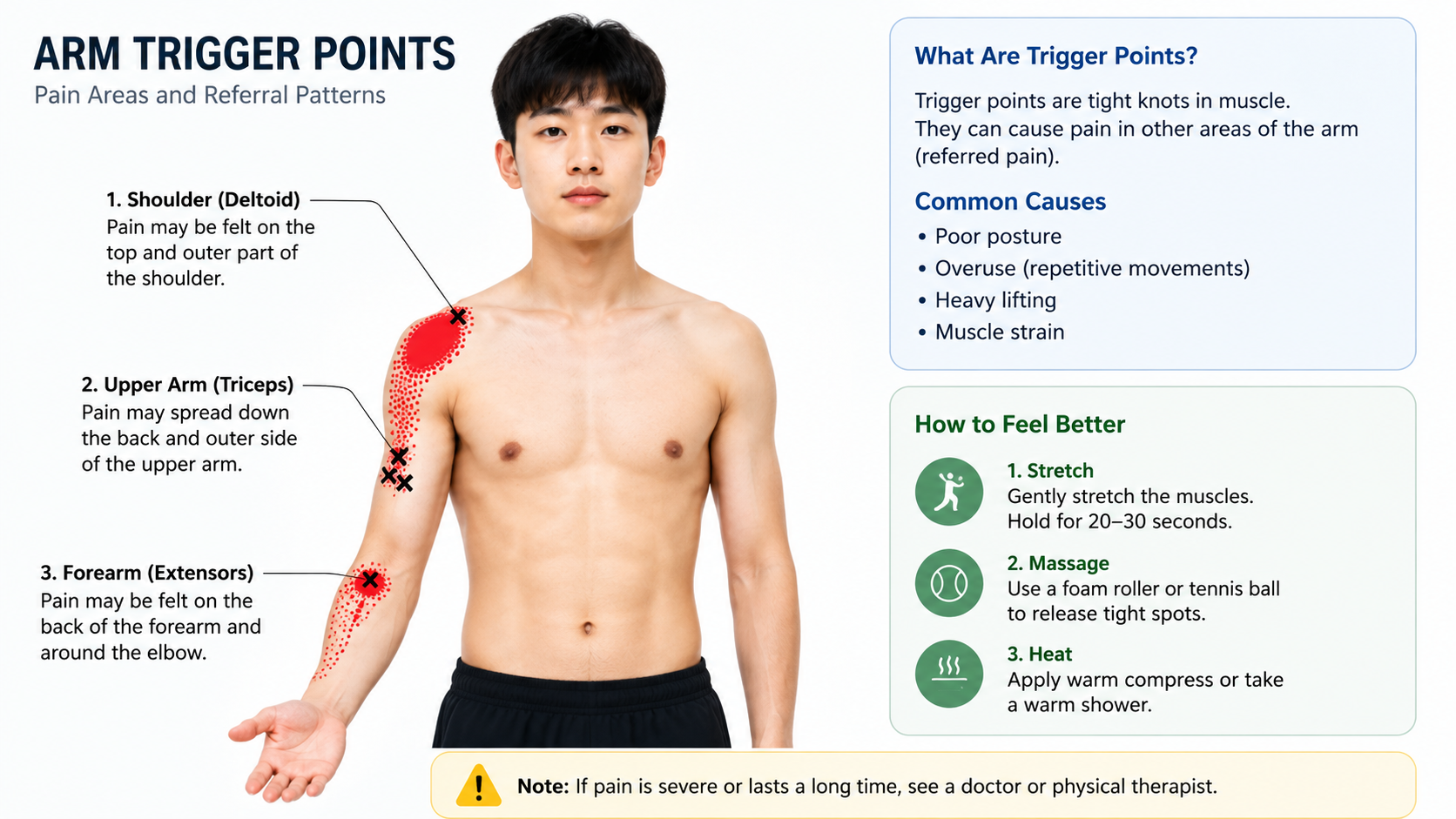
in teenagers with chronic muscle stiffness —
including the pectoralis major, deltoid,
biceps brachii, and infraspinatus.
When we observed his posture lying flat on the treatment bed, several indicators of advanced teenager muscle stiffness immediately stood out.
The arms and shoulders were in a state of chronic contraction. Not simply “tight” in the way a muscle feels after exercise — but hardened, with individual muscle groups compressed together and resistant to movement. The right forearm, in particular, felt dense and immobile around the biceps and triceps region. The tissue had lost its natural pliability.
This is a condition sometimes described in clinical body work as myofascial densification — where layers of muscle and connective tissue lose their ability to slide and glide freely against each other, creating a sensation of thickness and restriction that goes beyond ordinary soreness.
The lower body told a parallel story of compensation. His left foot had fallen outward passively, with the outer ankle bone resting against the bed without any muscular control holding it in neutral alignment. This kind of passive external rotation suggests that the stabilizing muscles of the hip, lower leg, and foot were no longer maintaining their baseline tone — a common compensatory pattern when the upper body is chronically overloaded with heavy tension.
In body balance assessment, we rarely look at one region in isolation. The human body communicates systemically, especially when dealing with chronic teenager muscle stiffness.
Why the Body Responds to Teenager Muscle Stiffness
According to Mayo Clinic, chronic muscle tension
that persists beyond normal fatigue requires
professional assessment. The human muscular system
is designed around a fundamental principle:
tension and release.
The human muscular system is designed around a fundamental principle: tension and release.
Muscles contract to create movement and maintain posture, then release to allow recovery and circulation. When this cycle is disrupted — by prolonged static postures, chronic psychological stress, or insufficient movement — the system defaults to a state of sustained contraction.
For teenagers, the compounding factors are significant. The table below breaks down how modern daily habits lead to systemic physical lockdown:
- Heavy backpack load: Forward head posture, upper trapezius compression
- Prolonged desk sitting: Hip flexor shortening, thoracic rounding
- Gaming / screen posture: Anterior shoulder drift, neck extensor fatigue
- Academic stress: Elevated cortisol, systemic muscle guarding
- Low movement volume: Reduced fascial hydration, circulation stagnation
None of these factors alone would cause serious dysfunction. Together, sustained over months and years during a period of active skeletal and muscular development, they create the perfect storm for chronic teenager muscle stiffness.
The Clinical Session: Releasing Teenager Muscle Stiffness
1. Tension Release Through Traditional Cupping Therapy
Traditional cupping therapy was applied to the forearm, shoulder, and clavicle region. This approach uses localized suction to decompress compressed tissue layers, encourage circulatory movement, and interrupt sustained muscular contraction patterns.
After the session, darker reaction marks appeared across the treatment area — a common response in cases of long-term muscle tension and reduced local circulation, well-recognized in traditional East Asian body care traditions.
The student’s immediate feedback was telling:
“My arms feel lighter now. My shoulders move more easily.”
This is not simply a subjective impression of relaxation. When compressed tissue is decompressed and circulation is encouraged to flow through areas that have been chronically restricted by teenager muscle stiffness, the perceived weight and resistance in the limbs decreases noticeably within the same session.
2. Foot Reflex and Neurological Movement Management
Foot reflex techniques and non-conscious neurological balance management were also applied to the lower extremities.
This component of clinical posture care is essential but often overlooked. The feet are not simply the foundation of standing posture — they are a continuous feedback system sending postural signals upward through the kinetic chain at all times.
When the feet lose their stability and grounding, the body compensates by increasing muscular tension throughout the lower leg, thigh, hip, and eventually the lumbar and thoracic spine. This compensation travels upward, contributing to shoulder and neck tension that appears, on the surface, to be entirely unrelated to the feet.
Addressing the lower body was not secondary.
It was essential to solving his upper body
stiffness. For a deeper look at how foot
health affects whole-body posture, see our
guide on ingrown toenails and postural
imbalance.
The Upward Chain: Why Foot Instability Reaches the Shoulders
One of the most important concepts in body care is understanding how tension travels through connected systems. When the feet are unstable, the body recruits muscular compensation from progressively higher regions, amplifying the overall teenager muscle stiffness:
- [Feet & Ankles] — Instability & passive external rotation
- [Calves] — Gastrocnemius and soleus overactivation (Compensatory bracing begins)
- [Thighs] — Quadriceps and hamstring tightening (Upward muscle tightening)
- [Hips & Pelvis] — Chronic hip joint compression (Joint compression)
- [Lower Back] — Lumbar muscle guarding (Spine protection guarding)
- [Shoulders & Neck] — Severe stiffness, tension, and persistent pain (Final visible stress point)
By the time a patient notices shoulder stiffness, the pattern may have originated much further down the body — sometimes months or years earlier.
This is why treating only the area of complaint rarely produces lasting results. Comprehensive body balance management works across the full kinetic chain to eradicate teenager muscle stiffness at its source.
Teenager Muscle Stiffness: A Rapidly Growing Modern Pattern
The case described above is not exceptional. Over recent years, posture clinics have seen a consistent, alarming increase in teenagers presenting with physical tension patterns that were previously associated almost exclusively with working-age adults.
The modern lifestyle factors driving this shift are structural and hard to avoid:
- Screen time — smartphones, tablets, and computers now occupy several hours of most students’ evenings.
- Postural monotony — hours in the same seated position without adequate movement breaks.
- Load imbalance — heavy school bags carried asymmetrically over developing spines.
- Sleep disruption — late-night studying and blue light screen use reducing restorative rest.
- Movement poverty — physical education reduced in favor of intense academic preparation.
Many students normalize their discomfort because it has been present for so long. They say: “I’m just tired from studying,” or “My shoulders are naturally stiff.” These rationalizations are understandable — but they delay the recognition that the body is desperately asking for professional attention.
and muscle tension relief.
Why Early Intervention for Teenager Muscle Stiffness Matters
Adolescence is a period of rapid musculoskeletal development. The patterns established during these years — postural habits, muscular tension tendencies, and movement preferences — tend to persist and deepen into adulthood.
This is both a major challenge and a powerful opportunity.
When chronic tension patterns are identified and addressed early, during a period when the body retains high adaptive capacity, the potential for meaningful improvement is significant. Correction becomes exponentially more difficult with each year that compensatory patterns are allowed to consolidate into adult bone and muscle structures.
Early body balance care for teenager muscle stiffness is not a luxury. It is proactive maintenance of a physical system that is still in the process of forming itself.
Appropriate interventions may include:
- Postural awareness education — learning what neutral alignment feels like and how to return to it.
- Targeted stretching and mobility work — particularly for the hip flexors, thoracic spine, and upper trapezius.
- Load management — reassessing backpack weight and carry method.
- Movement integration — regular breaks to interrupt prolonged static postures.
- Professional body balance assessment — when tension has already become chronic.
A Final Thought on Whole-Body Balance
At the end of the session, the student sat up and rotated his shoulders slowly. The heavy stiffness that had settled into his upper body so gradually that he had stopped noticing it — was, for the moment, completely gone.
His mother watched quietly, then asked: “Why didn’t we seek help sooner?”
It is a question worth sitting with — not just for this family, but for anyone caring for a young person today. The body keeps a strict record of everything it carries. It is worth paying attention before the record becomes a permanent burden.