Have you ever sat in a doctor’s office, holding a stack of “perfectly normal” test results, while still dealing with a throbbing skull? If you are reading this, you might know the frustration of unexplained headaches all too well:
A tight, invisible band wrapped around your forehead.
A heavy, dull pressure anchoring on one side of your head.
One ear that constantly feels like it’s underwater.
A strange, floating dizziness that intensifies when you are tired or stressed. You’ve probably had the MRIs. You’ve seen the ENT specialists. They look at the scans, smile, and tell you, “Everything is fine. There is nothing wrong.” But you don’t feel fine. You feel it every single day. Here is the story of a client who walked into our center with these exact symptoms—and how unlocking one core muscle can finally relieve unexplained headaches.
The Gap Between “Normal Scans” and Living Without Unexplained Headaches
When medical tests come back clear, most people feel a brief moment of relief, followed by deep confusion. If there is nothing wrong, why do I keep getting these unexplained headaches? The answer is simple: Scans show structure, not function. An MRI can detect tumors or neurological diseases, but it cannot see:
Chronic muscle guarding
Functional tension patterns
An overworked, hyper-vigilant nervous system These are not structural diseases; they are states of imbalance. Yet, they can cause very real, persistent, and distressing physical symptoms. To find real relief from unexplained headaches, we must look beyond the skull and investigate how the rest of our body functions as a whole. According to clinical research on unexplained headaches, muscle tightness and dysfunction in the neck and shoulder region are major contributors to persistent head pressure. But what causes this muscle tightness in the first place?
The Core Muscle You Need to Unlock: The Diaphragm
During our initial assessment of this client, we didn’t start with his head. We looked at his whole body as an interconnected system. While his standing posture looked fine at a glance, we noticed something unexpected during the physical assessment: the tissue just below his left ribcage was incredibly rigid. The area around his diaphragm—the primary core muscle of respiration—was hard, almost locked in place. When we gently pressed it, he winced.
“I didn’t even know that was tight,” he said.
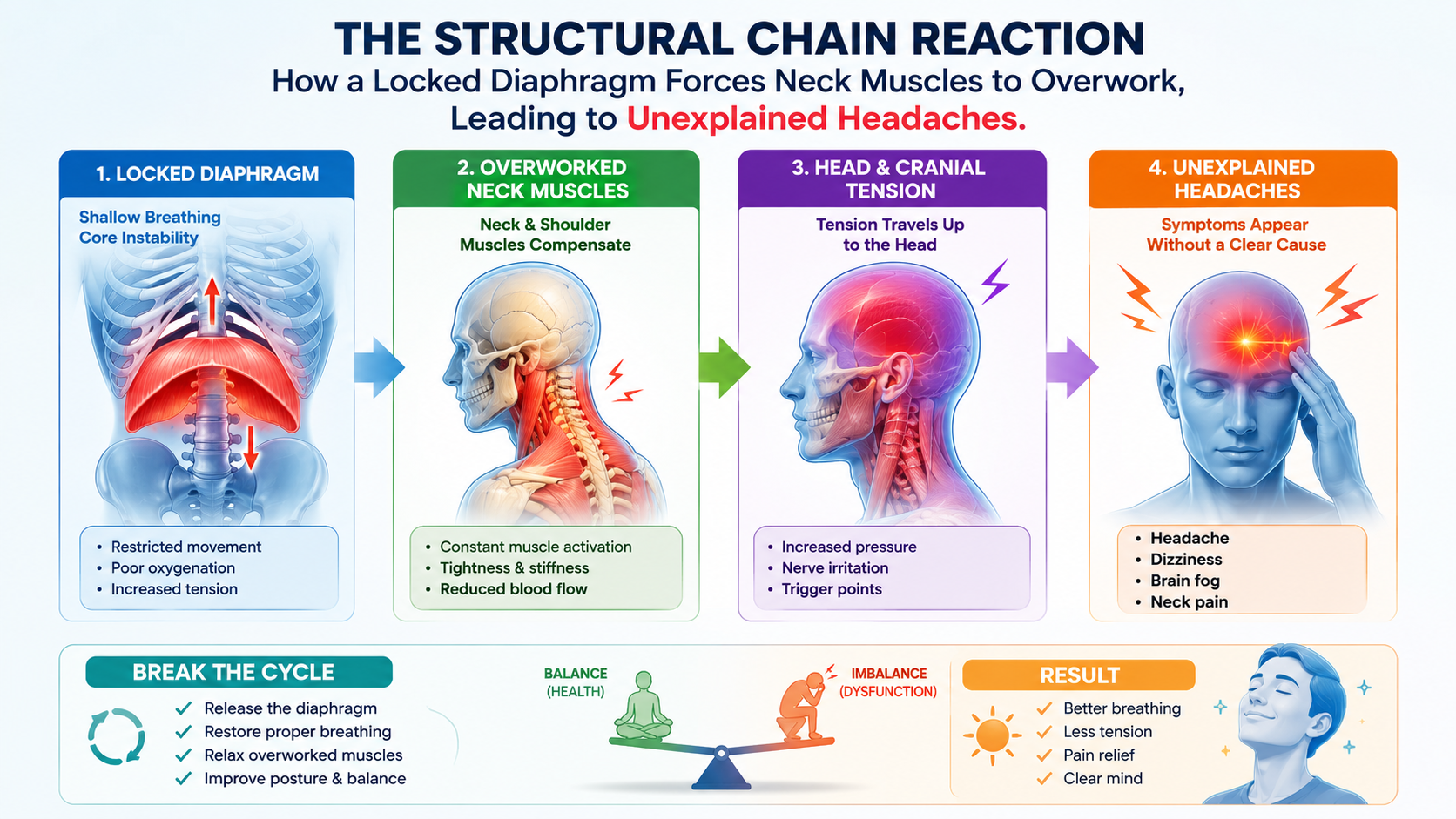
How a locked diaphragm triggers muscular imbalance, leading to neck tension and unexplained headaches.
   [ Locked Diaphragm ]  -->  Limits deep diaphragmatic breathing
            │
            ▼
   [ Overworked Neck Muscles ]  -->  Step in to lift the ribcage (Scalenes, Suboccipitals)
            │
            ▼
   [ Head & Cranial Tension ]  -->  Triggers unexplained headaches, forehead heaviness & dizziness
How a Tight Diaphragm Triggers Unexplained Headaches
When your diaphragm stops doing its job, your body doesn’t stop breathing. Instead, it adapts. It recruits “helper” muscles in your neck and shoulders—specifically the scalenes and suboccipitals—to manually pull your ribcage up with every single breath. These small neck muscles were never designed for 24/7 labor. Over time, they become exhausted, shorten, harden, and pull relentlessly on the base of your skull. This structural chain reaction is the hidden root cause of your chronic and unexplained headaches:
Temple Tension: Caused by overworked neck and jaw muscles pulling on the facial fascia.
Forehead Heaviness: Triggered by restricted blood flow and tight cranial tissue.
Ear Fullness: Caused by tension radiating near the jaw, compressing the eustachian tubes.
Dizziness: Triggered when tight muscles at the base of the skull send confused, hyper-tense signals to your brain’s balance centers. Often misdiagnosed as standard migraines, these unexplained headaches are actually biomechanical alarms telling you that your breathing mechanics are completely out of order.
The structural chain reaction: How a locked diaphragm forces neck muscles to overwork, leading to unexplained headaches.
Letting the Body Breathe Again
Our sessions are slow, quiet, and gentle. We don’t crack joints or force the tissue with heavy pressure. Instead, we focus on helping the diaphragm soften, guiding the nervous system out of “fight-or-flight” and into safety. As that deep, core tension began to melt, we worked our way up the ribcage, eased the overworked muscles of the neck, and finally addressed the forehead. About twenty minutes into the session, the client took a long, deep, audible sigh. His shoulders visibly dropped, and his history of chronic, unexplained headaches began to make perfect sense to him.
“Something just let go,” he whispered.
When he stood up at the end of the session, his face looked entirely different. The heavy, exhausted cloud had lifted from his eyes. “How did you know exactly where it hurt?” he asked. “I never even told you my forehead was tight.” “Your body told us,” was the honest answer.
Self-Check: Are Unexplained Headaches Stemming from Your Respiration?
If you are experiencing unexplained headaches, try this simple, two-step check at home to see if your breathing pattern might be contributing to your symptoms.
1. The Hand-on-Chest Test
Place one hand on your chest and one hand on your belly. Take a deep breath.
Does the hand on your chest rise first and highest? * Do your shoulders shrug upward toward your ears?
If yes, your neck muscles are working overtime to pull air in, bypassing your diaphragm.
2. The Rib Release Breath (A Daily Practice)
To help invite your diaphragm back into the conversation and find relief from unexplained headaches, try this gentle reset:
Sit comfortably and wrap your hands gently around the sides of your lower ribcage.
Inhale slowly through your nose, focusing on pushing your ribs outward into your hands (like an umbrella opening), rather than lifting your chest upward.
Exhale slowly through your mouth, letting your ribs sink back inward.
Practice this for 2 to 3 minutes when you feel head pressure rising.
Listen to the Whispers of Your Body
Watch this self-care guide to release deep physical tension and find natural relief from unexplained headaches.
Your body rarely starts by shouting. It whispers first. It whispers with a slight neck stiffness in the morning, a mild ear fullness that comes and goes, or unexplained headaches at the end of a long workday. These are not imaginary complaints, and they are not “all in your head.” They are physical signals that your breathing, posture, and nervous system have drifted out of balance. If your symptoms are new, sudden, or worsening, always consult a medical doctor first. Ruling out underlying medical conditions is an essential step. But if you have done that, and you are still searching for answers, it might be time to stop looking at the scans and start listening to your body. Treating unexplained headaches requires an integrated approach that addresses the root muscular imbalances, not just the symptoms. If you are ready to stop managing symptoms and start restoring your posture, explore our Sole to Body balancing services to find the root cause of your tension and reclaim your daily comfort.