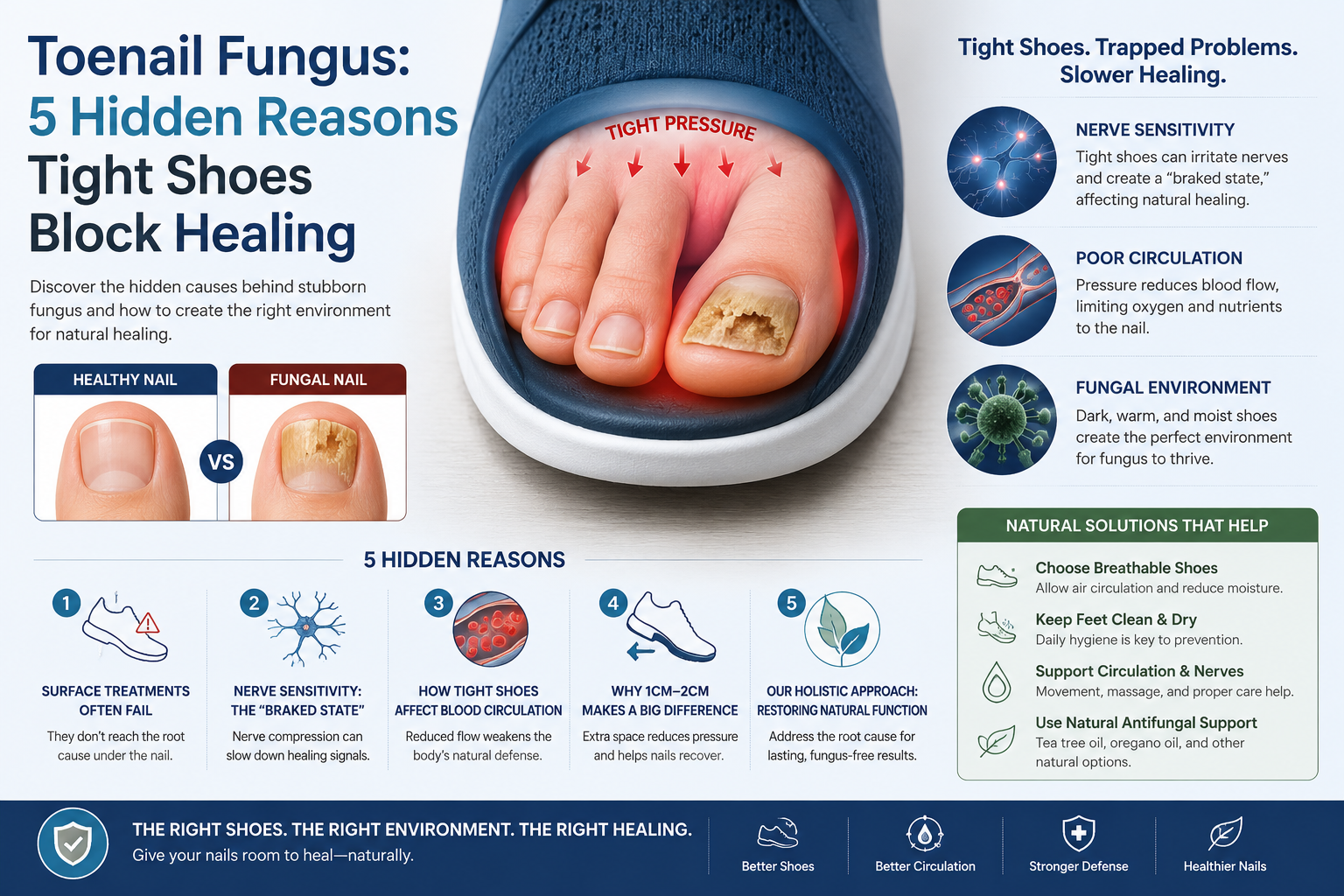
- Toenail Fungus & Nerve Sensitivity: How Tight Shoes Block Healing

This is more than just a toenail fungus problem.

showing the link between circulation and toenail fungus
Introduction: Why Surface Treatments Often Fail
Many people mistakenly view toenail fungus as a purely aesthetic or surface-level infection caused by poor hygiene. They spend months—sometimes even years—applying topical creams and antifungal treatments, only to find the condition returning time and again. However, at Haim Body Balance Center, our clinical observations suggest that persistent fungus is often a symptom of a much deeper mechanical and neurological dysfunction within the foot.
The hidden culprit behind this cycle is often tight shoes. When our toes are restricted by modern footwear with narrow toe boxes, the nervous system enters a protective “braked state,” disrupting vital signaling and healthy blood flow. This chronic compression leads to nerve hypersensitivity and poor circulation, creating an oxygen-deprived environment where fungi thrive. To truly clear the infection and restore foot health, we must look beyond the surface and address the root cause: the physical environment of your feet.
Many people view toenail fungus as a simple surface-level infection caused by poor hygiene.
They spend months applying topical creams, only to find the condition returning.
Toenail fungus is often misunderstood as a simple condition, but it may reflect deeper issues within the foot.
At Haim Body Balance Center, we have observed a surprising clinical pattern…
The Hidden Link: Nerve Sensitivity and the “Braked State”
The toes play a critical role in maintaining body balance and neurological signaling. When toes are restricted, the nervous system enters what we describe as a “braked state”—a protective mechanism where normal signals are disrupted because the brain perceives instability.
Common signs of this neurological dysfunction include:
- Hyper-reactivity: A sharp pain or a startled reaction when the big toe is lightly touched.
- Chronic Rigidity: An inability to move the toes independently.
- Imbalance: A shift in walking posture that creates long-term stress on the knees and hips.
The Science of Circulation → How Tight Shoes Affect Blood Circulation
When the nervous system is in this “braked” state, it doesn’t just affect movement—it directly impacts the biological health of the nail bed.
The most overlooked cause of persistent fungus is poor blood flow. To understand this, we must look at the science of circulation:
- Capillary Compression: The toes are the furthest points from the heart. Blood must travel through tiny capillaries to reach the nail. Tight shoes physically compress these vessels, starving the tissue of oxygen and nutrients.
- The Muscle Pump Effect: Blood is moved through the feet by the contraction and extension of toe muscles. If your toes are “locked” in a shoe, this pump stops working.
- Immune Response: Stagnant blood flow leads to a low-oxygen environment—the perfect breeding ground for fungi. Without fresh, oxygenated blood, the body’s natural immune cells cannot reach the area to fight the infection.
How Tight Shoes Create a “Fungal Environment”
Modern footwear is often designed for aesthetics rather than anatomy. Shoes with narrow toe boxes and high pressure on the forefoot lead to:
- Reduced Airflow: Creating a dark, moist, and warm environment.
- Nerve Hypersensitivity: Chronic pressure irritates the nerves, making them reactive to even a light touch.
- Structural Locking: The toes lose their natural splay, causing the entire foot to become rigid.
The Solution: Why You Should Choose Shoes 1cm to 2cm Larger
To restore balance and clear the fungus, the first step is mechanical decompression. We strongly recommend choosing a shoe size 1cm to 2cm larger than your actual foot measurement.
- Allow for Expansion: Your feet naturally expand as you walk. That extra 1–2cm of “Toe Room” allows for this natural expansion without compressing the nerves.
- Reactivate Neural Pathways: With enough space, your toes can begin to move again, sending “safe” signals to the brain to release the “braked state.”
- Optimize Blood Flow: Roomy shoes allow for the Muscle Pump Effect to resume, flushing out toxins and delivering the nutrients required to grow a healthy, fungus-free nail.
Our Holistic Approach: Restoring Natural Function
Instead of focusing only on the fungus, we focus on restoring the body’s foundation:
- Toe Activation: Exercises to wake up the dormant muscles in the foot.
- Pressure Release: Transitioning to footwear with a wide toe box.
- Nervous System Reset: Helping the body move out of a reactive, “braked” state through alignment.
- Circulation Support: Improving systemic flow to ensure the nail bed is healthy from the inside out.
If you’re experiencing toe sensitivity or recurring toenail issues,
it may be helpful to understand what’s really happening beneath the surface.
You can also learn more about foot balance and toenail fungus connection.
Conclusion
Improving foot balance and nerve sensitivity is essential for preventing recurring toenail fungus.
Toenail fungus may seem like a minor cosmetic issue, but it is often a reflection of deep-seated foot dysfunction. By addressing your footwear habits and restoring nerve and circulatory health, you can achieve long-term improvement rather than just temporary relief.
Give your toes the space they need to heal. Your balance depends on it.
Take a closer look at your foot balance and nerve response.If you’re experiencing toe sensitivity or recurring toenail issues,
it may be helpful to understand what’s really happening beneath the surface.
Take a closer look at your foot balance and nerve response.
For more medical insights on toenail fungus, refer to Mayo Clinic.