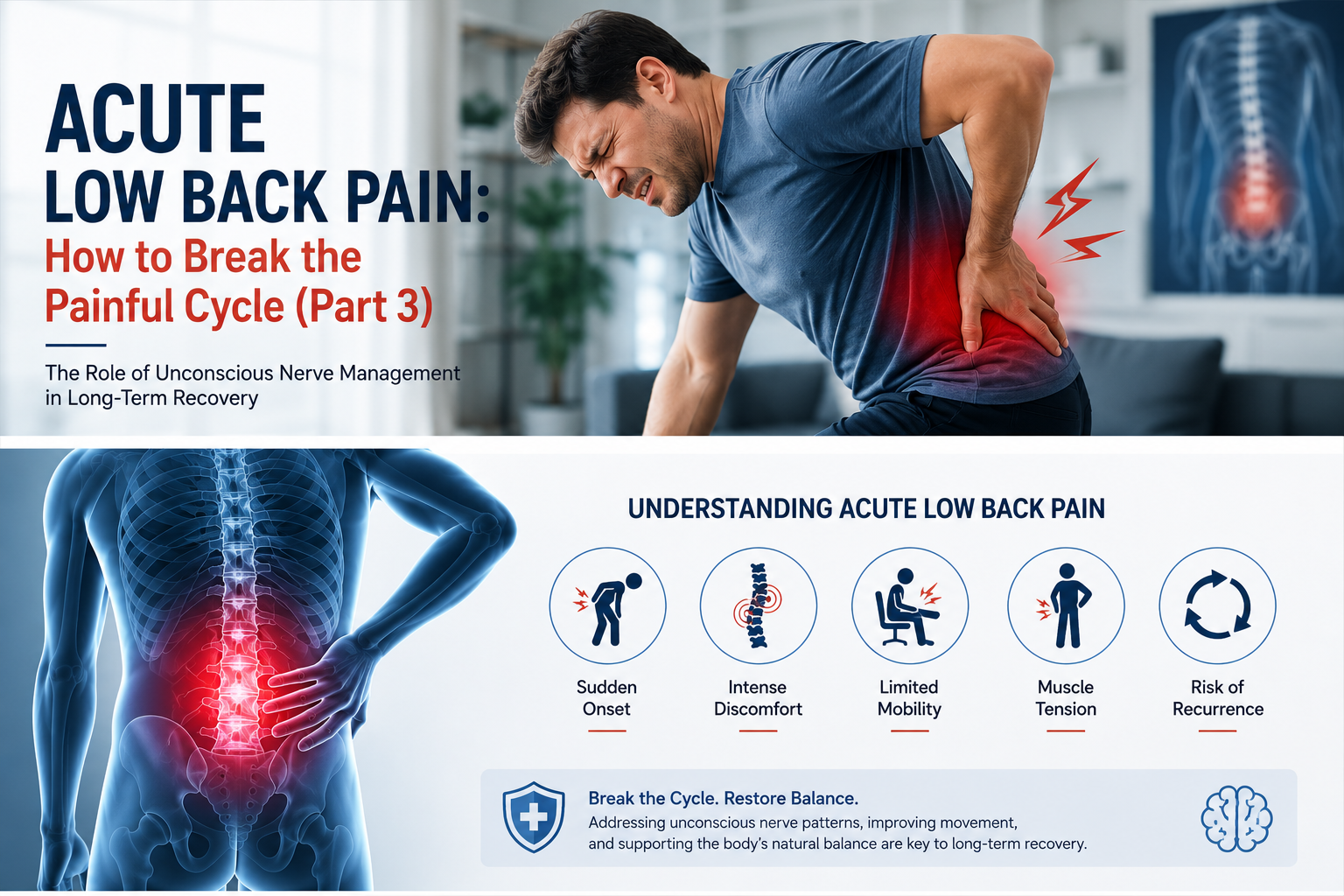
Acute low back pain can strike without warning — and for many people, it keeps coming back. This article explores why recurrence happens and introduces the role of unconscious nerve management in long-term recovery.
A Real Story: The Pain That Returned

Six months ago, a man experienced a severe episode of acute low back pain. The pain was so intense that he could barely move. He visited a hospital, received injections and treatment, and after some time, the discomfort disappeared.
Like many people, he assumed the problem had been solved. He returned to his normal routine — and thought nothing more of it.
Recently, however, the same pain returned. This time it became so severe that he had to leave a social gathering early and head straight to the hospital for treatment again.
His experience raises an important question: Why do some people experience repeated episodes of acute low back pain even after treatment?
Pain Relief Does Not Always Mean the Problem Is Gone
Many people assume that when pain disappears, the body has fully recovered. In reality, pain relief and complete recovery are not always the same thing.
Medical treatment can be extremely helpful for reducing inflammation, calming irritated tissues, and providing short-term relief. However, if daily movement habits remain unchanged, the body may continue to place stress on the same structures. Over time, these hidden stresses accumulate again — and trigger another episode of acute low back pain.

The Body Often Gives Warning Signs
Before a severe pain episode occurs, many people notice subtle changes in how their body feels and moves:
- Morning stiffness
- Tight hips
- Reduced flexibility
- Difficulty standing upright
- Fatigue after walking
- One-sided muscle tightness
- Discomfort after sitting for long periods
Unfortunately, these early warning signs are often ignored because they do not seem serious. The body may be quietly asking for attention long before pain becomes unbearable.
Why Recurrence Happens: Common Contributing Factors
Recurring acute low back pain is rarely caused by a single event. More often, it develops from a combination of factors that go unaddressed after the first episode:
Poor Posture
Long hours of sitting can place continuous stress on the lower back, especially when posture is not supported.
Weak Core Stability
When deep stabilizing muscles become inactive, other muscles compensate and become overworked — creating imbalance throughout the spine.
Limited Hip Mobility
Restricted hip movement often forces the lower back to move excessively, placing strain on joints and soft tissues that are not designed for that range of load.
Returning to Old Habits
Once pain improves, people frequently stop paying attention to posture, walking patterns, and movement quality. Without conscious awareness, old habits return — and so does the pain.
The Missing Piece: Unconscious Nerve Management (KSNS)
One factor that is often overlooked in the management of acute low back pain is the role of the nervous system — specifically, what we call unconscious nerve management, or KSNS (Kinesthetic Subconscious Nerve System).
The human body does not move by conscious thought alone. A large portion of postural control, muscle coordination, and spinal stabilization is governed by automatic, subconscious nerve signals that operate below the level of awareness. When these signals become disrupted — through injury, poor habits, or prolonged stress — the body loses its ability to self-regulate efficiently.
In clinical practice, we observe that many patients who recover from acute low back pain and then relapse have not restored this unconscious regulation. Their pain resolves on the surface, but the underlying nerve-muscle communication patterns that protect the spine remain dysfunctional.
Unconscious nerve management — the Sbonsdo approach — focuses on identifying and retraining these subconscious patterns. Rather than simply targeting muscles or joints, this method works with the nervous system’s automatic responses to restore balance from the inside out. By addressing the root level of neurological control, it becomes possible to reduce the risk of recurrence more effectively than symptom-based treatment alone.
When the nervous system learns to stabilize the spine automatically and efficiently again, the body no longer needs to compensate in ways that create vulnerability to re-injury.
Recovery Requires More Than Temporary Relief
Long-term improvement often involves more than simply waiting for pain to disappear. Many health professionals emphasize the importance of:
- Consistent daily movement
- Regular walking habits
- Maintaining flexibility and hip mobility
- Improving posture awareness throughout the day
- Building deep core stability
- Restoring unconscious nerve control and muscle coordination
Small daily actions performed consistently can often have a greater long-term impact than occasional intensive efforts.
A Different Way to Think About Back Pain
Instead of asking: “How can I stop today’s pain?”
A better question may be: “What daily habits — and what patterns in my nervous system — are causing my body to repeat this cycle?”
This shift in thinking encourages a focus on prevention, root-cause awareness, and the restoration of proper nerve-body communication — rather than simply reacting when acute low back pain returns.
Conclusion
The man in this story found relief from acute low back pain six months ago — yet the pain eventually returned, forcing him to seek treatment once again. His experience reflects a challenge faced by many people around the world.
Pain may disappear, but underlying movement patterns, lifestyle habits, and unconscious nerve regulation often remain unchanged. Understanding the body’s warning signs, improving daily movement quality, restoring subconscious nerve-muscle coordination through KSNS management, and maintaining consistent self-care may all help reduce the likelihood of future episodes.
Recovery is not only about feeling better today. It is about creating conditions — in your habits, your movement, and your nervous system — that help your body function better tomorrow.
Have you ever experienced recurring back pain? Share your thoughts or questions in the comments below.