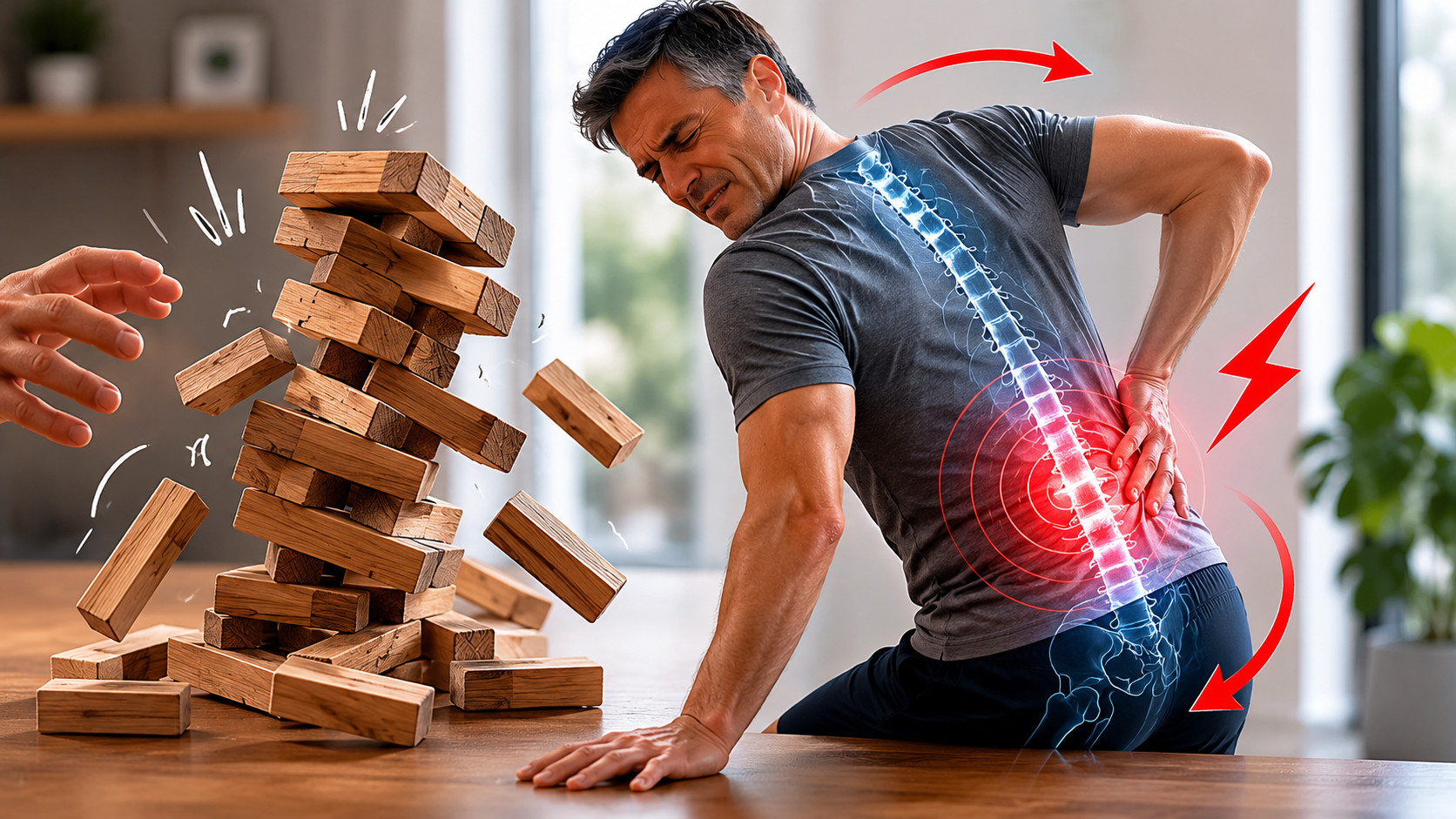
Do you know that your body behaves exactly like a giant Jenga Tower? Imagine you are piloting a giant, state-of-the-art robot suit. It’s sleek, fast, and incredibly powerful.
Suddenly, BAM! A red warning light flashes on the control panel: KNEE JOINT FAILURE!
Your body behaves exactly like a giant Jenga Tower.
What do you do?
Option A: Spray paint over the warning light so you don’t have to look at it.
Option B: Slap a piece of duct tape on the outside of the robot’s knee and keep running.
Option C: Open the blueprint, find the actual electrical glitch, and fix it from the roots.
If you chose Option A or B, congratulations—you are doing exactly what most people do when they feel pain!
Whenever we get a headache, we pop a pill. When our knee feels stiff, we slide on a tight brace. But what if your pain is actually a giant liar? What if the real culprit is hiding somewhere else entirely, quietly stabilizing your body’s Jenga Tower?
Let’s dive into the ultimate body detective story to find out why your pain isn’t healing, and how a secret superhero inside you holds the key to saving the day!
1. Stop Chasing the Alarm: Why Your Pain is a Big Liar
We’ve all been there. You play a match of soccer, scroll on your phone for three hours, or sit at your school desk, and suddenly… Ouch! Your shoulder hurts.
Naturally, we react with our Mindless Habits:
The Pill Pop: Swallowing painkillers to mute the alarm.
The Patch Slap: Sticking icy-hot patches on our skin like stickers.
The Compression Squeeze: Wearing braces to force the joint to stay still.
These might make you feel better for an hour or two. But here is the shocking truth: the pain always comes back. Treating only where it hurts is like trying to fix a sinking ship by scooping out water with a teacup. You aren’t plugging the actual hole!
2. The Jenga Tower Effect: How Your Foot Controls Your Jaw
Your body is not a collection of random, separate Lego bricks. It is a highly connected chain—just like a giant Jenga Tower.
If you pull out a block from the very bottom of a Jenga Tower, what happens? The top of the tower starts to wobble, tilt, and eventually… CRASH!
In your body, the bottom of your Jenga Tower is your feet.
[ Your Jaw & Neck ] <– Complains and hurts!
▲
[ Your Shoulders ] <– Tilts to compensate
▲
[ Your Spine ] <– Curves under pressure
▲
[ Your Hips ] <– Shifts out of alignment
▲
[ Your Knees ] <– Absorbs the weird angles
▲
[ Your Feet ] <– THE FOUNDATION (The Glitch starts here!)
If your left foot is slightly tilted or weak, your knee has to bend weirdly to keep you upright. Because your knee is bending weirdly, your hip rotates. To make up for the crooked hip, your spine curves, your shoulder drops, and suddenly… you have a massive headache!
So, when your neck hurts, the actual “criminal” might be your left pinky toe. This bottom-up connection is what we call the Jenga Tower effect.
3. Wake Up Your Autopilot: The Unconscious Nervous System
Watch how activating the foot’s reflexive nerves restores the body’s natural balance mechanism.
If you had to consciously tell your heart to beat, your lungs to breathe, and every single muscle in your leg to contract just to take one step, your brain would literally explode from overload.
Thanks to our body’s built-in wisdom, we have a superhero: The Unconscious Nervous System. Think of this as your body’s Autopilot.
Your body’s autopilot relies on perfect nerve alignment to stay balanced.
When you step on a sharp pebble, you don’t think: “Hmm, a sharp object. I should lift my foot.” No! Your Autopilot yanks your foot away before you even realize what happened. This is an automatic reflex controlled by your nervous system.
Check out this scientific guide on Proprioception and Reflexes to learn more about how your body senses balance and movement.
When this Autopilot glitches, it stops realigning the Jenga Tower automatically, leading to chronic muscle tightness.
4. Calibrate Your Left-Right Balance (The 50/50 Rule)
For your Autopilot to run smoothly, your left side and right side must be perfectly balanced. They need to share the load 50/50.
But what if your Autopilot gets a “glitch” due to an uneven foundation?
If one side of your nervous system becomes lazy or unresponsive, your other side has to work twice as hard to keep you from falling over. Over time, this constant, unconscious muscle tension accumulates.
If you don’t reboot this nervous system Autopilot, your body’s Jenga Tower will remain crooked, and no massage or stretching will ever cure the pain permanently.
5. Rebuilding the Jenga Tower: The Haim Method Audit
At Haim Body Balance Center, we don’t play the guessing game. We don’t just put a hot pack where you point. Instead, we put on our detective hats and examine your body from the ground up, rebuilding your Jenga Tower from the foundation!
Through specialized neural response patterns (the KSNS method), we investigate:
The Foot Blueprint: Finding why your foundation is tilted.
The Postural Alignment: Checking how the wobble travels up to your neck.
The Autopilot Reflex: Verifying if your nerves are reacting at lightning speed.
By waking up those sleepy, unconscious nerves, we help your body heal itself and restore the Jenga Tower to its upright alignment.
Conclusion: Start Listening to Your Body’s True Language!
Pain is not your enemy. Pain is just your body’s way of waving a flag and saying, “Hey! My Jenga Tower is falling!”
The next time you feel a pinch or a stiff joint, don’t just try to silence it with mindless habits. Stop, look down at your feet, and realize that your body is a beautiful, connected masterpiece.
Are you ready to stop treating the symptoms and finally fix the root cause?
Read more on our About page to see how we help you achieve instant, lasting balance.
Let’s get your Jenga Tower perfectly stacked again!
For those suffering from chronic muscle tension, the frustration of unexplained physical discomfort can be overwhelming. Many people living with this silent struggle of chronic muscle tension hear this disappointing sentence: “Doctor, the pain is still there… but all my test results say I’m completely fine.”
Medical Disclaimer: The information provided in this article is for educational and informational purposes only and is not intended as medical advice. Always consult with a qualified healthcare professional or physician regarding any medical condition, diagnosis, or treatment plan.
A close friend of mine recently shared this frustrating, anxiety-inducing story with me. For nearly six months, he lived with a persistent, nagging discomfort on the right side of his waist and rib area. It wasn’t the kind of sharp, agonizing pain that would send you rushing to the emergency room. Instead, it was a dull, constant tightness—uncomfortable enough to disrupt his focus every single day. Sitting at his desk for more than an hour felt strangely exhausting. Twisting his upper body felt tight and restricted.
To find answers, he visited a major hospital and underwent a series of comprehensive medical examinations. He had an abdominal ultrasound, an MRI of his lumbar spine, and routine blood work. Yet, every single time, the medical reports returned with the same puzzling verdict: “No structural abnormalities found.”
At first glance, hearing this news should have brought a massive wave of relief. But strangely, it had the opposite effect. He asked himself, “If there is absolutely nothing wrong with my body, why do I still feel this discomfort every single second?” What my friend didn’t realize is that his body was experiencing the profound physical effects of chronic muscle tension. When medical scans find nothing, the culprit is almost always rooted in the nervous system and muscular system.
Prolonged sitting with poor posture is a silent trigger for chronic muscle tension.
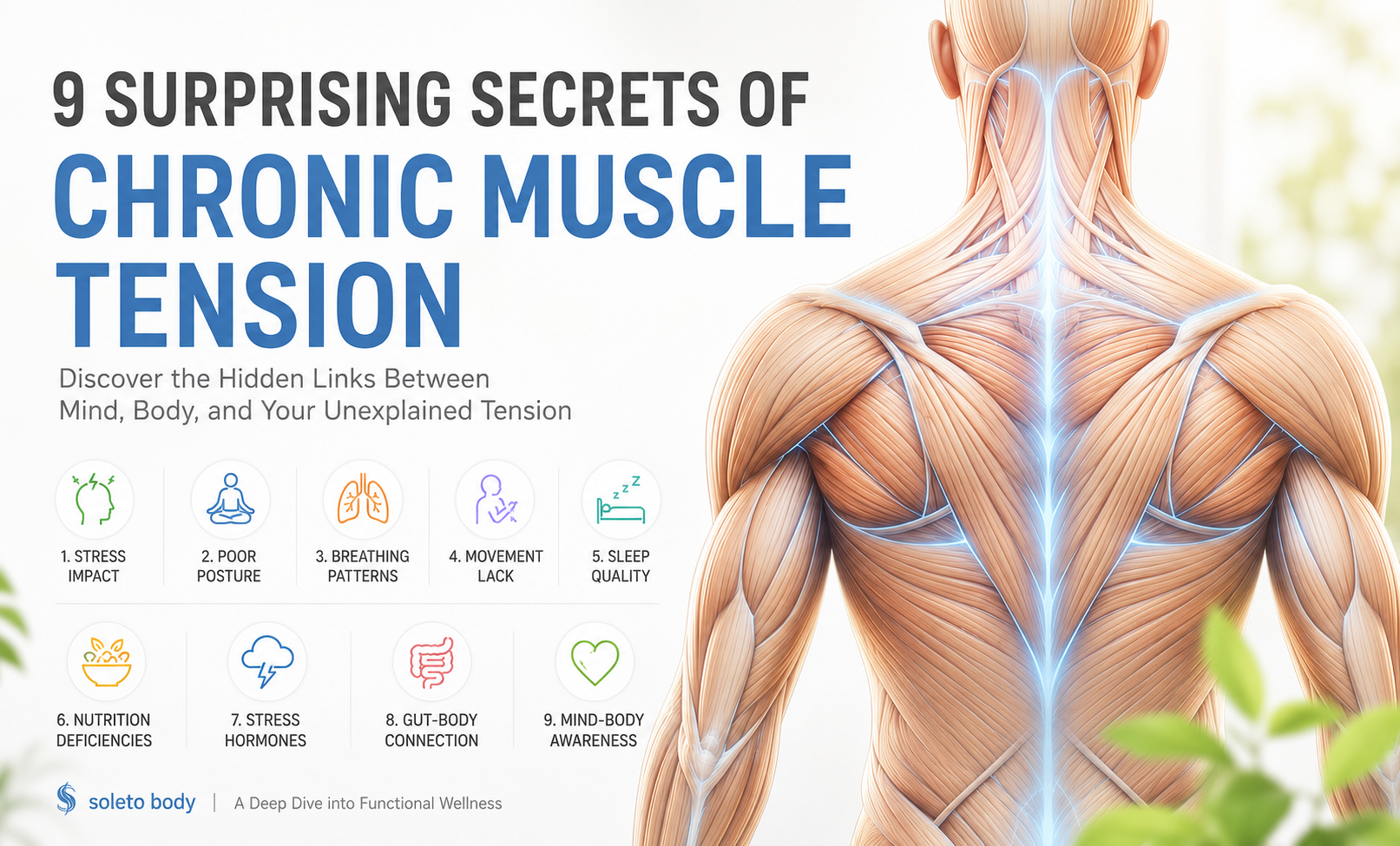
Here are the 9 surprising secrets of chronic muscle tension that you are likely ignoring, and how they completely dictate your physical well-being.
Watch how the revolutionary KSNS (Sbonsdo) method restores deep muscular and nerve balance to relieve long-standing back pain that standard MRI scans often miss.
Modern medical imaging technology is incredibly advanced. An MRI, CT scan, or ultrasound can detect structural crises with microscopic precision. They are designed to spot tumors, herniated discs, fractures, acute inflammation, and advanced organ diseases.
However, these advanced machines have a massive blind spot: they cannot measure the invisible pain of chronic muscle tension or soft-tissue ischemia. Muscles, tendons, and fascia do not show “pain” on an MRI unless they are physically torn or ruptured. A muscle can be severely locked up, starved of oxygen, and firing continuous pain signals to your brain, yet it will look completely normal on a high-tech scan. If your tests are clear but you are still hurting, your pain is not imaginary—it is simply structural-free. To understand how chronic muscle tension behaves, we must look deeper into our daily stress responses.
2. Your Brain Subconsciously “Guards” Areas of Stress
When you experience psychological stress, financial anxiety, or physical fatigue, your brain instinctively perceives a threat. It triggers a primitive survival mechanism known as muscle guarding.
Without you ever realizing it, your brain sends a continuous, low-grade electrical signal to your muscles to “brace for impact.” Your shoulders shrug toward your ears, your jaw clenches, and your core muscles tighten. If the stress never truly stops, the muscles never get the signal to relax. This subconscious reaction directly triggers chronic muscle tension, keeping your body in an ongoing state of physical alarm and deep postural restriction.
3. The Deep Diaphragm is the Epicenter of Unexplained Side Pain
When we are stressed or sitting hunched over a laptop for eight hours a day, our breathing patterns instinctively change. We stop breathing deeply into our abdomen and begin taking shallow, rapid chest breaths.
This is often the primary root of upper torso chronic muscle tension. This bad breathing habit causes the deep diaphragm—the primary muscle of respiration sitting right up under your ribs—to tighten and seize up. Because the diaphragm shares profound myofascial connections with the lower back, ribs, and waist, a locked diaphragm projects a constant, vague sense of pressure or aching right around the lower rib cage, which can worsen overall chronic muscle tension over time.
4. The Quadratus Lumborum (QL) Mimics Internal Organ Pain
The Quadratus Lumborum (QL) is a deep lower back muscle that connects your lowest rib to your pelvis. It is a notorious culprit for unexplained side-waist pain and structural chronic muscle tension.
When you sit with poor posture—such as leaning heavily to one side, crossing your legs, or slouching—the QL muscle on one side is forced to stay in a constantly stretched or locked position. Over time, it develops hyper-irritable knots called trigger points. These trigger points are famous for radiating deep, sickening discomfort to the front of the abdomen, hips, and lower waist. This chronic muscle guarding leads to localized chronic muscle tension, making people believe they have a kidney or bowel issue when it is simply a suffocating muscle.
5. Chronic Tension Starves Your Muscles of Crucial Oxygen
When a muscle remains in a state of constant, uninterrupted contraction, it physically squeezes the microscopic blood vessels running through it. This localized restriction of blood flow is known as micro-chemia.
Because the blood flow is restricted, the muscle tissue is starved of fresh oxygen and vital nutrients. At the same time, metabolic waste products like lactic acid cannot be efficiently flushed out. This toxic, low-oxygen environment directly causes chronic muscle tension, creating a constant, burning, or dull ache that resting alone will not fix. To help alleviate chronic muscle tension, restoring normal blood flow and oxygenation to the affected tissues is an absolute priority.
6. The Nervous System Becomes “Hyper-Sensitized” Over Time
If a muscle stays tight for months on end, the relationship between that muscle and your central nervous system completely changes. This neurological phenomenon is called central sensitization, which acts as an amplifier for chronic muscle tension.
Your spinal cord and brain become hyper-reactive to the constant stream of distress signals. Essentially, the volume knob on your pain receptors gets turned all the way up. Once this neurological link to chronic muscle tension is established, even normal, gentle movements—like twisting your torso, bending over, or sitting down—are misinterpreted by your brain as dangerous threats, triggering an intensified sensation of pain.
7. Youth and Regular Exercise Do Not Make You Immune
Many young adults in their 20s and 30s believe that severe muscle stiffness is an old-age issue. This is a dangerous misconception. Today, young office workers, software developers, dedicated gamers, and even regular gym-goers are highly vulnerable to chronic muscle tension due to prolonged static postures.
In fact, people who lift weights regularly often overlay heavy physical stress on top of an already exhausted, poorly aligned posture. The human body adapts to daily stress silently, accumulating micro-tensions until one day, a seemingly simple movement causes the entire system to lock up under the weight of accumulated chronic muscle tension.
8. Postural Adaptation Creates a Domino Effect in the Body
The human body is bound together by a continuous, interconnected web of connective tissue called fascia. No muscle operates in isolation, meaning that the physical manifestation of chronic muscle tension in one area will quickly travel to another.
If you have a tight right waist or QL muscle, your body will instinctively tilt or shift your weight to the opposite side to avoid discomfort. This subtle, subconscious shift forces your opposite hip, your mid-back, and even your neck muscles to overwork to keep your eyes level. What started as a small, localized tension in your lower ribs can slowly morph into a full-body structural imbalance, worsening your systemic chronic muscle tension, altering your gait and sleep quality.
9. True Relaxation is Not a Luxury—It is Essential Maintenance
When my friend asked me, “If the medical tests are normal but I’m still hurting, what am I supposed to do?” my answer was simple: Your body does not need aggressive medical intervention. To treat chronic muscle tension, it needs systematic, neurological safety.
When your muscles are locked in a chronic guarding state, pushing through the pain or attempting aggressive, heavy workouts will only make your nervous system tighten up further. True relaxation is not about being lazy or pampering yourself; it is a vital physiological requirement to signal back to your brain that the danger has passed, allowing you to resolve long-standing chronic muscle tension.
Consistent, gentle somatic stretching is essential to signal safety to your nervous system and release deep tissue tightness.
Calming your mind with natural soundscapes is a powerful way to reduce somatic guarding and ease chronic muscle tension.
Calming your mind with natural soundscapes is a powerful way to reduce somatic guarding and ease chronic muscle tension.
🛠️ The 4-Step Recovery Action Plan
1. Diaphragmatic Breathing (The 4-7-8 Reset): Inhale deeply through your nose for 4 seconds, allowing your belly to expand. Hold for 7 seconds, and exhale slowly through your mouth for 8 seconds. Do this for 5 minutes daily to immediately down-regulate your fight-or-flight response and release a locked diaphragm, easing chronic muscle tension.
2. Gentle, Passive Mobility Work: Avoid intense stretching that causes your muscles to fight back. Instead, perform gentle movements like the Cat-Cow stretch, passive supine spinal twists, and gentle side bends. Focus on breathing smoothly through the movement to reduce chronic muscle tension.
3. Progressive Muscle Relaxation (PMR): Before sleep, deliberately tense a specific muscle group (like your shoulders or lower back) for 5 seconds, then completely let go for 10 seconds. This contrast trains your brain to recognize and release subconscious muscle guarding.
4. Implement Movement Snacking: Never sit continuously for hours. Set an alarm to stand up, shake out your limbs, and walk around for 2 minutes every single hour to prevent micro-ischemia from setting into your lower back and waist.
(Note: For more professional guidance on physical health and alignment, check out high-quality health resources like Mayo Clinic’s guide on myofascial pain to learn more about somatic recovery.)
Conclusion: Listen to the Whisper Before Your Body Screams
Your body is an incredibly intelligent, communicative system. It rarely begins with an unbearable medical crisis. Instead, it starts with a subtle whisper—a slight tightness in your side, a faint restriction when you twist, or an unexplainable dull ache after a stressful day.
When a doctor tells you that your scans are clear but it looks like muscular tension, it is not a dismissive diagnosis. It is a profound invitation to re-evaluate how you live, breathe, and handle daily stress. By understanding chronic muscle tension and actively giving your body the restorative care, hydration, and neurological safety it deserves, you can finally break free from invisible pain and guide your physical health back into perfect, vibrant balance.
(If you found this guide helpful, be sure to read our Sole to Body somatic health blog for daily somatic wellness and posture management.)
Chronic posture imbalance affecting the back, pelvis, and lower body.
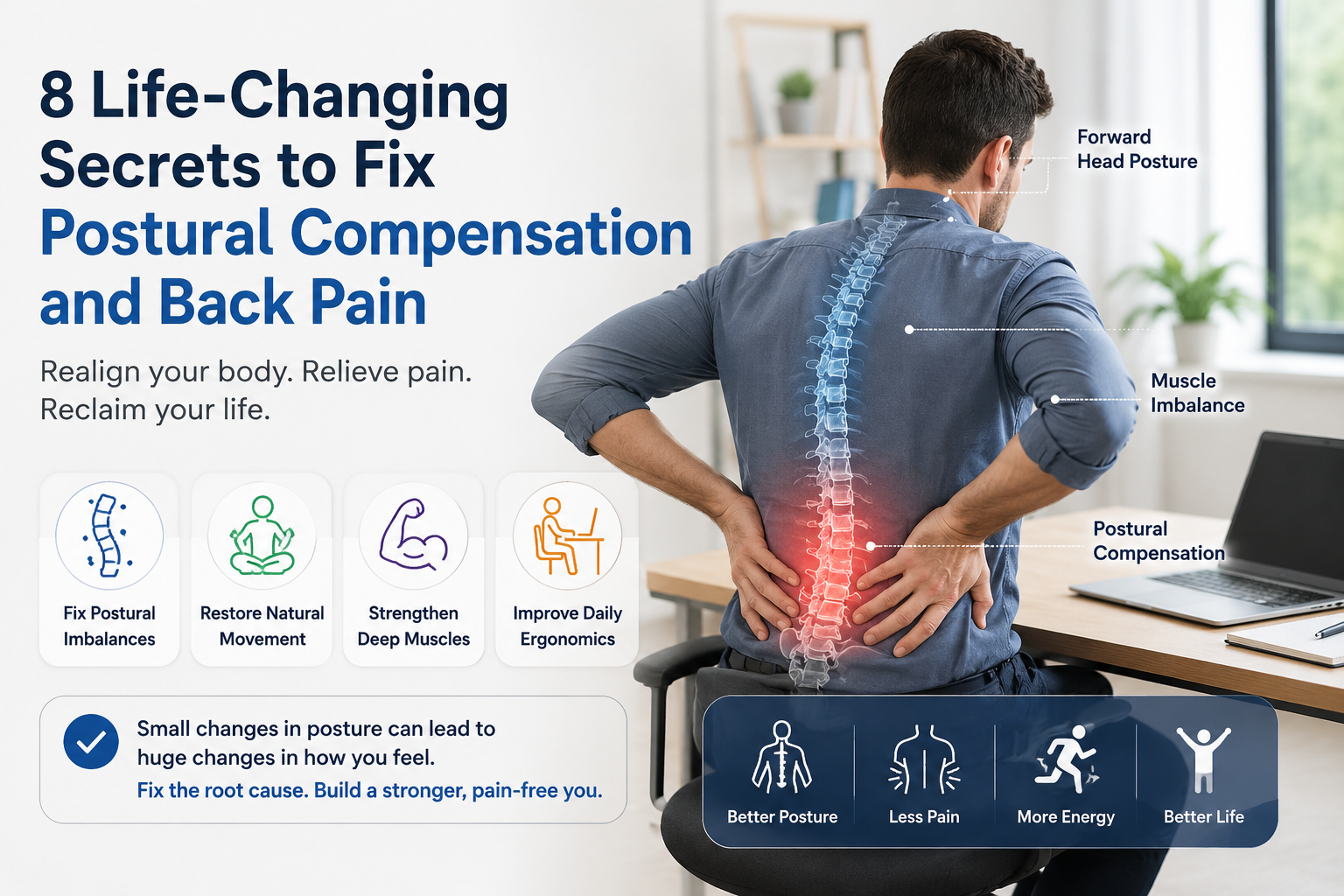
8 Life-Changing Secrets to Fix Postural Compensation and Back Pain
1. Introduction: The Invisible Burden of Decades
Understanding body alignment is often the first step toward resolving chronic lower back pain that has lasted for years. In many real-life cases, persistent discomfort is not isolated to one muscle or joint. Instead, the body develops long-term compensation patterns that slowly affect posture, breathing, balance, and movement.
Many women assume lower back pain or pelvic heaviness are simply part of aging. However, from a structural perspective, these symptoms may reflect years of forward weight shift, muscular guarding, and movement imbalance.
Your body constantly tries to prevent you from falling. When the center of gravity changes, the nervous system automatically reorganizes muscle tension to keep you upright. Over time, this protective strategy can become deeply ingrained.
Over time, these Postural Compensation patterns may affect the entire body.
2. A Real-Life Perspective: The “Leaden Body” Feeling
A woman in her 60s came seeking help for what she believed was ordinary lower back pain.
“My legs feel heavy like lead,” she explained.
After evaluation, it became clear that the lower back itself was not the primary issue. For decades after childbirth, her upper body weight distribution had gradually shifted forward. Her shoulders rounded inward, the rib cage became compressed, and her pelvis continuously tightened to stabilize the body.
The tension pattern had become so familiar that her nervous system accepted it as normal.
3. The Biomechanical Shift After Motherhood
Pregnancy changes the body’s center of gravity dramatically. During this period, the spine, pelvis, and lower body adapt in order to maintain balance.
For some women, those altered movement patterns never fully reset.
Years later, they may continue walking, standing, and breathing with the same forward-dominant posture developed decades earlier. This can create excessive stress throughout the lower back, hips, knees, and feet.
The Hidden Forward Pull
Even a small forward shift in body weight can place enormous tension on the posterior chain muscles. The upper back stiffens, the pelvis braces, and the body gradually loses fluidity.
Over time, many people begin experiencing:
This type of Postural Compensation gradually increases muscular stress.
rounded upper back posture
shallow breathing
pelvic heaviness
foot pressure imbalance
chronic muscular tightness
fatigue while standing
4. Why the Feet Matter More Than Most People Realize
Chronic posture imbalance may gradually affect calf tension, foot pressure, and walking stability.
The feet are often the final “shock absorbers” of long-term imbalance.
Long-term Postural Compensation often changes foot pressure patterns and standing stability.
This type of Postural Compensation gradually increases muscular stress.
In this case, the tissue beneath the toes and forefoot had become stiff and dense, almost like the feet were constantly bracing against the ground.
When pressure distribution changes for many years, the body loses its natural spring-like movement. Standing becomes exhausting, and even getting up from a chair may feel unusually difficult.
Many people focus only on the painful area while ignoring the foundation underneath them.
5. The Fascial Connection and Structural Bracing
Muscles move the body, but fascia helps maintain long-term tension patterns.
Under chronic stress, connective tissue can gradually harden and reinforce protective postures. This often creates the sensation of stiffness, heaviness, and restricted movement throughout the torso and pelvis.
Hydration, breathing mechanics, circulation, and movement quality all influence how flexible these tissues remain over time.
6. Breathing, Rib Cage Compression, and Stress
One overlooked factor in chronic discomfort is breathing restriction.
When the rib cage collapses forward, the diaphragm cannot move freely. This often leads to shallow chest breathing, increased stress signaling, and persistent muscular guarding.
The body may remain in a low-level “protective mode” for years without the person fully realizing it.
Restoring natural rib cage movement can significantly reduce overall tension patterns.
7. Re-Educating Movement Patterns
Long-standing movement habits do not disappear overnight.
The nervous system must gradually relearn safer and more balanced movement strategies. Small changes in foot pressure, pelvic alignment, breathing, and walking mechanics can create meaningful improvements over time.
Many people report:
lighter legs
easier standing
reduced pelvic pressure
improved breathing
less foot discomfort
better body awareness
8. Moving Toward a Lighter Body
True physical comfort is not simply the absence of pain.
It is the feeling that the body no longer has to fight gravity every moment of the day.
When balance improves and unnecessary muscular guarding decreases, people often describe their bodies as feeling “lighter” and less compressed.
Especially for women who have spent decades compensating after pregnancy and childbirth, restoring body awareness and movement quality can be an important part of long-term well-being.
https://youtu.be/5GBP9frJbW4?si=i5F4TXUMG319uGjm
FAQ
Can chronic posture imbalance improve after many years?
According to Harvard Health, posture and movement patterns may influence chronic musculoskeletal discomfort.
Yes. The nervous system can adapt throughout life when movement patterns, breathing, and body awareness are gradually retrained.
Reducing Postural Compensation often begins with improving balance, breathing, and movement awareness.
Why does my pelvis feel heavy when standing up?
Pelvic heaviness is often connected to muscular bracing, altered weight distribution, restricted breathing mechanics, and long-term compensation strategies.
Why do my feet feel stiff and pressured?
The feet frequently absorb stress created higher up in the body. Chronic imbalance can change pressure patterns and reduce natural flexibility in the foot tissues.
You can also explore more posture and body balance articles on our homepage.
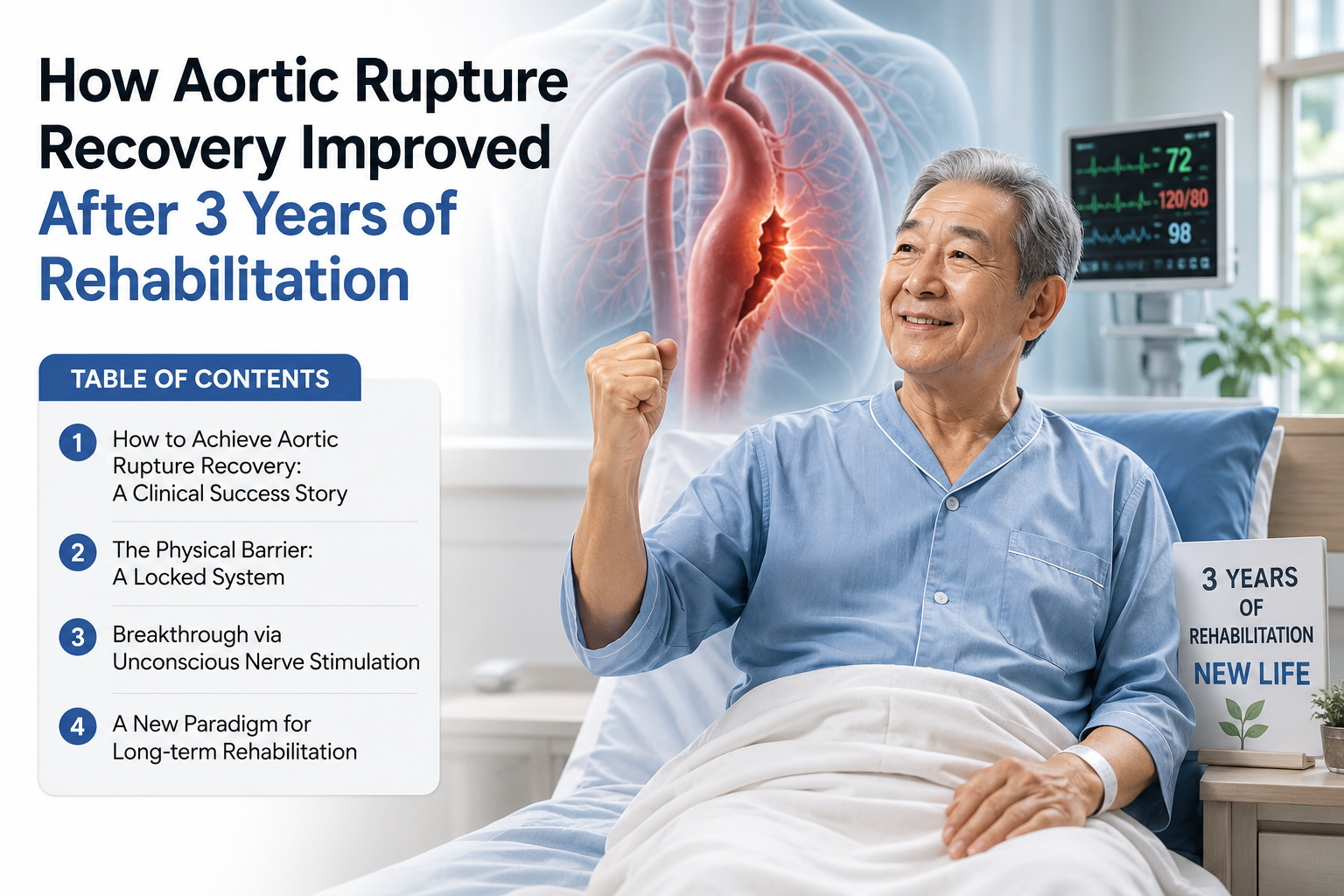
How to Achieve Aortic Rupture Recovery: A Clinical Success Story
Recovering after an aortic rupture can be a long rehabilitation journey. This report explores how supportive nerve stimulation and circulation-focused care were used alongside long-term rehabilitation to improve mobility and daily function.
Survival after an aortic rupture is a medical phenomenon. This Aortic Rupture Recovery case study highlights a patient who survived the critical “Golden Hour” six years ago but was left with severe physical impairments. After two years of intensive hospital care and four years of continuous rehabilitation, the medical team concluded that no further progress could be made. The client was left dependent on two canes, struggling with a lower body that felt “disconnected” from the brain.
The Physical Barrier: A Locked System
Aortic Rupture RecoveryWalking rehabilitation
When the client first arrived at the Haim Body Balance Center, the physical state was more than just “weakness.” Walking was impossible without the heavy support of two canes. A striking symptom was the inability to lift the legs while sitting. It wasn’t just muscle atrophy; the neurological pathway to the femoral nerve was effectively “locked.” Even if the legs were lifted manually, they would drop instantly, lacking any neurological “hold.” Furthermore, a massive, involuntary contraction around the abdomen acted like a heavy girdle, creating constant downward pressure on the lower body.
Breakthrough via Unconscious Nerve Stimulation
Our approach to successful Aortic Rupture Recovery focused on “Unconscious Nerve Stimulation” through specific reflex zones in the feet. For a patient with low autonomic nervous system (ANS) efficiency, the initial response is unique.
By applying targeted pressure to specific reflex points for just three seconds, we triggered a “sizzling” (jingle-jingle) sensation. This is a vital clinical sign in Aortic Rupture Recovery. It indicates that the stagnant neurological pathways are being reactivated. Much like releasing a parking brake on a car, this stimulation sent a sudden signal to the brain, overriding the “lock” on the femoral nerves.
Removing Physical Blockages: The Ankle Congestion
Beyond the nerves, a major physical barrier was identified around the ankles. Years of poor circulation led to:
Chronic Inflammatory Deposits: The area around the ankle joints was congested with hardened, fatty masses.
Circulatory Stagnation: These deposits were so dense that they physically choked the blood flow, exacerbating the numbness.
We initiated an intensive plan to manually break down and release these hardened inflammatory deposits. By physically clearing these “clogs,” we restored the structural freedom the ankle needed to move, which in turn improved the overall circulation, a crucial step in the Aortic Rupture Recovery process.
A New Paradigm for Long-term Rehabilitation
Rehabilitation is not a sprint; it is a marathon. Over three years of consistent management, the transformation has been remarkable. The “lock” on the thigh nerves has loosened, allowing for conscious leg movement. The dependence on the two canes has shifted from a desperate necessity to a supportive aid.
This Aortic Rupture Recovery case suggests that long-term rehabilitation and supportive neurological care may help improve mobility and daily function after severe physical limitations. By addressing unconscious nerve responses, circulation issues, and overall body balance, gradual physical improvement may continue over time.
Today, the patient still faces challenges, but the “powerless” legs of years ago are gone. There is now strength, coordination, and, most importantly, hope. For those suffering from the after-effects of major surgery, remember: when one door closes, another pathway through neurological stimulation may open.
More information about aortic conditions and rehabilitation can be found through Mayo Clinic resources.
Relaxing healing music may also help support emotional comfort during long-term rehabilitation.
For more information about body balance care and rehabilitation support, visit Haim Body Balance Center.https://soletobody.com