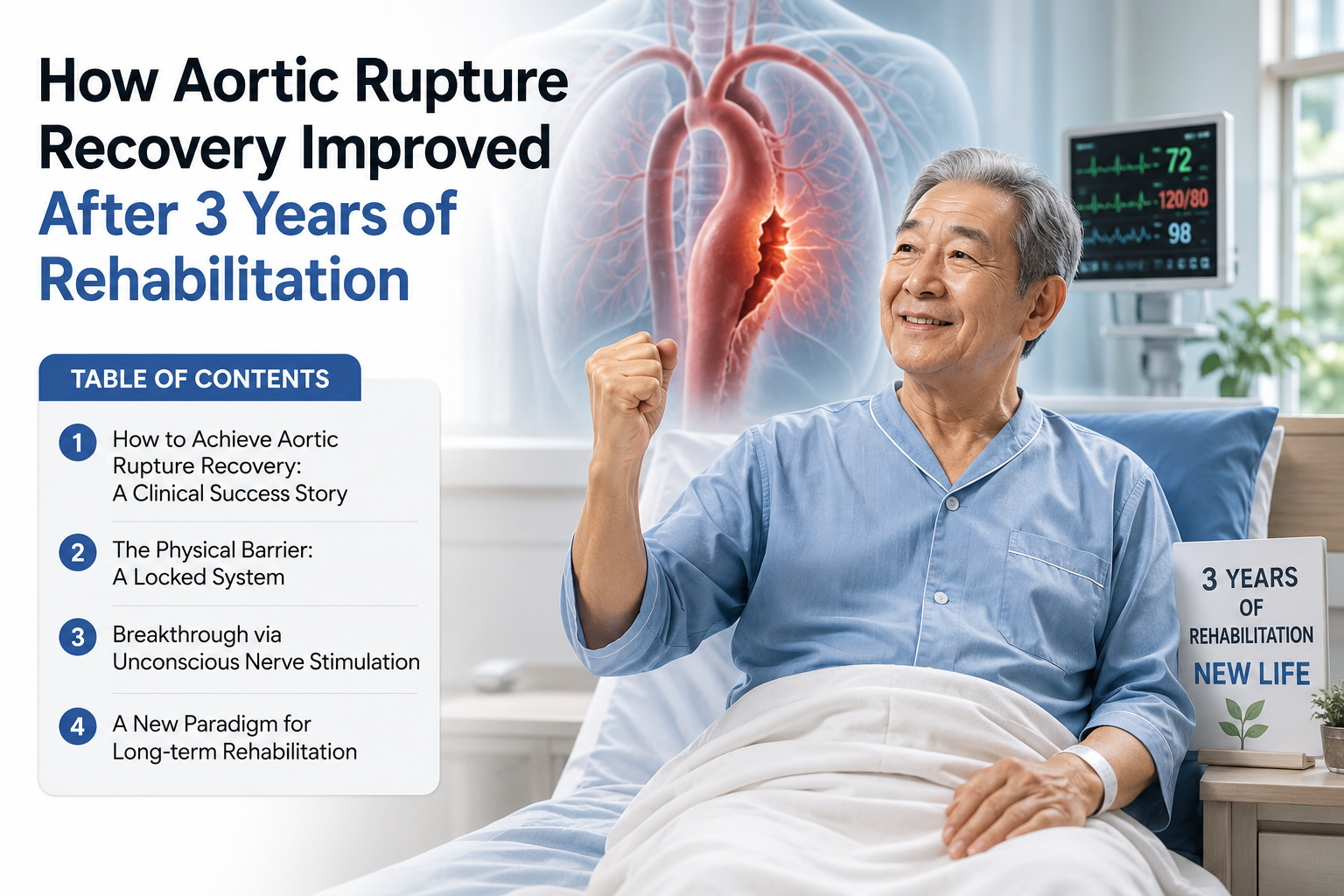
How to Achieve Aortic Rupture Recovery: A Clinical Success Story
Recovering after an aortic rupture can be a long rehabilitation journey. This report explores how supportive nerve stimulation and circulation-focused care were used alongside long-term rehabilitation to improve mobility and daily function.
Survival after an aortic rupture is a medical phenomenon. This Aortic Rupture Recovery case study highlights a patient who survived the critical “Golden Hour” six years ago but was left with severe physical impairments. After two years of intensive hospital care and four years of continuous rehabilitation, the medical team concluded that no further progress could be made. The client was left dependent on two canes, struggling with a lower body that felt “disconnected” from the brain.
The Physical Barrier: A Locked System


When the client first arrived at the Haim Body Balance Center, the physical state was more than just “weakness.” Walking was impossible without the heavy support of two canes. A striking symptom was the inability to lift the legs while sitting. It wasn’t just muscle atrophy; the neurological pathway to the femoral nerve was effectively “locked.” Even if the legs were lifted manually, they would drop instantly, lacking any neurological “hold.” Furthermore, a massive, involuntary contraction around the abdomen acted like a heavy girdle, creating constant downward pressure on the lower body.
Breakthrough via Unconscious Nerve Stimulation
Our approach to successful Aortic Rupture Recovery focused on “Unconscious Nerve Stimulation” through specific reflex zones in the feet. For a patient with low autonomic nervous system (ANS) efficiency, the initial response is unique.
By applying targeted pressure to specific reflex points for just three seconds, we triggered a “sizzling” (jingle-jingle) sensation. This is a vital clinical sign in Aortic Rupture Recovery. It indicates that the stagnant neurological pathways are being reactivated. Much like releasing a parking brake on a car, this stimulation sent a sudden signal to the brain, overriding the “lock” on the femoral nerves.
Removing Physical Blockages: The Ankle Congestion
Beyond the nerves, a major physical barrier was identified around the ankles. Years of poor circulation led to:
- Chronic Inflammatory Deposits: The area around the ankle joints was congested with hardened, fatty masses.
- Circulatory Stagnation: These deposits were so dense that they physically choked the blood flow, exacerbating the numbness.
We initiated an intensive plan to manually break down and release these hardened inflammatory deposits. By physically clearing these “clogs,” we restored the structural freedom the ankle needed to move, which in turn improved the overall circulation, a crucial step in the Aortic Rupture Recovery process.
A New Paradigm for Long-term Rehabilitation
Rehabilitation is not a sprint; it is a marathon. Over three years of consistent management, the transformation has been remarkable. The “lock” on the thigh nerves has loosened, allowing for conscious leg movement. The dependence on the two canes has shifted from a desperate necessity to a supportive aid.
This Aortic Rupture Recovery case suggests that long-term rehabilitation and supportive neurological care may help improve mobility and daily function after severe physical limitations. By addressing unconscious nerve responses, circulation issues, and overall body balance, gradual physical improvement may continue over time.
Today, the patient still faces challenges, but the “powerless” legs of years ago are gone. There is now strength, coordination, and, most importantly, hope. For those suffering from the after-effects of major surgery, remember: when one door closes, another pathway through neurological stimulation may open.
More information about aortic conditions and rehabilitation can be found through Mayo Clinic resources.
Relaxing healing music may also help support emotional comfort during long-term rehabilitation.
For more information about body balance care and rehabilitation support, visit Haim Body Balance Center.https://soletobody.com