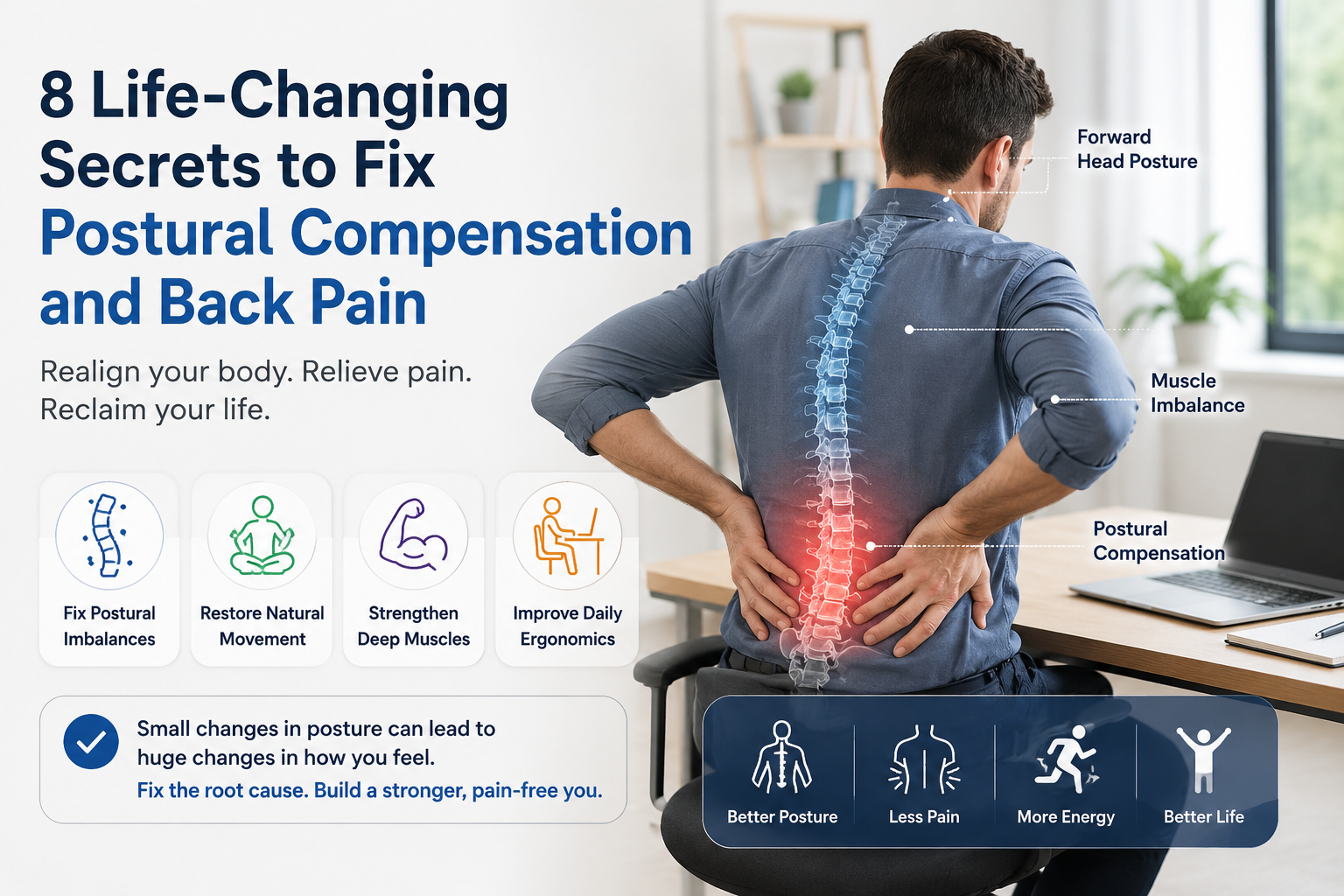

8 Life-Changing Secrets to Fix Postural Compensation and Back Pain
1. Introduction: The Invisible Burden of Decades
Understanding body alignment is often the first step toward resolving chronic lower back pain that has lasted for years. In many real-life cases, persistent discomfort is not isolated to one muscle or joint. Instead, the body develops long-term compensation patterns that slowly affect posture, breathing, balance, and movement.
Many women assume lower back pain or pelvic heaviness are simply part of aging. However, from a structural perspective, these symptoms may reflect years of forward weight shift, muscular guarding, and movement imbalance.
Your body constantly tries to prevent you from falling. When the center of gravity changes, the nervous system automatically reorganizes muscle tension to keep you upright. Over time, this protective strategy can become deeply ingrained.
Over time, these Postural Compensation patterns may affect the entire body.
2. A Real-Life Perspective: The “Leaden Body” Feeling
A woman in her 60s came seeking help for what she believed was ordinary lower back pain.
“My legs feel heavy like lead,” she explained.
After evaluation, it became clear that the lower back itself was not the primary issue. For decades after childbirth, her upper body weight distribution had gradually shifted forward. Her shoulders rounded inward, the rib cage became compressed, and her pelvis continuously tightened to stabilize the body.
The tension pattern had become so familiar that her nervous system accepted it as normal.
3. The Biomechanical Shift After Motherhood
Pregnancy changes the body’s center of gravity dramatically. During this period, the spine, pelvis, and lower body adapt in order to maintain balance.
For some women, those altered movement patterns never fully reset.
Years later, they may continue walking, standing, and breathing with the same forward-dominant posture developed decades earlier. This can create excessive stress throughout the lower back, hips, knees, and feet.
The Hidden Forward Pull
Even a small forward shift in body weight can place enormous tension on the posterior chain muscles. The upper back stiffens, the pelvis braces, and the body gradually loses fluidity.
Over time, many people begin experiencing:
This type of Postural Compensation gradually increases muscular stress.
- rounded upper back posture
- shallow breathing
- pelvic heaviness
- foot pressure imbalance
- chronic muscular tightness
- fatigue while standing
4. Why the Feet Matter More Than Most People Realize

The feet are often the final “shock absorbers” of long-term imbalance.
Long-term Postural Compensation often changes foot pressure patterns and standing stability.
This type of Postural Compensation gradually increases muscular stress.
In this case, the tissue beneath the toes and forefoot had become stiff and dense, almost like the feet were constantly bracing against the ground.
When pressure distribution changes for many years, the body loses its natural spring-like movement. Standing becomes exhausting, and even getting up from a chair may feel unusually difficult.
Many people focus only on the painful area while ignoring the foundation underneath them.
5. The Fascial Connection and Structural Bracing
Muscles move the body, but fascia helps maintain long-term tension patterns.
Under chronic stress, connective tissue can gradually harden and reinforce protective postures. This often creates the sensation of stiffness, heaviness, and restricted movement throughout the torso and pelvis.
Hydration, breathing mechanics, circulation, and movement quality all influence how flexible these tissues remain over time.
6. Breathing, Rib Cage Compression, and Stress
One overlooked factor in chronic discomfort is breathing restriction.
When the rib cage collapses forward, the diaphragm cannot move freely. This often leads to shallow chest breathing, increased stress signaling, and persistent muscular guarding.
The body may remain in a low-level “protective mode” for years without the person fully realizing it.
Restoring natural rib cage movement can significantly reduce overall tension patterns.
7. Re-Educating Movement Patterns
Long-standing movement habits do not disappear overnight.
The nervous system must gradually relearn safer and more balanced movement strategies. Small changes in foot pressure, pelvic alignment, breathing, and walking mechanics can create meaningful improvements over time.
Many people report:
- lighter legs
- easier standing
- reduced pelvic pressure
- improved breathing
- less foot discomfort
- better body awareness
8. Moving Toward a Lighter Body
True physical comfort is not simply the absence of pain.
It is the feeling that the body no longer has to fight gravity every moment of the day.
When balance improves and unnecessary muscular guarding decreases, people often describe their bodies as feeling “lighter” and less compressed.
Especially for women who have spent decades compensating after pregnancy and childbirth, restoring body awareness and movement quality can be an important part of long-term well-being.
FAQ
Can chronic posture imbalance improve after many years?
According to Harvard Health, posture and movement patterns may influence chronic musculoskeletal discomfort.
Yes. The nervous system can adapt throughout life when movement patterns, breathing, and body awareness are gradually retrained.
Reducing Postural Compensation often begins with improving balance, breathing, and movement awareness.
Why does my pelvis feel heavy when standing up?
Pelvic heaviness is often connected to muscular bracing, altered weight distribution, restricted breathing mechanics, and long-term compensation strategies.
Why do my feet feel stiff and pressured?
The feet frequently absorb stress created higher up in the body. Chronic imbalance can change pressure patterns and reduce natural flexibility in the foot tissues.
You can also explore more posture and body balance articles on our homepage.