A man in his 50s walked into our center looking defeated. His knees had been giving him trouble for months. Friends pushed him toward surgery. One doctor mentioned stem cell injections. Another suggested a knee replacement consultation.
And that tesitation changeed everything
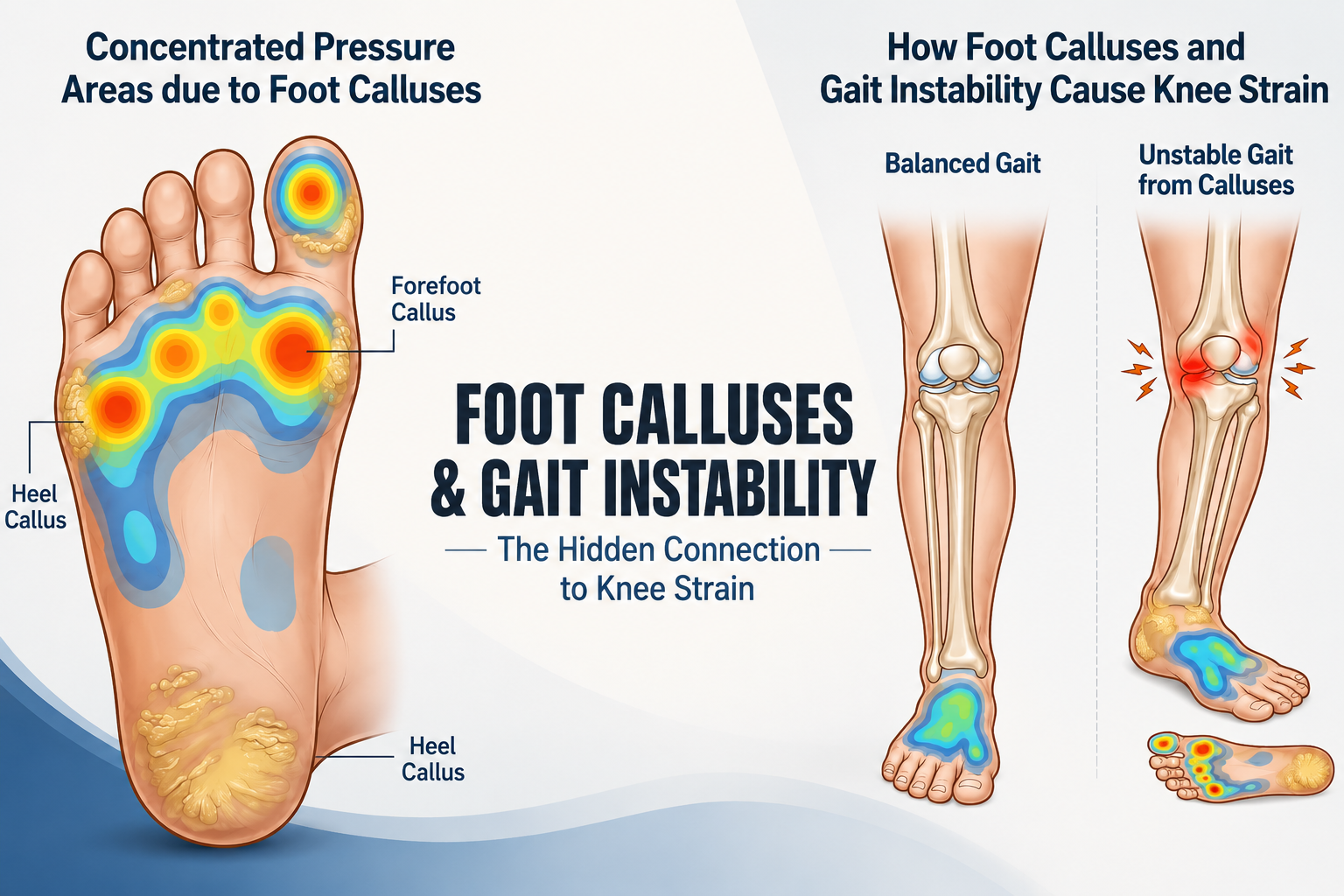
Impact of persistent foot calluses on walking balance and knee joint health.
A closer look at how foot conditions influence overall body alignment
What Foot Calluses Do to Your Walking Balance
When he walked across the room, we did not look at his knees first.
We looked at his feet.
The bottom of both feet told a story that years of medical appointments had missed. Thick, uneven foot calluses covered specific areas. The left foot looked completely different from the right. Certain zones had absorbed enormous pressure — day after day, year after year.
He had spent decades in sales. Long hours. Hard floors. Dress shoes that offered almost nothing in support.
His feet had adapted. Unfortunately, adaptation and health are not always the same thing.
How Uneven Foot Calluses Destroy Walking Balance
Most people treat foot calluses as a cosmetic issue.
At our center, we see them differently.
Calluses form where pressure repeats. When one area of the foot consistently absorbs more load than it should, the skin thickens as protection. The callus is not the enemy. It is the messenger.
Think of a car with uneven tire pressure. The stressed tire wears faster. Eventually, the entire vehicle suffers.
The same principle applies to the human body. Uneven foot pressure travels upward. The ankles adjust. The knees compensate. The hips shift. The spine responds.
By the time a person feels knee discomfort, the pattern has usually been building for years.
Rebuilding Walking Balance from the Ground Up
Foot pressure changes can influence leg alignment and overall walking balance.
We did not promise quick results.
We focused on awareness first. Footwear choices. Daily walking habits. How his feet contacted the ground with each step. Reducing tension in overworked muscles. Rebuilding movement confidence gradually.
Week by week, something shifted.
His steps became smoother. His legs felt less tired at the end of the day. Stairs that had felt uncertain began to feel manageable again.
And then something unexpected happened.
The thick foot calluses that had built up over many years began to soften. Not because we treated the skin. Because the pressure patterns underneath were finally changing.
The Hidden Link Between Foot Calluses and Daily Life
Most people spend years focusing on their knees, hips, and back.
Very few people look down.
Yet the feet carry every single step. They absorb impact. They communicate with the nervous system. They shape how the entire body moves.
When the foundation is uneven, everything above it works harder than it should.
We see similar patterns regularly at Haim Body Balance Center. People arrive focused on one painful area. When we examine the whole movement chain — starting from the feet — a different picture often emerges.
“Experience soothing healing music as you focus on your foot health and balance improvement.”
How Uneven Foot Calluses Destroy Your Walking Balance
Most people treat foot calluses as a cosmetic issue. They grab a pumice stone, file them down, and go about their day. But if you have persistent, uneven foot calluses, your feet are telling a story about your mechanics.
When your feet develop thick patches of hardened skin, it isn’t just about the skin—it’s about the pressure. These foot calluses often develop because your body is compensating for poor arch support or structural imbalances in your gait.
The Hidden Connection: Calluses and Gait
When you have an uneven gait, your foot doesn’t strike the ground uniformly. This creates “pressure hotspots.” Over time, the body builds thick foot calluses as a defense mechanism to protect those specific areas. By ignoring the cause, you aren’t just letting the foot calluses grow; you are allowing your body to continue walking in a way that puts unnecessary strain on your ankles, knees, and hips.
What You Should Do
Analyze your footwear: Wear shoes with proper arch support to distribute pressure evenly.
Consult a specialist: If foot calluses are recurring, see a podiatrist to check for biomechanical issues.
Stretch and Strengthen: Focus on foot intrinsic muscles to improve your overall walking stability.
A Final Word
This client did not need surgery.
He needed someone to look at the right place.
If you have been dealing with uneven shoe wear, tired legs, unstable walking, or unexplained knee discomfort, your feet may be worth a closer look.
At Haim Body Balance Center, we specialize in reading the body’s signals — starting from the ground up.
Sometimes the answer has been beneath your feet all along.
Do you know that your body behaves exactly like a giant Jenga Tower? Imagine you are piloting a giant, state-of-the-art robot suit. It’s sleek, fast, and incredibly powerful.
Suddenly, BAM! A red warning light flashes on the control panel: KNEE JOINT FAILURE!
Your body behaves exactly like a giant Jenga Tower.
What do you do?
Option A: Spray paint over the warning light so you don’t have to look at it.
Option B: Slap a piece of duct tape on the outside of the robot’s knee and keep running.
Option C: Open the blueprint, find the actual electrical glitch, and fix it from the roots.
If you chose Option A or B, congratulations—you are doing exactly what most people do when they feel pain!
Whenever we get a headache, we pop a pill. When our knee feels stiff, we slide on a tight brace. But what if your pain is actually a giant liar? What if the real culprit is hiding somewhere else entirely, quietly stabilizing your body’s Jenga Tower?
Let’s dive into the ultimate body detective story to find out why your pain isn’t healing, and how a secret superhero inside you holds the key to saving the day!
1. Stop Chasing the Alarm: Why Your Pain is a Big Liar
We’ve all been there. You play a match of soccer, scroll on your phone for three hours, or sit at your school desk, and suddenly… Ouch! Your shoulder hurts.
Naturally, we react with our Mindless Habits:
The Pill Pop: Swallowing painkillers to mute the alarm.
The Patch Slap: Sticking icy-hot patches on our skin like stickers.
The Compression Squeeze: Wearing braces to force the joint to stay still.
These might make you feel better for an hour or two. But here is the shocking truth: the pain always comes back. Treating only where it hurts is like trying to fix a sinking ship by scooping out water with a teacup. You aren’t plugging the actual hole!
2. The Jenga Tower Effect: How Your Foot Controls Your Jaw
Your body is not a collection of random, separate Lego bricks. It is a highly connected chain—just like a giant Jenga Tower.
If you pull out a block from the very bottom of a Jenga Tower, what happens? The top of the tower starts to wobble, tilt, and eventually… CRASH!
In your body, the bottom of your Jenga Tower is your feet.
[ Your Jaw & Neck ] <– Complains and hurts!
▲
[ Your Shoulders ] <– Tilts to compensate
▲
[ Your Spine ] <– Curves under pressure
▲
[ Your Hips ] <– Shifts out of alignment
▲
[ Your Knees ] <– Absorbs the weird angles
▲
[ Your Feet ] <– THE FOUNDATION (The Glitch starts here!)
If your left foot is slightly tilted or weak, your knee has to bend weirdly to keep you upright. Because your knee is bending weirdly, your hip rotates. To make up for the crooked hip, your spine curves, your shoulder drops, and suddenly… you have a massive headache!
So, when your neck hurts, the actual “criminal” might be your left pinky toe. This bottom-up connection is what we call the Jenga Tower effect.
3. Wake Up Your Autopilot: The Unconscious Nervous System
Watch how activating the foot’s reflexive nerves restores the body’s natural balance mechanism.
If you had to consciously tell your heart to beat, your lungs to breathe, and every single muscle in your leg to contract just to take one step, your brain would literally explode from overload.
Thanks to our body’s built-in wisdom, we have a superhero: The Unconscious Nervous System. Think of this as your body’s Autopilot.
Your body’s autopilot relies on perfect nerve alignment to stay balanced.
When you step on a sharp pebble, you don’t think: “Hmm, a sharp object. I should lift my foot.” No! Your Autopilot yanks your foot away before you even realize what happened. This is an automatic reflex controlled by your nervous system.
Check out this scientific guide on Proprioception and Reflexes to learn more about how your body senses balance and movement.
When this Autopilot glitches, it stops realigning the Jenga Tower automatically, leading to chronic muscle tightness.
4. Calibrate Your Left-Right Balance (The 50/50 Rule)
For your Autopilot to run smoothly, your left side and right side must be perfectly balanced. They need to share the load 50/50.
But what if your Autopilot gets a “glitch” due to an uneven foundation?
If one side of your nervous system becomes lazy or unresponsive, your other side has to work twice as hard to keep you from falling over. Over time, this constant, unconscious muscle tension accumulates.
If you don’t reboot this nervous system Autopilot, your body’s Jenga Tower will remain crooked, and no massage or stretching will ever cure the pain permanently.
5. Rebuilding the Jenga Tower: The Haim Method Audit
At Haim Body Balance Center, we don’t play the guessing game. We don’t just put a hot pack where you point. Instead, we put on our detective hats and examine your body from the ground up, rebuilding your Jenga Tower from the foundation!
Through specialized neural response patterns (the KSNS method), we investigate:
The Foot Blueprint: Finding why your foundation is tilted.
The Postural Alignment: Checking how the wobble travels up to your neck.
The Autopilot Reflex: Verifying if your nerves are reacting at lightning speed.
By waking up those sleepy, unconscious nerves, we help your body heal itself and restore the Jenga Tower to its upright alignment.
Conclusion: Start Listening to Your Body’s True Language!
Pain is not your enemy. Pain is just your body’s way of waving a flag and saying, “Hey! My Jenga Tower is falling!”
The next time you feel a pinch or a stiff joint, don’t just try to silence it with mindless habits. Stop, look down at your feet, and realize that your body is a beautiful, connected masterpiece.
Are you ready to stop treating the symptoms and finally fix the root cause?
Read more on our About page to see how we help you achieve instant, lasting balance.
Let’s get your Jenga Tower perfectly stacked again!
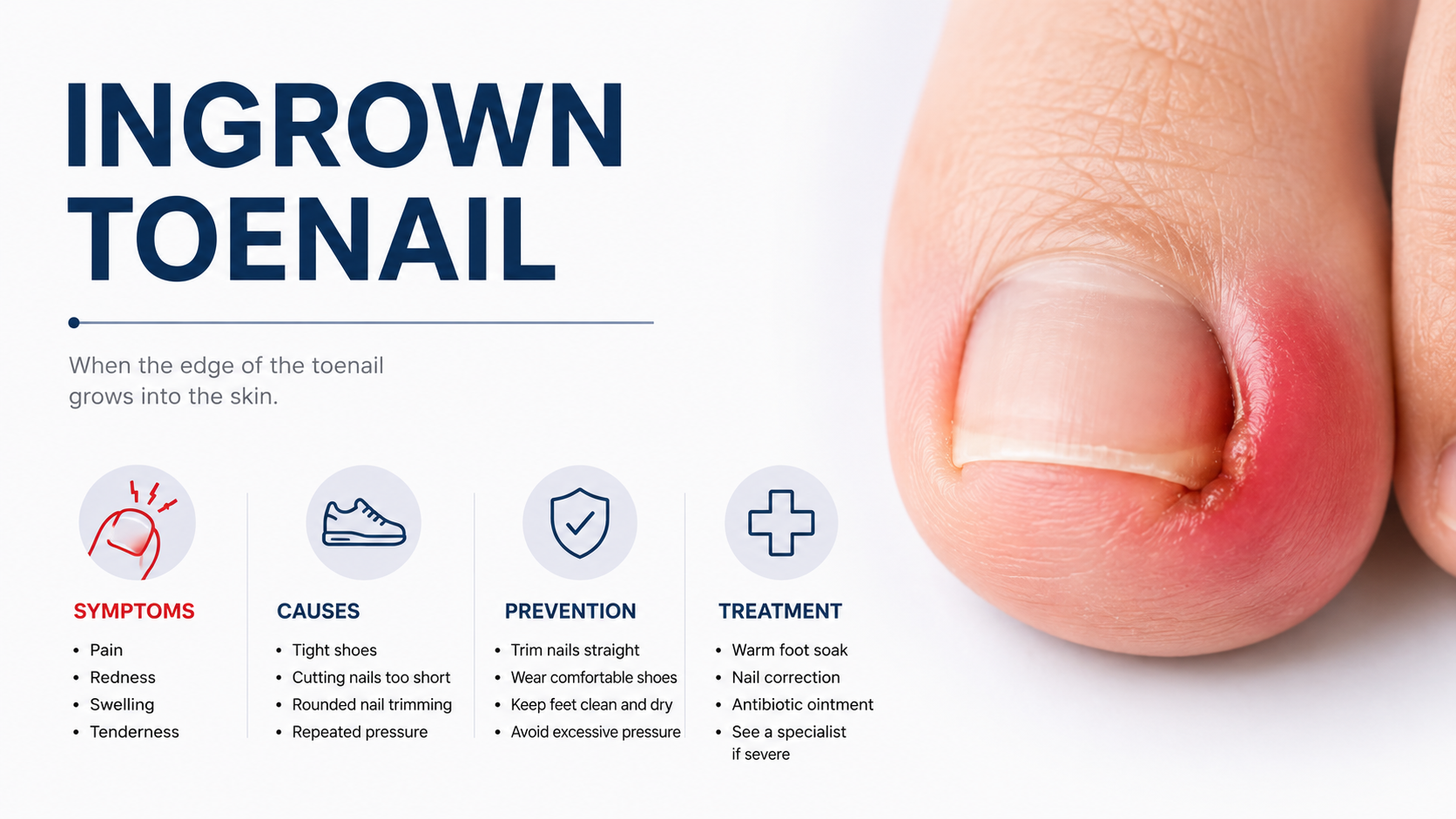
Are you struggling with ingrown toenails (clinically known as onychocryptosis) that keep coming back no matter how many times you visit the doctor?
For many, chronic foot pain becomes a frustrating cycle of temporary relief and agonizing relapse. Most people perceive an ingrown toenail as a localized, minor issue—just a sharp piece of nail hitting the sensitive nail fold. However, after 20 years of clinical experience in podiatric health and advanced biomechanics, we have discovered that ingrown toenails are actually the “ending” of a much deeper story involving your entire musculoskeletal system and postural alignment. If the pain still returns after multiple procedures, it is time to stop treating the symptom and start addressing the structural root cause: your body balance.
In this definitive guide, we reveal 7 professional secrets to breaking the cycle of recurring ingrown toenails and restoring your body’s natural structural integrity.
Why Traditional Surgery Often Fails for Ingrown Toenails
Real transformation of a client’s ingrown toenail through Haim Body Balance Center’s advanced structural integration and neurological body balancing approach.
Before diving into the secrets, we must understand why even surgical interventions like a matrixectomy (partial or total nail removal) sometimes fail to provide permanent relief. Surgery addresses the anatomy of the nail plate, but it does not address the pathological mechanical load placed on the toe.
If your natural walking pattern forces your big toe into the ground at an unnatural angle, the surrounding soft tissue will remain inflamed even if the nail is narrowed. The nail is simply a passenger on a ship that is tilting. This is why a holistic, whole-body approach is mandatory for those who suffer from chronic ingrown toenails.
1. Decoding the “Kinetic Chain” and Biomechanical Forces
The Kinetic Chain illustrates how a tilted pelvis leads to collapsed arches and recurring foot issues.
The first secret is recognizing that your feet are the final link in your body’s Kinetic Chain. In biomechanics, every joint from your cervical spine down to your metatarsals is interconnected through complex fascia and muscle groups.
!
Caption: The Kinetic Chain illustrates how a tilted pelvis leads to collapsed arches and recurring foot issues.
When you have a postural imbalance, such as an anterior pelvic tilt, it forces your femur (thigh bone) and tibia (shin bone) to rotate internally. This internal rotation creates a downward pressure that leads to overpronation—the collapse of the foot arch. When the arch collapses, the hallux (big toe) is forced to absorb excessive “shear force” with every step. This force literally mashes the skin against the nail edge, creating the perfect environment for ingrown toenails. To fix the issue permanently, you must address the functional alignment of the hip and pelvis.
2. Releasing the “Unconscious Nerve Brake” (KSNS Theory)
Your central nervous system is hardwired for survival and protection. When you experience chronic stress or poor ergonomic habits, your brain locks certain muscles in a state of hyper-tension as a protective measure. This creates a high risk for developing ingrown toenails because your body loses its ability to absorb shock naturally.
This subconscious tension, which we call the Unconscious Nerve Brake, alters your center of gravity and creates a dysfunctional gait cycle. This concept aligns with the KSNS (Kim Ses-yeon New Structure) theory, which emphasizes the recovery of unconscious neurological sensing in the feet.
Watch how restoring the neurological ‘nerve brake’ through KSNS and Sbonsdo can naturally resolve chronic foot pain and prevent recurring ingrown toenails.
[Video: How KSNS Techniques and Sbonsdo Restore Foot Sensation and Balance – Healing YouTube. ALT: KSNS Therapy for Ingrown Toenails]
Caption: Watch how restoring the neurological ‘nerve brake’ through KSNS can naturally resolve chronic foot pain.
Releasing this “muscle memory” through specialized neurological body balancing is a prerequisite for long-term relief from ingrown toenails. Without calming the nervous system and restoring natural reflexes, physical therapy often provides only temporary results.
3. Detecting Postural Compensation Patterns
Chronic ingrown toenails are rarely isolated events; they are often the loudest warning signal of a larger compensation pattern within your skeleton. Your body is a master at hiding pain by shifting mechanical stress to other joints.
Perform this quick self-assessment to see if your body is compensating:
Do you experience chronic lumbar stiffness or lower back fatigue by the afternoon?
Does one knee ache more than the other after a long walk?
Are the heels of your shoes worn down asymmetrically?
If you answered yes, your body is likely compensating for a structural imbalance. This shift in your vertical axis acts as a silent, constant force driving your toe into your soft tissue 10,000 times a day, triggering the recurrence of ingrown toenails.
4. The Stability Secret: Beyond “Wide-Toe-Box” Shoes
While narrow, pointed footwear is a primary enemy of podiatric health, simply buying “wider shoes” isn’t always the solution for ingrown toenails. The real secret lies in torsional stability.
A shoe that is too flexible or lacks a proper shank can exacerbate the pressure on your feet. If the midfoot collapses inward, it increases lateral pressure on the nail bed. You need footwear that respects your anatomy while providing enough stability to prevent excessive pronation and further ingrown toenails. Look for a firm heel counter and anatomical arch support. Avoid “minimalist” or “zero-drop” shoes if your foundation is already unstable, as they may increase the load on your forefoot.
5. Master the Gait Cycle: Correcting Your Walking Pattern
The way you strike the ground dictates the health of your nail folds and prevents ingrown toenails. A healthy gait cycle consists of three phases: heel strike, mid-stance, and terminal stance (toe-off).
Many chronic sufferers have a malfunctioning “toe-off” phase. Instead of weight being distributed across all five metatarsals, they “push off” exclusively from the inner edge of the big toe. Relearning a balanced gait through proprioceptive awareness can eliminate the friction that triggers ingrown toenails, paronychia (nail fold infection), and nail plate deformities. Focusing on a “straight-ahead” foot position during the stride can significantly reduce medial pressure.
6. Restoring Ankle Mobility and Dorsiflexion
The human foot is an engineering marvel with 26 bones and 33 joints, all designed for efficient movement to prevent chronic ingrown toenails. If your ankle joint is stiff, your big toe is forced to work twice as hard to clear the ground during the “swing phase” of walking.
!
Caption: Proper ankle dorsiflexion is critical for redistributing weight away from the big toe.
Stiffness in the ankle, specifically limited dorsiflexion, is a major contributor to persistent foot pain. When the ankle doesn’t bend enough, the foot is forced to turn outward (abduct), placing the big toe in a high-pressure “valgus” position. Improving the flexibility of the talocrural joint ensures the nail bed is no longer the primary impact zone for your body weight, helping you avoid ingrown toenails for good.
7. Professional Body Balancing and Structural Integration
The final secret is seeking professional intervention that focuses on whole-body integration to resolve ingrown toenails. Standard medical treatments are necessary for acute infections, but they rarely address the biomechanical root cause.
At Haim Body Balance Center, we specialize in identifying these hidden structural links. Our holistic approach involves:
Comprehensive Postural Mapping: Analyzing the tilt in your structural foundation.
Neurological Release: Deactivating the “nerve brakes” in your muscular system.
Alignment Integration: Ensuring your pelvis, knees, and feet work as a synchronized unit.
Therapeutic Exercises for Foot Alignment
To support your recovery and prevent ingrown toenails, try these three simple daily exercises:
Short Foot Exercise: Try to pull the ball of your foot toward your heel without curling your toes. This strengthens the intrinsic muscles of the arch.
Ankle Circles: Perform 20 slow circles in each direction every morning to improve joint lubrication and mobility.
Toe Spreading: Sit with your feet flat and try to spread your toes as wide as possible. This helps reverse the compression caused by modern footwear.
5 Common Myths About Ingrown Toenails
Myth: Cutting a “V” in the middle of the nail helps. (Fact: This does nothing to change how the edges grow and can lead to bacterial traps.)
Myth: It’s purely genetic. (Fact: While nail shape is genetic, the pressure that makes it ingrow is usually mechanical or postural.)
Myth: Antibiotics will cure it. (Fact: They treat the infection, but not the physical trauma of the nail hitting the skin.)
Myth: Tight socks don’t matter. (Fact: Any external compression can worsen ingrown toenails if your foot is already overpronating.)
Myth: Once you have surgery, it’s gone forever. (Fact: Recurrence rates are surprisingly high if underlying biomechanical issues are ignored.)
How to Properly Trim Nails to Prevent Issues
To minimize the risk of ingrown toenails, follow these expert trimming steps:
Always cut straight across; never round the corners into a “C” shape.
Leave the nail long enough so that the corners sit comfortably beyond the skin fold.
Use a proper straight-edge toenail clipper, not curved fingernail clippers.
File away sharp edges gently with an emery board to prevent snagging on socks.
FAQ: Solving the Mystery of Recurring Foot Pain
Q: I have had surgery twice. Why do my ingrown toenails return?
A: Surgery removes the nail, but not the pathological pressure pattern. If your biomechanical alignment still forces the toe into the ground at an angle, the surrounding skin will remain irritated even without the nail.
Q: Can emotional stress really cause physical foot pain?
A: Indirectly, yes. Stress increases systemic muscle memory tension, particularly in the calves and pelvis, which “tightens” your gait and increases localized mechanical stress on your toes, eventually leading to ingrown toenails.
Q: Is there a simple home check for imbalance?
A: Stand in front of a mirror with feet hip-width apart. If your kneecaps point inward toward each other (“squinting patellae”), your hips are internally rotated, placing excessive pressure on your toes and potentially causing ingrown toenails.
Conclusion: Start Listening to the Signal
Pain is a sophisticated language. A recurring ingrown toenail is a persistent distress signal that your foundation is struggling to support your structure. Stop chasing the symptom with temporary, painful fixes. By understanding the Kinetic Chain and addressing your body balance, you can finally achieve lasting relief. Your journey to a pain-free, balanced life begins with a single, aligned step.
Conclusion: Start Listening to the Signal Pain is a sophisticated language. A recurring ingrown toenail is a persistent distress signal that your foundation is struggling to support your structure. Stop chasing the symptom with temporary, painful fixes. By understanding the Kinetic Chain and addressing your body balance, you can finally achieve lasting relief. Your journey to a pain-free, balanced life begins with a single, aligned step.
### Summary: The Ultimate Path to Foot Health
Achieving permanent relief from persistent foot discomfort requires shifting your focus from the symptoms to the entire skeletal framework. True physical balance cannot be achieved overnight, nor can it be resolved by treating an isolated area. It demands a systematic and holistic approach that targets the nervous system, core alignment, and joint mobility altogether.
For those who wish to study these structural connections further, conducting regular postural self-assessments and analyzing your daily walking habits is highly recommended. True recovery begins when you listen to your body’s subtle warnings and take a synchronized approach to body stabilization.
Caption: Experience deep relaxation and structural release with our original 432Hz Arirang healing meditation music, designed to calm the nervous system and restore body balance.
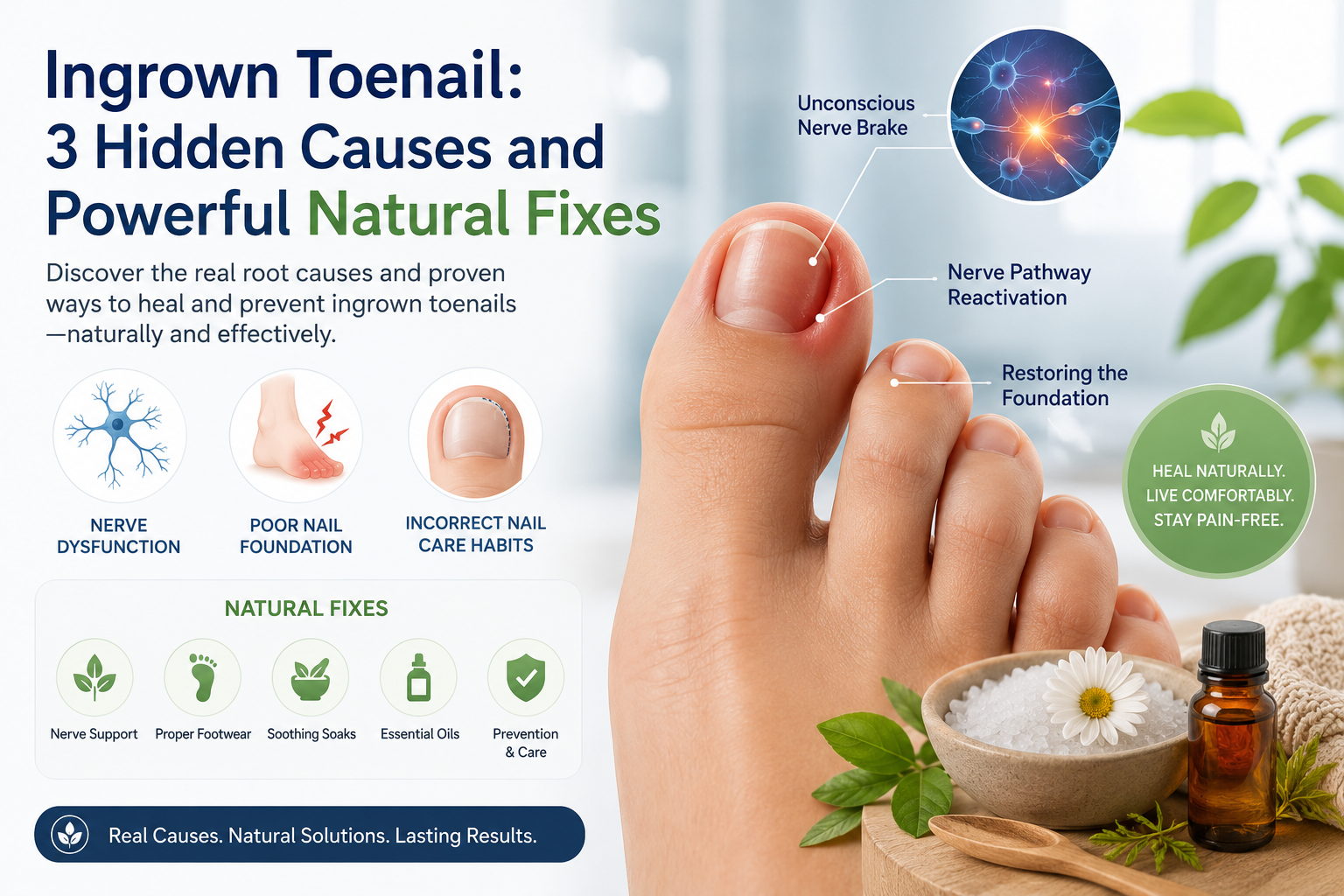
Ingrown toenail: 3 hidden causes and how to prevent recurrence naturally.
Many people live with the constant discomfort of an ingrown toenail, a condition medically known as Onychocryptosis. It begins as a slight pressure, but soon escalates into sharp, stabbing pain and chronic inflammation. For those who have reached their limit, the most common path is having the nail removed. However, the most frustrating part of this journey is the high rate of recurrence.
Ingrown toenail problems often begin with subtle nerve sensitivity and foot imbalance.
Improving ingrown toenail nerve sensitivity is key to preventing recurrence.
Improving ingrown toenail nerve sensitivity is essential for long-term recovery.
Big toe structural imbalance and a “braked” nerve response from the sole may contribute to ingrown toenail pain.
Why does a new nail, after a painful removal process, grow back into the skin again? To understand this, we must look beyond the surface. Traditional treatments often view the nail as the sole problem. In reality, the nail is merely a reflection of the environment beneath it. If the soil is tilted, the tree will always grow crooked. In the human body, this “tilted soil” is often a result of a dysfunctional nervous system in the foot.
Foot balance plays a critical role in preventing recurring nail problems and improving overall stability.
Foot therapy to improve nerve sensitivity and prevent ingrown toenail recurrence.
This condition is often related to ingrown toenail nerve sensitivity and poor foot balance.
Improving ingrown toenail nerve sensitivity is key to preventing recurrence.
3 Causes of Ingrown Toenail and Why It Keeps Returning
When a nail is surgically removed, the trauma can further desensitize the surrounding nerves. If the underlying cause—the lack of neurological feedback and poor circulation—is not addressed, the nail bed remains constricted. As the new nail attempts to grow, it follows the path of least resistance, which is often right back into the tender skin.
The Hidden Culprit: The “Unconscious Nerve Brake”
At the Haim Body Balance Center, we have identified a phenomenon called the “Unconscious Nerve Brake.” The big toe serves as the primary anchor for bodily balance. When the sensory nerves in the toe are “inhibited” or “braked”—due to structural misalignment or trauma—the brain restricts the toe’s natural movement as a protective measure.
This is a common pattern in ingrown toenail recurrence cases.
Improving ingrown toenail nerve sensitivity is essential to prevent recurrence.
This neurological inhibition leads to a cascade of issues:
Micro-circulation Collapse: Reduced nerve signals lead to constricted blood vessels.
Loss of Nail Bed Elasticity: Without proper flow, the skin becomes rigid and prone to deformation.
Growth Path Distortion: The nail “loses its way” and starts piercing the soft tissue.
Restoring the Foundation: Nerve Pathway Reactivation
Our approach focuses on “releasing the brake.” Instead of cutting the nail, we focus on reactivating the dormant sensory receptors. By restoring the unconscious nerve response, we improve the systemic flow to the toe. When the nerves are active and foot balance is restored, the nail bed flattens, and the new nail begins to grow straight and healthy.
How to Check Your Nerve Health (Self-Assessment)
Is your ingrown toenail caused by a “Nerve Brake”? Check if you have these symptoms:
Does the pain persist even when you aren’t wearing tight shoes?
Does the toe feel cold or have a different skin texture compared to other toes?
Is there a loss of sensation or a tingling feeling around the nail?
Have you had multiple recurrences after professional nail care or surgery?
According to Mayo Clinic, ingrown toenails are often caused by improper nail growth and pressure from tight shoes.
If you answered “yes” to more than two, your nervous system likely needs professional attention.
A Real Clinical Success Story
In one notable clinical case, a client came to us after failing three separate surgical procedures over five years. Her toe was in a state of permanent inflammation. By focusing on her nerve response rather than the nail, we were able to stop the inflammation within weeks. Six months later, her nail had completely returned to its normal, healthy shape for the first time in a decade.
In many cases, the body does not need more aggressive treatment, but better awareness and proper stimulation.
When the nervous system regains its natural responsiveness, the toe can recover its normal function, and the nail can grow in a healthier direction.
This is why addressing the root cause — nerve balance and circulation — is essential for long-term results.
Healthy nail growth is not only about the nail itself, but about restoring proper nerve sensitivity, foot balance, and circulation within the body.
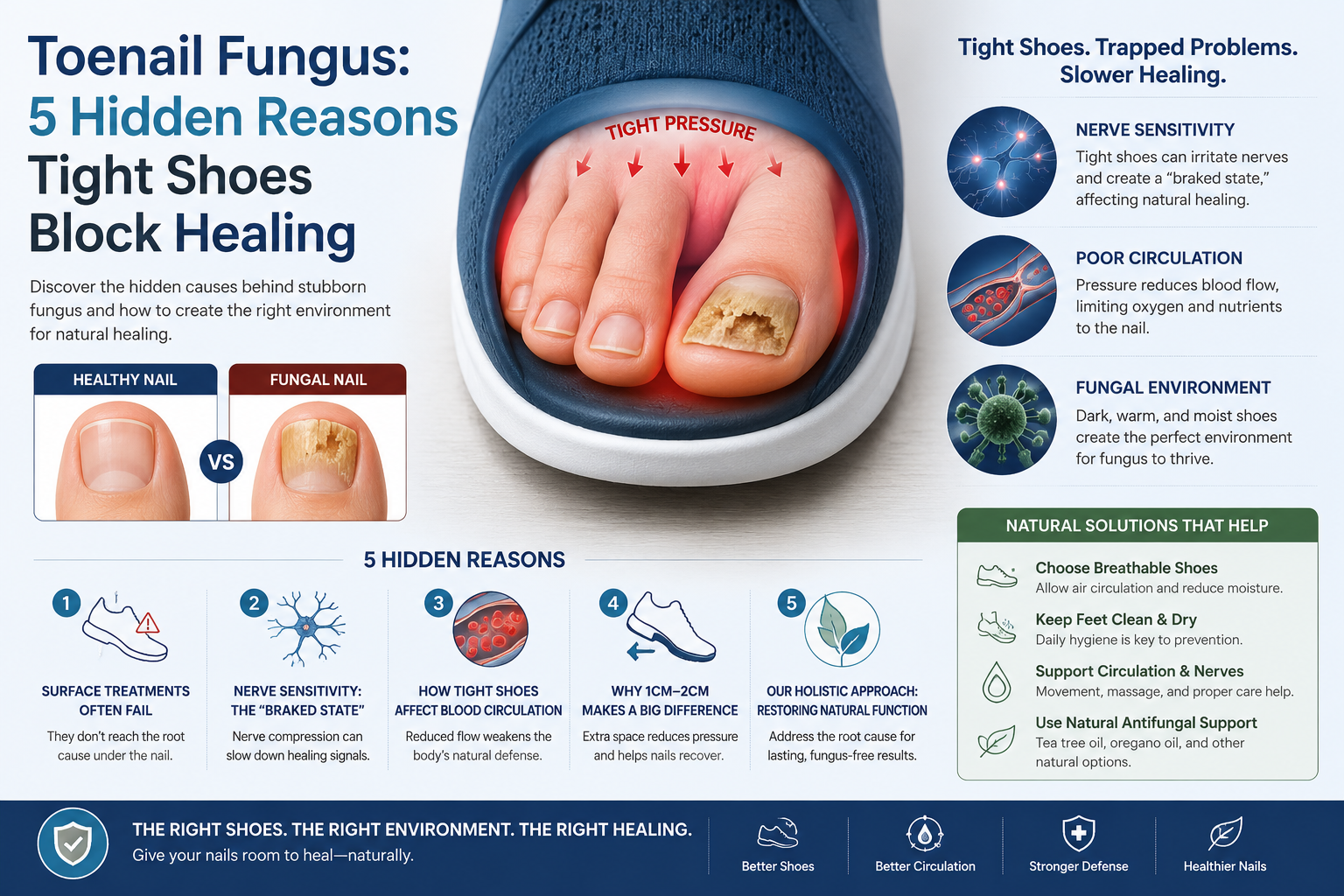
Toenail Fungus & Nerve Sensitivity: How Tight Shoes Block Healing
Even a slight touch can feel painful in sensitive toes. This is more than just a toenail fungus problem.Anatomical diagram of foot nerves and muscles showing the link between circulation and toenail fungus
Introduction: Why Surface Treatments Often Fail
Many people mistakenly view toenail fungus as a purely aesthetic or surface-level infection caused by poor hygiene. They spend months—sometimes even years—applying topical creams and antifungal treatments, only to find the condition returning time and again. However, at Haim Body Balance Center, our clinical observations suggest that persistent fungus is often a symptom of a much deeper mechanical and neurological dysfunction within the foot.
The hidden culprit behind this cycle is often tight shoes. When our toes are restricted by modern footwear with narrow toe boxes, the nervous system enters a protective “braked state,” disrupting vital signaling and healthy blood flow. This chronic compression leads to nerve hypersensitivity and poor circulation, creating an oxygen-deprived environment where fungi thrive. To truly clear the infection and restore foot health, we must look beyond the surface and address the root cause: the physical environment of your feet.
Many people view toenail fungus as a simple surface-level infection caused by poor hygiene. They spend months applying topical creams, only to find the condition returning.
Toenail fungus is often misunderstood as a simple condition, but it may reflect deeper issues within the foot.
At Haim Body Balance Center, we have observed a surprising clinical pattern…
The Hidden Link: Nerve Sensitivity and the “Braked State”
The toes play a critical role in maintaining body balance and neurological signaling. When toes are restricted, the nervous system enters what we describe as a “braked state”—a protective mechanism where normal signals are disrupted because the brain perceives instability.
Common signs of this neurological dysfunction include:
Hyper-reactivity: A sharp pain or a startled reaction when the big toe is lightly touched.
Chronic Rigidity: An inability to move the toes independently.
Imbalance: A shift in walking posture that creates long-term stress on the knees and hips.
The Science of Circulation → How Tight Shoes Affect Blood Circulation
When the nervous system is in this “braked” state, it doesn’t just affect movement—it directly impacts the biological health of the nail bed.
The most overlooked cause of persistent fungus is poor blood flow. To understand this, we must look at the science of circulation:
Capillary Compression: The toes are the furthest points from the heart. Blood must travel through tiny capillaries to reach the nail. Tight shoes physically compress these vessels, starving the tissue of oxygen and nutrients.
The Muscle Pump Effect: Blood is moved through the feet by the contraction and extension of toe muscles. If your toes are “locked” in a shoe, this pump stops working.
Immune Response: Stagnant blood flow leads to a low-oxygen environment—the perfect breeding ground for fungi. Without fresh, oxygenated blood, the body’s natural immune cells cannot reach the area to fight the infection.
How Tight Shoes Create a “Fungal Environment”
Modern footwear is often designed for aesthetics rather than anatomy. Shoes with narrow toe boxes and high pressure on the forefoot lead to:
Reduced Airflow: Creating a dark, moist, and warm environment.
Nerve Hypersensitivity: Chronic pressure irritates the nerves, making them reactive to even a light touch.
Structural Locking: The toes lose their natural splay, causing the entire foot to become rigid.
The Solution: Why You Should Choose Shoes 1cm to 2cm Larger
To restore balance and clear the fungus, the first step is mechanical decompression. We strongly recommend choosing a shoe size 1cm to 2cm larger than your actual foot measurement.
Allow for Expansion: Your feet naturally expand as you walk. That extra 1–2cm of “Toe Room” allows for this natural expansion without compressing the nerves.
Reactivate Neural Pathways: With enough space, your toes can begin to move again, sending “safe” signals to the brain to release the “braked state.”
Optimize Blood Flow: Roomy shoes allow for the Muscle Pump Effect to resume, flushing out toxins and delivering the nutrients required to grow a healthy, fungus-free nail.
Our Holistic Approach: Restoring Natural Function
Instead of focusing only on the fungus, we focus on restoring the body’s foundation:
Toe Activation: Exercises to wake up the dormant muscles in the foot.
Pressure Release: Transitioning to footwear with a wide toe box.
Nervous System Reset: Helping the body move out of a reactive, “braked” state through alignment.
Circulation Support: Improving systemic flow to ensure the nail bed is healthy from the inside out.
If you’re experiencing toe sensitivity or recurring toenail issues, it may be helpful to understand what’s really happening beneath the surface.
Improving foot balance and nerve sensitivity is essential for preventing recurring toenail fungus.
Toenail fungus may seem like a minor cosmetic issue, but it is often a reflection of deep-seated foot dysfunction. By addressing your footwear habits and restoring nerve and circulatory health, you can achieve long-term improvement rather than just temporary relief.
Give your toes the space they need to heal. Your balance depends on it.
Take a closer look at your foot balance and nerve response.If you’re experiencing toe sensitivity or recurring toenail issues, it may be helpful to understand what’s really happening beneath the surface.
Take a closer look at your foot balance and nerve response.
For more medical insights on toenail fungus, refer to Mayo Clinic.