Tag: neck tension

  • ​Tired eyes: It’s not your eyes, it’s your scalp.

    ​Tired eyes: It’s not your eyes, it’s your scalp.

    tired eyes from computer screen fatigue
    Tired eyes from prolonged screen time may signal deeper muscle tension in your scalp and neck.

    Tired eyes are one of the most common complaints we hear at our body balance center. Do you ever feel like something is stuck in your eye? That gritty, heavy, uncomfortable sensation that just won’t go away — even after a full night’s sleep?

    One client walked into our center with that exact complaint. He kept rubbing his tired eyes throughout the day. Sometimes his eyes felt heavy. Sometimes they felt dry. At other times, he described it as feeling like a tiny grain of sand was trapped inside.

    The surprising part? He had already visited an eye clinic. His examination showed no major problems. So, what was causing the persistent discomfort?

    While eye symptoms can stem from many sources — and only a qualified doctor can diagnose medical conditions — there is a common possibility that most people overlook: Muscle Tension.

    Why Tired Eyes Are Often a Body Problem

    Most people with tired eyes assume the problem starts and ends with the eye itself. But the muscles around your eyes, temples, forehead, scalp, and neck are all intricately connected. When we spend hours staring at computers, smartphones, or books, we focus only on the fatigue inside the eyes. However, the muscles surrounding them are never working in isolation.

    • The forehead becomes tense from deep concentration.
    • The temples become tight, restricting blood flow.
    • The back of the head and neck stiffen from poor posture.
    • The scalp loses its natural flexibility, acting like a tight, restrictive cap.

    Research by the American Optometric Association confirms that prolonged screen use contributes significantly to eye strain — and that postural tension in the neck and shoulders plays a key role in worsening symptoms.

    Two Real Cases: Tired Eyes Relieved by Body Work

    During our assessment, we noticed this client’s temples were unusually firm. The muscles around the side of his head were tight, and his neck showed significant tension. When we applied gentle relaxation techniques focused on the scalp and neck, he immediately reported feeling “lighter” and more comfortable. His tired eyes felt noticeably less strained after just one session.

    I recall another office worker who visited our center with chronic tired eyes. After just a few sessions focused on releasing his shoulder and neck tension, he told me that his “sand-in-the-eye” feeling had decreased by more than half — simply because he was no longer carrying that constant physical strain in his upper body.

    Think of Tired Eyes Like Wearing a Tight Hat

    Imagine wearing a hat two sizes too small all day long. Even if your vision is perfect, the constant pressure around your head would make you feel uncomfortable, fatigued, and mentally drained. Modern life — long screen time, stress, poor posture, and lack of sleep — creates this exact “tight hat” effect on your skull and neck muscles.

    This is why so many people experience tired eyes not from vision problems, but from accumulated physical tension they are not even aware of.

    3 Simple Ways to Relieve Tired Eyes

    If you find yourself rubbing your eyes repeatedly, try these simple habits to see if the fatigue subsides:

    1. Scalp Massage: Use your fingertips to gently massage your scalp in circular motions. Focus on the area right above your ears. Even 2–3 minutes can noticeably reduce tension.
    2. Neck Release: Slowly tilt your head from side to side, holding for 10 seconds on each side to release the trapezius muscles. Repeat 3 times daily.
    3. The “Look Away” Rule: Every 30 minutes, look at something at least 20 feet away for 20 seconds. While doing this, consciously drop your shoulders and unclench your jaw. This follows the 20-20-20 rule recommended by eye care professionals.

    For additional support,explore our related guide on why your body still feels unsafe after rehabilitation— because tension rarely exists in isolation.

    Important Note on Wellness Care

    tired eyes scalp tension neck massage relief
    Gentle scalp and neck care at Haim Body Balance Center —
    helping clients find relief from tired eyes and chronic tension.

    In our practice, we help clients improve body balance through gentle care focused on the scalp, neck, and shoulders. However, always understand the limits of wellness care. If you experience severe symptoms like blurred vision, double vision, sudden eye pain, or unusual headaches, please consult an eye specialist immediately. Professional medical evaluation is the safest choice for serious conditions.

    Is Your Body Asking for Rest?

    Take a moment to relax your eyes and breathe.
    This 432Hz healing music may help release
    the tension you’ve been carrying all day.

    Sometimes, tired eyes aren’t just about the eyes. They are a signal that your neck is carrying too much tension and your head has been working overtime.

    How many hours a day do you spend looking at a screen? Take a moment right now to roll your shoulders back and take a deep breath. You might be surprised by how much tension you are holding without even realizing it.

    The first step toward feeling better is simply paying attention to the signals your body has been sending all along.

    Are you ready to let go of that tension?

  • Menier Disease: 5 Hidden Causes of Dizziness You Need to Know

    Menier Disease: 5 Hidden Causes of Dizziness You Need to Know

    Living with Meniere’s disease often feels like living in a state of constant betrayal. One moment you are fine, and the next, the world is spinning, your ears are ringing, and you are left feeling physically and mentally shattered. Most medical advice focuses strictly on the inner ear—diuretics, low-salt diets, or injections. But for many, these treatments only scratch the surface because they ignore a fundamental truth: the ear does not exist in isolation from the rest of the body.

    ​After years of clinical observation in body alignment and unconscious nerve management, a clear pattern emerges. Meniere’s is often the “final alarm” of a body that has been struggling with imbalance and nervous system exhaustion for a very long time.

    ​The “Flu-Like” Weight of Chronic Dizziness

    Meniere disease causes
    Analyzing the link between foot balance and Meniere’s symptoms.

    ​If you suffer from Meniere’s, you likely recognize a specific set of symptoms that doctors rarely mention:

    • ​A body that feels heavy, as if you are coming down with the flu.
    • ​Waking up exhausted, no matter how many hours you slept.
    • ​A persistent “brain fog” that makes simple mental tasks feel draining.
    • ​A sense of anxiety that lingers even when you aren’t dizzy.

    ​These aren’t “side effects”—they are evidence that your Autonomic Nervous System is stuck in a defensive, high-stress state. When the brain feels that the body is physically unstable, it shifts into a “fight or flight” mode. Over time, this constant state of alert exhausts your lymphatic system and stagnates circulation, leading to that heavy, toxic feeling in your limbs.

    ​The Foundation: It Starts at Your Feet

    ​We often think of balance as something happening in the head, but balance actually begins at the soles of your feet. Your feet are the primary sensors sending data to your brain about where you are in space.

    Meniere disease foot balance
    Clinical observation of foot alignment in Meniere’s disease patients

    ​When the feet become tense or the arches collapse, the “data” sent to the brain becomes distorted. To compensate, the muscles in your calves, thighs, and eventually your neck and shoulders tighten up to “hold” you in place. This chronic tension restricts blood flow and lymphatic drainage. When the fluid in your body cannot circulate properly, the delicate pressure balance in the inner ear (which is central to Meniere’s) can become the ultimate casualty.

    ​The Unconscious Nervous System Reaction

    ​In many cases of chronic dizziness, the body has “remembered” stress. During evaluations, we often see that even light pressure on the toes or the base of the neck triggers a sharp, over-sensitive reaction. This is the unconscious nervous system protecting a body it perceives as being in danger.

    ​If your brain doesn’t feel “safe” on the ground, it will remain in a state of neurological static. This static manifests as the ringing in your ears (tinnitus), the pressure (aural fullness), and the eventual vertigo.

    ​A Path Toward True Stability

    Watch this clinical case demonstrating how restoring foot balance and neurological strength can eliminate chronic dizziness, even when it’s been persistent for years.”

    ​To truly address Meniere’s and chronic dizziness, we must look beyond the ear. True recovery involves recalibrating the body from the ground up:

    1. Restoring Foot Balance: Softening the tension in the soles allows the brain to receive “clear” signals of stability.
    2. Releasing Lower Body Stagnation: Clearing tension in the calves and pelvis encourages lymphatic flow, removing the “heavy” flu-like feeling.
    3. Calming the Nervous System: Through specialized body alignment, we signal to the unconscious mind that the body is supported and safe.
    4. Improving Circulation: When blood and lymph move freely, the body can naturally regulate the fluid pressures that affect the inner ear.

    ​Conclusion: Listen to Your Whole Body

    ​Meniere’s is not just a diagnosis; it is a message. It is your body’s way of saying that the system is overloaded and out of sync.

    ​If you are tired of just “managing” symptoms and want to understand why your body feels the way it does, it is time to look at your overall balance. When we stabilize the foundation and calm the nervous system, the world often stops spinning because the body finally feels like it is standing on solid ground again.

    True healing begins when we stop looking at the ear and start looking at the person.Meniere’s Disease: 5 Hidden Causes of Dizziness You Need to Know

    Learn More about Balance Health:

    For further professional resources on vestibular disorders and Meniere’s health, you can visit VEDA (Vestibular Disorders Association).

    https://soletobody.com/7-reasons-why-bppv-keeps-comi

    Relaxation therapy to calm the nervous system and find inner balance.

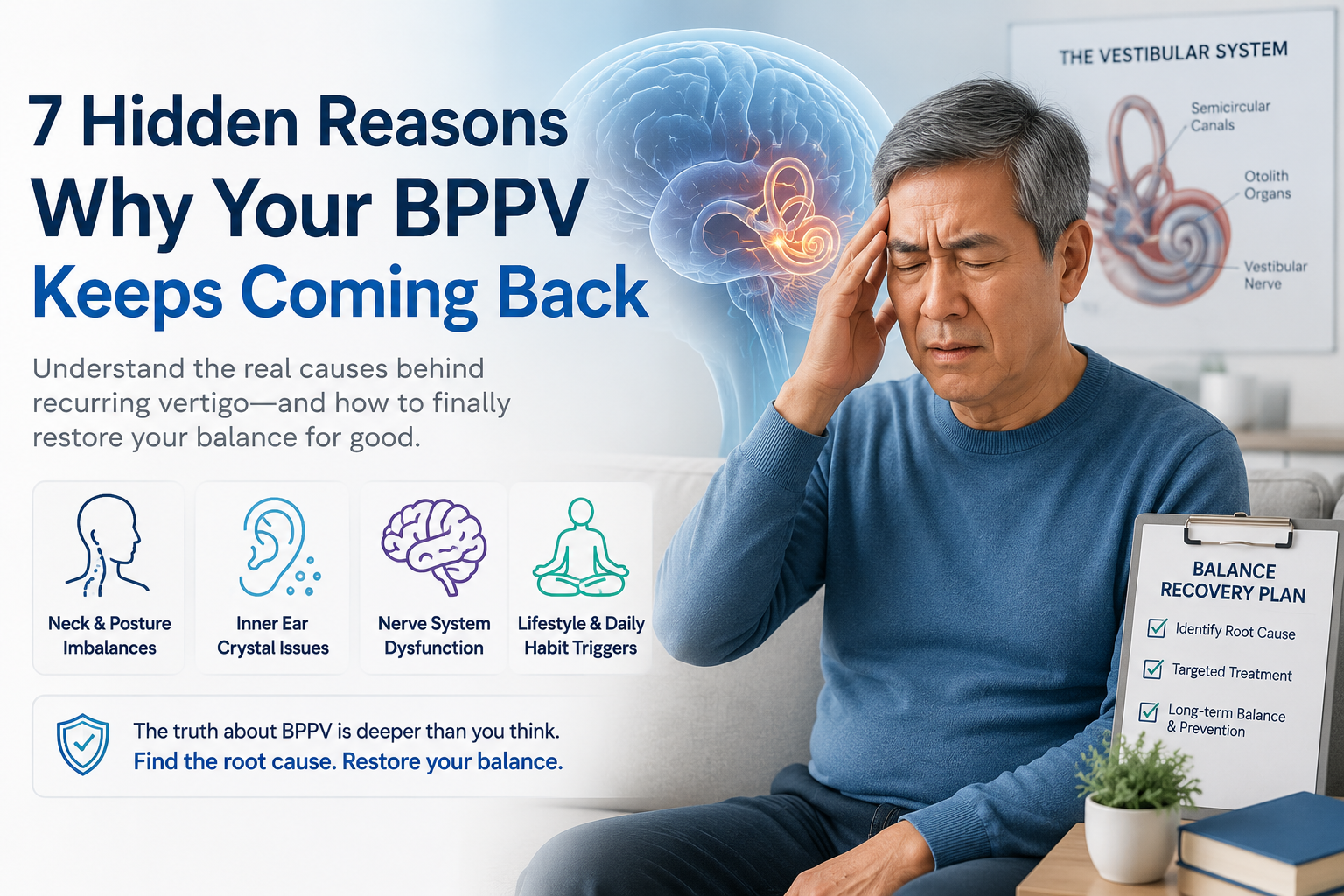
  • 7 Hidden Reasons Why Your BPPV Keeps Coming Back

    7 Hidden Reasons Why Your BPPV Keeps Coming Back

    For many struggling with BPPV (Benign Paroxysmal Positional Vertigo), the world often feels like an unstable place. You might have tried the Epley maneuver or vestibular suppressants, only to find the spinning sensation returning weeks or months later. This recurrence is not just bad luck; it is often a sign of a deeper systemic imbalance.

    ​As a director with 12 years of clinical experience in Body Alignment and Unconscious Nerve Management, I have found that chronic vertigo is rarely just an isolated “inner ear problem.” It is a manifestation of a “hardware” misalignment and a “software” error in your nervous system.

    1. The Hardware: Why Your Neck Controls **BPPV** Balance

    ​7 Reasons Why Your BPPV Keeps Coming Back & How to Fix It
    Precision realignment of the upper cervical spine (C1-C2) to stabilize the vestibular system.

    ​Your vestibular system doesn’t work in a vacuum. It relies on Cervical Alignment, specifically the C1 and C2 vertebrae.

    When your posture is misaligned—due to “Tech Neck” or accumulated stress—it creates tension in the deep neck muscles. This tension restricts micro-circulation to the inner ear and sends conflicting signals to the brain. If the physical “hardware” of your neck is tilted, the balance sensors in your ear will eventually fail.

    ​[The Anatomy of Equilibrium]

    ​The human vestibular system is housed within the temporal bone of the skull. This delicate architecture relies on precise pressure levels and fluid dynamics. When your cervical spine is misaligned, it creates abnormal tension in the surrounding soft tissues, potentially interfering with the neurological signals sent to the brain. By focusing on Body Alignment, we address the root mechanical cause of BPPV, rather than just treating the temporary symptoms of dizziness.

    2. The Software: Stabilizing **BPPV** through the Nerve System

    ​The Autonomic (Unconscious) Nervous System is the software that keeps you upright without conscious effort.

    Anatomy of the inner ear and vestibular nerve distribution for BPPV recovery
    Anatomy of the inner ear and vestibular nerve distribution for BPPV recovery

    Chronic physical misalignment keeps your nervous system in a state of “High Alert” (Sympathetic dominance). In this state, your brain loses its ability to filter out minor balance errors. This is why many patients feel “heavy-headed” or “spaced out” even after the ear crystals are back in place.

    3. Essential **BPPV** Prevention: Daily Habits for Vertigo

    • Hydration: The fluid in your inner ear is sensitive to hydration levels. Ensure consistent water intake.
    • Anti-Inflammatory Sleep Posture: Avoid sleeping on your stomach, which twists the upper neck. Use a supportive pillow that maintains the natural curve of your neck.
    • Digital Detox: Overusing smartphones fatigues the visual system, forcing the vestibular system to work twice as hard.

    ​Home Rehabilitation: 3 Steps to Reclaim Your Balance

    1. The Ocular-Cervical Reset: Keep your head still. Move only your eyes to the far right for 30 seconds, then to the far left for 30 seconds. This resets the nerves connected to your balance centers.
    2. VOR Training: Focus on your thumbnail while slowly shaking your head “No.” This retrains your brain to maintain stability during motion.
    3. Proprioceptive Grounding: Stand barefoot and focus on the weight distribution on your feet. Grounding tells your brain the foundation is safe, allowing neck muscles to relax.

    ​True recovery isn’t just about fixing the ear; it’s about realigning the body and calming the unconscious nerves. When your structural balance is restored, your nervous system can finally return to equilibrium.

    ​[Frequently Asked Questions About BPPV]

    Q: https://en.wikipedia.org/wiki/Benign_paroxysmal_positional_vertigoCan stress trigger BPPV?

    A: Stress keeps your Unconscious Nerve System on high alert, lowering your threshold for dizziness.

    Q: Why does Tech Neck make it worse?

    A: Cervical misalignment from smartphones restricts blood flow to your vestibular system, making BPPV recurrence more likely.

    Q: How long does recovery take?

    A: Most patients see significant improvement in 4 to 6 weeks through consistent Body Alignment and neural stabilization.

    ​[Closing Thoughts]

    ​True recovery is a System Restoration. By realigning your hardware and calming your software, you can finally step off the merry-go-round of BPPV. At Haim Body Balance Center, we are here to help you find your center again.

    [Healing Music for Nerve Stabilization] https://youtu.be/Qb5hAzuCOB4?si=yNbJdOM6tNkUmkBKClick here to listen