Table of Contents
The hidden link between foot tension, nervous system “protection mode,” and recovery that never quite feels complete.
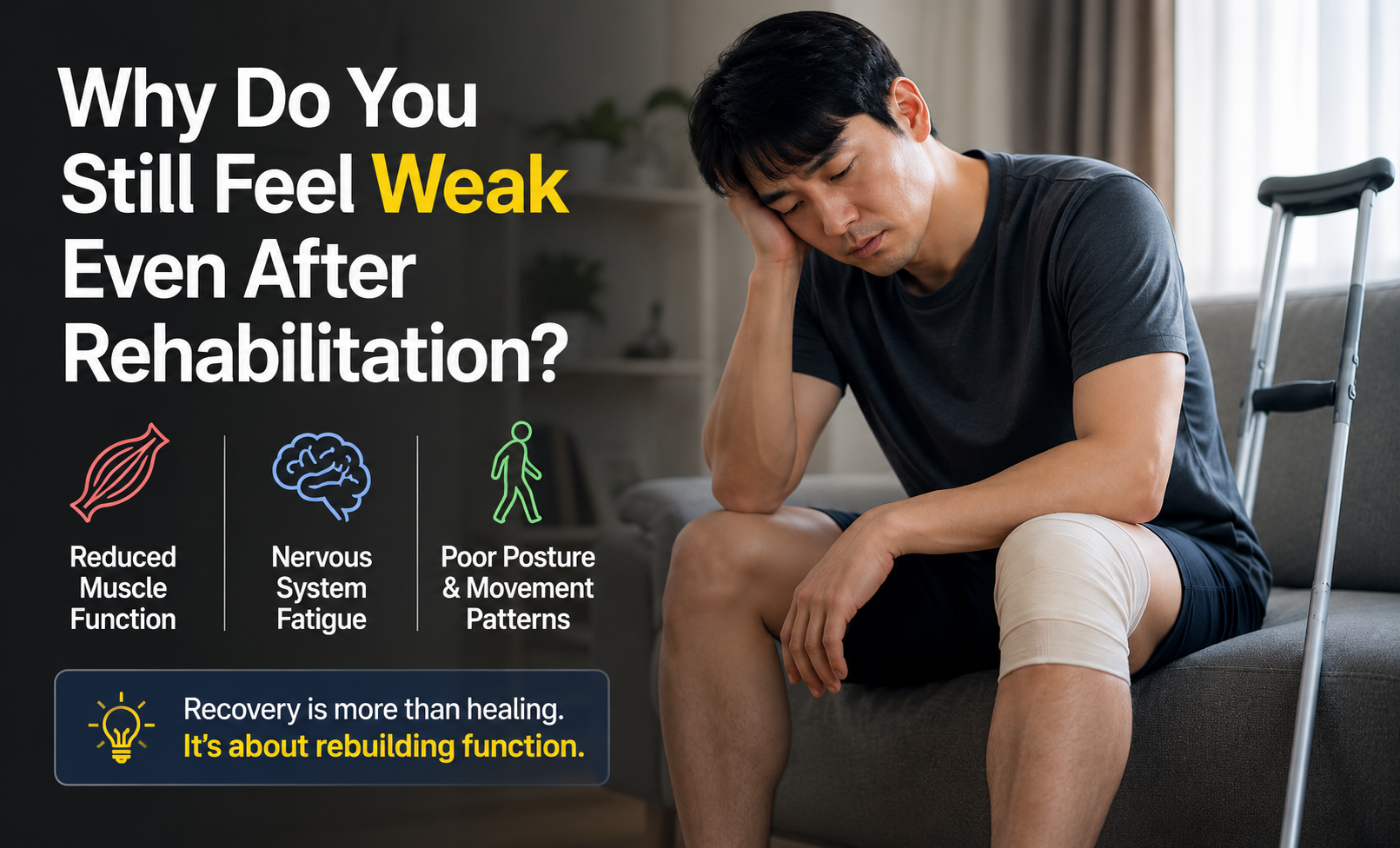
There is a moment many people reach after long rehabilitation — when the doctors say the hard part is over, when the charts show improvement, and when you are officially “recovered.”
And yet, something still doesn’t feel right.
Your legs tire too quickly. Your balance never feels quite trustworthy. Standing for too long feels like a negotiation. You reach for the wall, a cane, or a chair — not because you have to, but because your body quietly insists.
This is not a failure. This is not a weakness of character or a lack of effort.
This is what happens when the nervous system never fully received the message that the danger is gone.
A Client I Won’t Forget


Several months ago, a client came to our center with a story that stayed with me.
Years earlier, he had survived a thoracic aortic rupture — one of the most serious cardiovascular emergencies a person can endure. After emergency surgery and intensive care, he spent years in structured rehabilitation at a major university hospital.
Related Post: [How Aortic Rupture Recovery Improved]
By any objective measure, he had achieved something remarkable: he could walk again.
But he walked with two canes. His lower body fatigued within minutes. His balance never felt stable. Beneath the surface, his calves, ankles, and the soles of his feet held a kind of chronic tension — dense, accumulated, and guarded — that no amount of strengthening exercise had been able to reach.
1. When the Body Stays in “Protection Mode”
What struck me was not how far he still had to go, but how much his body was still working — holding itself together through sheer effort rather than natural ease.
After major trauma, surgery, or prolonged physical stress, the nervous system does something intelligent: it enters Protection Mode.
It braces. It guards. It keeps the muscles slightly activated and the posture stiffened. This is survival. This is the nervous system doing exactly what it was designed to do.
The problem is that the nervous system doesn’t always receive the signal to stop.
Even after formal rehabilitation ends, the body can continue running on that same protective setting. Not because something is wrong with the person, but because the nervous system is still waiting for confirmation that the threat has passed.
This shows up in ways that are often misread:
- Chronic Calf Stiffness: Regardless of how much you stretch.
- Ankle Restriction: Joints that feel slow or “locked.”
- Effortful Movement: Walking feels like a conscious task rather than a reflex.
- Low Balance Confidence: Especially on uneven surfaces.
- Disconnection: A general sense of heaviness or “numbness” in the lower body.
Most people assume this is purely muscular — that they just need more strength. While strength matters, it cannot switch off a nervous system that is quietly convinced the body is still in danger.
The Missing Piece of Recovery: The Soles of Your Feet
Here is something that often surprises people: The soles of your feet are among your body’s most vital sensory organs.
Every time you stand or walk, your feet send a continuous stream of data upward to your brain. This information tells your nervous system whether the ground is trustworthy, whether the body is balanced, and — most importantly — whether movement is safe.
When feet and ankles become chronically tense due to injury or compensation, this sensory signal becomes distorted. The brain receives feedback that says: Unstable. Uncertain. Not safe yet.
In response, the nervous system does what it always does when it perceives instability: it protects. It tightens the calves, stiffens the hips, and increases guarding throughout the body.
The result is a cycle that can persist for years:
Foot Tension → Distorted Sensory Signal → Nervous System Guarding → Fatigue & Instability → More Foot Tension.
Beyond Strength: Restoring the Sense of Safety
Rehabilitation programs are extraordinarily effective at restoring movement and rebuilding strength. But there is a dimension of recovery that often goes unaddressed: the body’s sense of safety.
True physical ease — where movement feels natural and balance feels trustworthy — depends on the nervous system feeling settled, not just the muscles feeling strong.
At our center, we focus on this transition: from a body that is “managing” to a body that feels “safe.”
Our approach involves:
- Releasing deep-seated tension in the calves, ankles, and soles.
- Restoring sensory clarity so the feet can send accurate signals to the brain.
- Supporting circulation to aid tissue recovery and neurological health.
- Calming the nervous system to shift it out of chronic protective patterns.
The goal is never to force the body. The goal is to help it feel grounded enough to move naturally again.
”My Body Notices Immediately”
One thing my client said has stayed with me. After several months of consistent care, he told me: “Now my body notices immediately when I skip a session.”
He didn’t say it with fear, but with awareness. It is the kind of awareness that comes when the body finally remembers what it feels like to move without guarding.
That quality of awareness is the true marker of deeper recovery. It means the body is no longer simply enduring; it is participating.
Signs Your Body is Still “On Alert”
You may recognize this in your own experience — not necessarily after major trauma, but after any period of physical stress or illness:
- You feel like you have to “think” about your balance.
- Your legs feel heavy or disconnected.
- You tire easily during simple standing or walking.
- Stretching provides only temporary relief from stiffness.
True recovery and physical balance require specialized focus even after your formal **rehabilitation** is complete.
Sometimes the most useful question isn’t “What is still weak?” but rather, “What is my body still trying to protect?”
Haim Body Balance Center — Yangsan, Korea
“Haim Body Balance Center offers a new perspective on rehabilitation.”
Foot-centered balance support and nervous system relaxation care.
Specializing in chronic tension, post-rehab recovery, and long-term body alignment.
Our goal is to provide a **rehabilitation** experience that focuses on both physical alignment and nervous system stability.
Haim Body Balance Center is your partner in successful **rehabilitation**
Leave a Reply