Tag: uneven shoulders

  • How to Fix Shoulder Imbalance in Teens: 4 Proven Steps

    How to Fix Shoulder Imbalance in Teens: 4 Proven Steps

    Do you ever glance in the mirror and notice one shoulder sitting higher than the other? You might dismiss it as nothing. But shoulder imbalance in teens is one of the most overlooked signs of long-term postural stress — and it is becoming increasingly common in teenagers and young adults.

    Many wellness professionals see this pattern daily. People who seek help for neck pain or back tension often share one thing in common: uneven shoulder height. And in many cases, their habits — not their age — are the root cause.

    This is how shoulder imbalance
    in teens begins unnoticed.

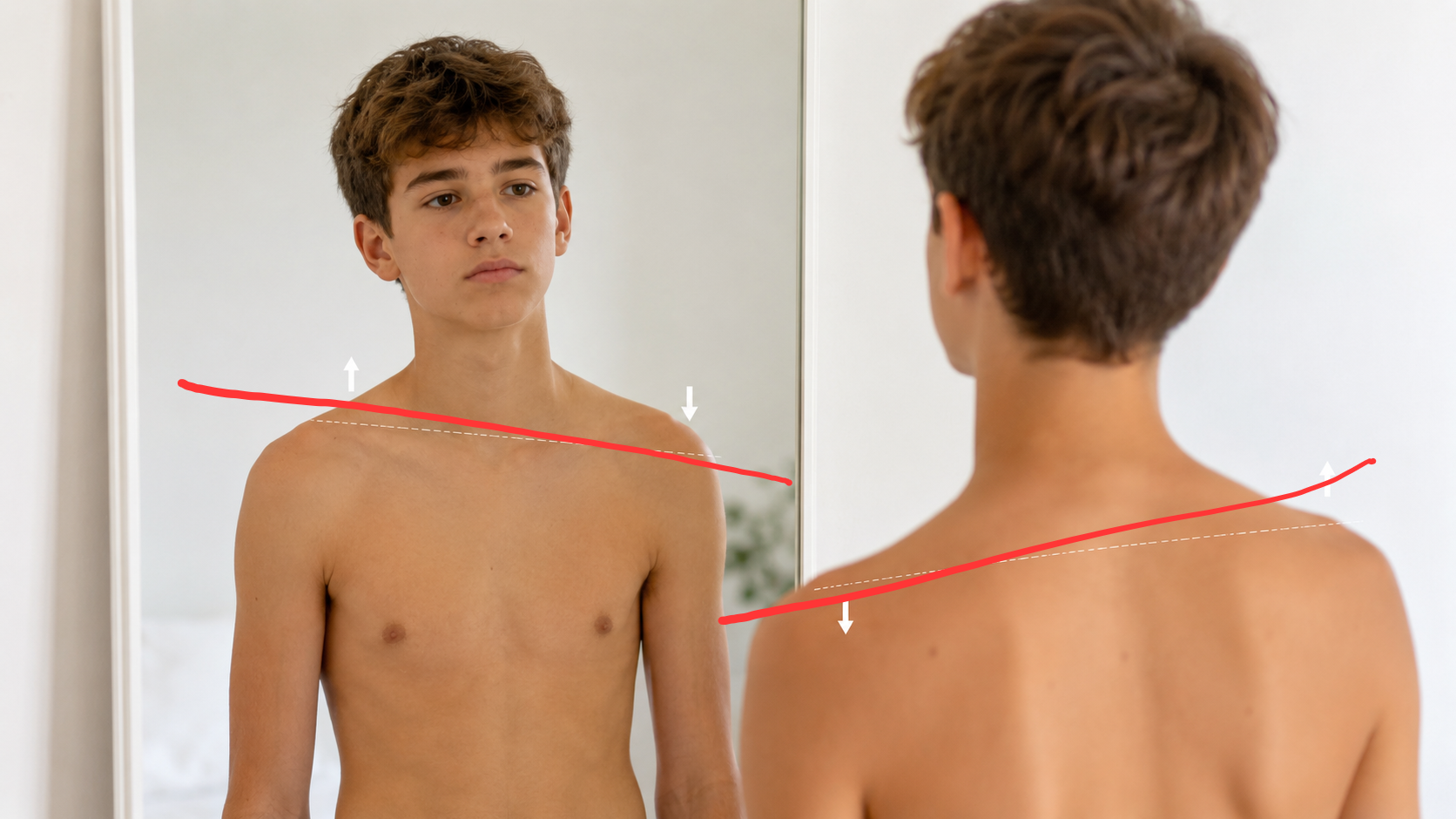
    shoulder imbalance in teens shown in mirror reflection with school uniform
    Shoulder imbalance in teens is often first noticed in a mirror — one side clearly higher than the other

    What Causes Shoulder Imbalance in Teens?

    Imagine a 17-year-old student — let’s call him Minjun. He spends over six hours a day looking at his phone, hunches over a laptop during class, and sits cross-legged on his bed while gaming at night.

    One day, his mother points it out: “Why is one of your shoulders higher than the other?”

    Minjun looks in the mirror. His right shoulder is clearly elevated. His response?

    “I’ve always been like this.”

    Shoulder imbalance in teens often
    develops silently, driven by everyday
    habits that nobody thinks twice about.

    That phrase — “I’ve always been like this” — is exactly how shoulder imbalance becomes permanent. Not overnight. But through hundreds of small, repeated movements that slowly retrain muscle memory.

    What Is Shoulder Imbalance in teens?

    Shoulder imbalance in teens occurs when one shoulder sits noticeably higher, more forward, or more internally rotated than the other. It may appear subtle at first — only visible in photographs or when someone else points it out.

    Over time, this imbalance places uneven load across the cervical spine, thoracic muscles, and shoulder girdle. The body compensates — and those compensations create tension, stiffness, and eventually pain.

    According to the National Institutes of Health (NIH), poor posture and prolonged static positions are primary contributors to musculoskeletal imbalance — especially in adolescents with high screen time.

    How 3 Common Habits Create Shoulder Imbalance

    Habit 1 — Looking Down at a Smartphone for Hours

    When you tilt your head just 15 degrees forward, the effective weight on your cervical spine increases to approximately 12 kilograms. At 60 degrees — a common angle for phone users — that load reaches 27 kilograms.

    The muscles that absorb this load — particularly the levator scapulae and upper trapezius — are forced to work constantly. If you hold the phone primarily in your right hand,shoulder your right side works harder. Over weeks and months, that side begins to tighten and elevate.

    The result: shoulder imbalance that looks like “a naturally higher shoulder” — but is actually a trained postural pattern.

    Early detection of shoulder imbalance
    in teens leads to faster recovery.

    Habit 2 — Carrying Bags on the Same Side Every Day

    Backpacks slung over one shoulder, heavy school bags, or gym totes carried daily on the same side create a chronic asymmetry. The shoulder-elevating muscles on the carrying side are in constant contraction, while the opposite side remains underused.

    This pattern is especially pronounced in students who carry heavy textbooks or equipment. The brain adapts by treating the elevated shoulder position as “normal” — which makes the imbalance progressively harder to correct without conscious effort.

    Stretching is essential for teens
    with shoulder imbalance in teens.

    shoulder imbalance in teens caused by bad posture habits
    shoulder imbalance in teens caused by bad posture habits

    Habit 3 — Sitting With the Same Leg Crossed or Body Tilted

    Sitting with one leg crossed over the other, or consistently leaning toward one side at a desk, shifts the pelvis and rotates the lumbar spine. The upper body compensates by adjusting the shoulder girdle — and one shoulder quietly rises to maintain balance.

    This connection between pelvic tilt and shoulder imbalance is why lower body posture habits directly affect upper body alignment. The body is one connected system.

    Over time, this worsens shoulder
    imbalance in teens significantly.

    Strengthening helps correct shoulder
    imbalance in teens over time.

    The Two Muscles Most Involved in Shoulder Imbalance

    Understanding which muscles drive shoulder imbalance helps explain why the problem persists even when people try to “stand up straight.”

    • Levator Scapulae: This muscle runs from the cervical spine (C1–C4) to the upper inner corner of the shoulder blade. Its primary job is to elevate the scapula. When chronically tight, it pulls the shoulder blade upward — creating visible shoulder height asymmetry.
    • Upper Trapezius: This broad muscle supports the neck and assists shoulder elevation. Emotional stress, prolonged forward-head posture, and shallow breathing all cause the upper trapezius to chronically contract — often on one side more than the other.

    For a deeper look at how these muscles interact with spinal alignment, the Spine-Health resource on trapezius muscle function provides a clear anatomical overview.

    Your Body Is Like a Car With Misaligned Wheels

    Imagine a car with wheels slightly out of alignment. It still drives — but one tire wears down far faster than the others. Eventually, the vehicle pulls to one side, the steering feels off, and the driver wonders why the car “just doesn’t feel right.”

    The human body with shoulder imbalance works the same way. Certain muscles are overworked while others become underactivated. Over time, this leads to:

    • Persistent neck tension and stiffness
    • Tension headaches, especially at the base of the skull
    • Reduced shoulder and arm range of motion
    • Upper back fatigue and general heaviness
    • Disrupted sleep due to discomfort

    How to Support Better Shoulder Balance Daily

    Correcting shoulder imbalance does not require dramatic intervention. Consistency with small habits creates meaningful change over time.

    • Raise your phone to eye level. A simple adjustment that immediately reduces cervical spine load.
    • Alternate bag shoulders daily. Prevents one-sided muscle dominance from developing.
    • Practice diaphragmatic breathing. Deep belly breathing reduces upper trapezius overactivation.
    • Perform gentle neck rolls and shoulder blade squeezes. 5 minutes before bed can release built-up tension.
    • Become aware of sitting asymmetry. Notice which leg you cross, which side you lean toward.
    • Take movement breaks every 45–60 minutes. Static positions are the primary driver of postural imbalance.

    Final Thought: The Body Whispers Before It Shouts

    Shoulder imbalance rarely announces itself with dramatic pain at first. It begins as a quiet, gradual shift — and that is exactly what makes it easy to ignore.

    But the body is always communicating. An elevated shoulder is a message. Neck tightness is a message. The key is learning to listen before the whisper becomes a shout.

    If you have noticed uneven shoulder height or persistent upper body tension, a professional assessment can help identify the root cause and create a path toward better balance and comfort.

    Sometimes the body whispers before it starts to shout. Are you listening?

    Many parents ask how to prevent
    shoulder imbalance in teens before
    it becomes a serious problem.

    If you suspect shoulder imbalance
    in teens, act early for best results.
  • ​How to Fix Uneven Shoulders Body Balance After Surgery

    ​How to Fix Uneven Shoulders Body Balance After Surgery

    Many people struggle with an uneven shoulders body, often overlooking that this can be a sign of deeper structural imbalance.

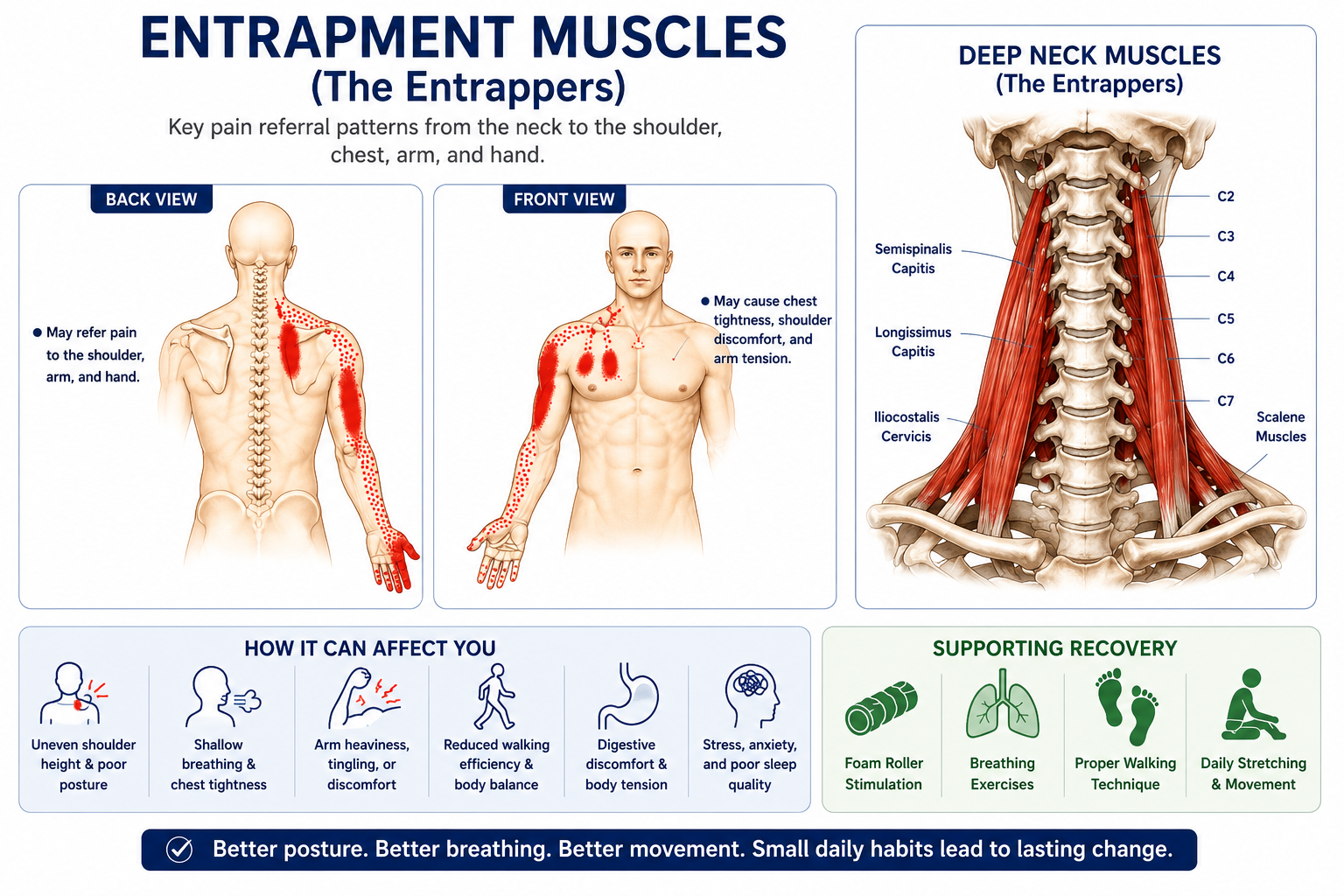
    If you are struggling with uneven shoulders body balance after surgery, you are not alone. It is a common pattern seen in clinical practice — and it is more connected to breathing, digestion, and daily movement than most people realize.

    Imagine this: the surgery goes well. The doctor is pleased. Your family is relieved. But a few weeks later, something still feels wrong. Your body feels tight. Breathing is shallow. You get tired just walking to the kitchen. And your right shoulder sits noticeably higher than your left.

    This is exactly what one client experienced — and it is far more common than most people expect.

    Why Uneven Shoulders Body Balance Affects More Than Your Posture

    uneven shoulders body balance posture comparison
    Small daily movements, like gentle foam rolling, are the key to releasing tension and supporting a healthy posture.”

    Most people treat shoulder imbalance as a local problem — something to stretch or massage. But the body works as a system, not in isolated parts.

    When one shoulder stays elevated for a long time, the surrounding muscles adapt. They shorten on one side and overstretch on the other. This tension then pulls on the chest wall, restricts the ribcage, and makes deep breathing difficult.

    Here is where it gets important: when breathing becomes shallow, the nervous system interprets this as a low-level threat. The body shifts into a protective state — muscles tighten, digestion slows, and energy drops. The body is essentially bracing, even when you are just sitting on the couch.

    Signs your body may be stuck in this pattern:

    • Visible difference in shoulder height
    • Shallow breathing that never feels satisfying
    • Persistent digestive discomfort or bloating
    • General body stiffness that does not improve with stretching
    • Difficulty walking with a smooth, balanced gait
    • Low energy even after rest

    A Real Recovery Story: Uneven Shoulders, Poor Breathing, and Knee Surgery

    shoulders body requires more than just stretching; it requires a holistic approach to body alignment

    This client had already undergone surgery on both knees but continued to experience discomfort. During movement assessment, several patterns appeared together: elevated right shoulder, tight chest and hip muscles, restricted breathing, stiff walking, and ongoing digestive discomfort.

    Rather than isolating the knees as the only problem, attention shifted to the whole body — how different regions were influencing each other, and what daily habits were keeping the body stuck in tension.

    This whole-body approach to uneven shoulders body balance — looking at how different regions influence each other — is often what makes the difference between temporary relief and lasting recovery.

    How to Improve Uneven Shoulders Body Balance at Home

    When you ignore an uneven shoulders body, it can eventually lead to chronic neck and back pain. For more detailed information on posture correction, please check out my other post on

    uneven shoulders body balance home rehabilitation foam roller
    Small daily movements, like gentle foam rolling, are the key to releasing tension and supporting a healthy posture.”

    Recovery does not require complex equipment or intense effort. Three simple daily practices made a real difference for this client.

    1. Gentle Foam Roller Stimulation

    Let this peaceful melody guide your nervous system into a state of relaxation. Soften your body and mind with the calming frequencies of ‘The Shepherd Never Leaves’.

    The goal is not to force tight muscles to release. Instead, gentle foam roller work helps the nervous system receive more accurate feedback from the body. When the brain gets clearer signals about where the body is in space, muscles can soften on their own — a more sustainable approach than aggressive stretching.

    2. Breathing Practice for Nervous System Reset

    Take a slow, relaxed inhalation. Pause briefly at the top. Then exhale slowly and completely. Do not force it.

    This simple practice signals safety to the nervous system. Over time, it helps shift the body out of its chronic protective state. Many clients also notice improved digestion — not a coincidence. The vagus nerve, which runs from the brainstem through the chest into the abdomen, is directly linked to breathing rhythm.

    3. Balanced Walking Habits

    Walking is one of the most underrated rehabilitation tools available. Small daily adjustments build new movement patterns over time:

    • Keep your gaze forward, not down — this naturally lifts the chest
    • Consciously relax your shoulders away from your ears
    • Pay equal attention to both feet with every step
    • Focus on consistency rather than speed or distance

    What Changed After Several Weeks of Consistent Practice

    Recovery rarely arrives in one dramatic moment. It comes quietly — in small improvements that are easy to miss until you look back.

    After several weeks of these daily practices, this client reported more level shoulders, easier breathing, improved walking comfort, reduced digestive discomfort, and less background tension throughout the day.

    None of it required anything dramatic. It came from small efforts, done consistently, with a clear understanding of why they mattered.

    Addressing uneven shoulders body balance through daily movement awareness — not just targeting the area that hurts — is often what makes the difference between temporary relief and lasting recovery.

    Final Thoughts

    https://www.healthline.com/health/posture

    Your body gives small signals long before larger problems appear. Tightness, shallow breathing, uneven posture, and post-surgical stiffness are not random. They are messages worth listening to.

    If these patterns feel familiar, consider looking not just at the area that hurts — but at the whole picture. Simple, consistent daily care is often more powerful than occasional intensive treatment.

    If you recognize these patterns in your own body, consider consulting a body balance or rehabilitation specialist who looks beyond the area that hurts — and at the whole picture.

    https://soletobody.com/postural-compensation-back-pain-relief/If you are ready to correct your uneven shoulders body, start by incorporating these simple daily routines into your life. You can find more tips on body balance and breathing techniques in my guide