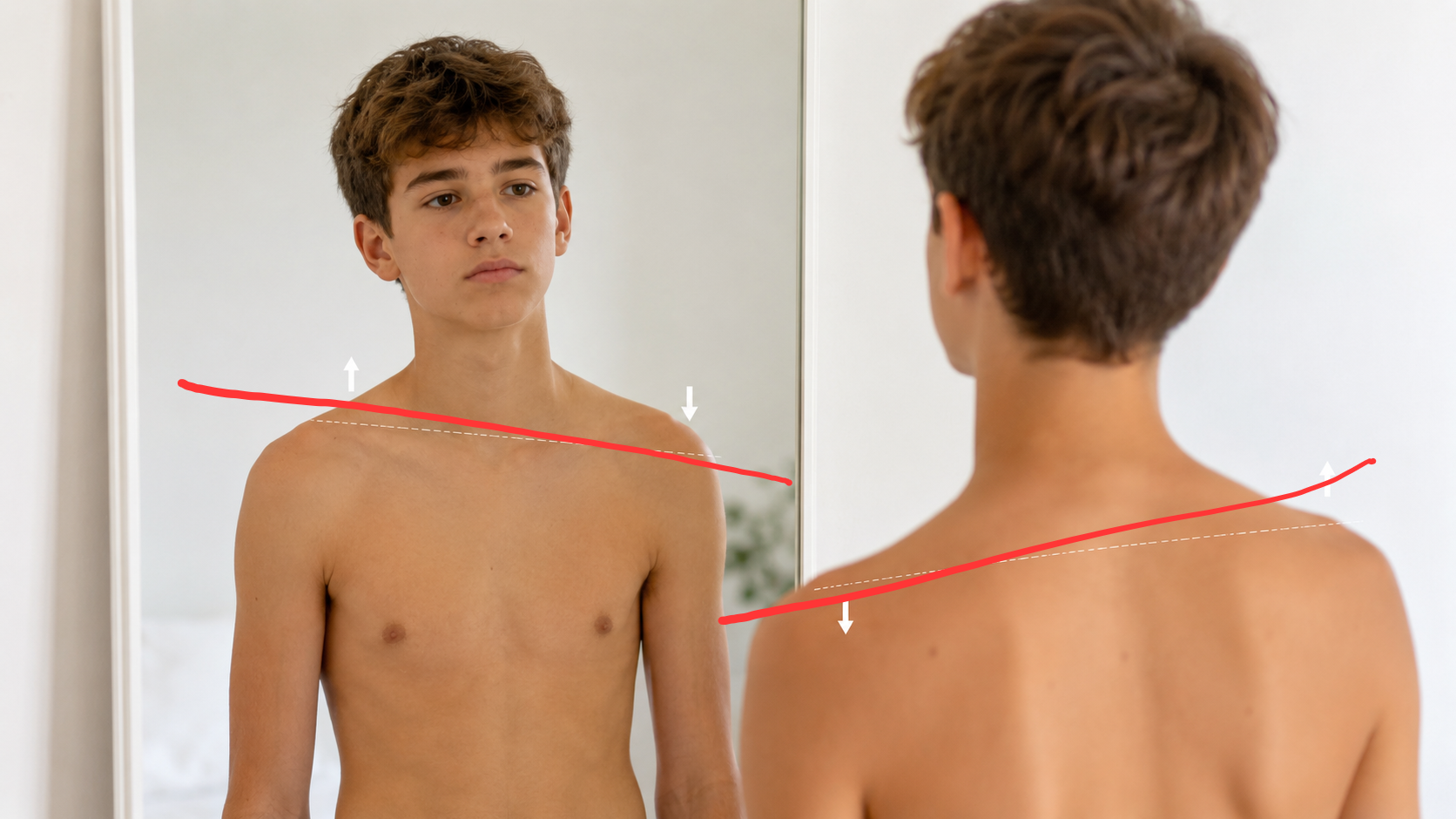
Do you ever glance in the mirror and notice one shoulder sitting higher than the other? You might dismiss it as nothing. But shoulder imbalance in teens is one of the most overlooked signs of long-term postural stress — and it is becoming increasingly common in teenagers and young adults.
Many wellness professionals see this pattern daily. People who seek help for neck pain or back tension often share one thing in common: uneven shoulder height. And in many cases, their habits — not their age — are the root cause.
This is how shoulder imbalance
in teens begins unnoticed.

What Causes Shoulder Imbalance in Teens?
Imagine a 17-year-old student — let’s call him Minjun. He spends over six hours a day looking at his phone, hunches over a laptop during class, and sits cross-legged on his bed while gaming at night.
One day, his mother points it out: “Why is one of your shoulders higher than the other?”
Minjun looks in the mirror. His right shoulder is clearly elevated. His response?
“I’ve always been like this.”
Shoulder imbalance in teens often
develops silently, driven by everyday
habits that nobody thinks twice about.
That phrase — “I’ve always been like this” — is exactly how shoulder imbalance becomes permanent. Not overnight. But through hundreds of small, repeated movements that slowly retrain muscle memory.
What Is Shoulder Imbalance in teens?
Shoulder imbalance in teens occurs when one shoulder sits noticeably higher, more forward, or more internally rotated than the other. It may appear subtle at first — only visible in photographs or when someone else points it out.
Over time, this imbalance places uneven load across the cervical spine, thoracic muscles, and shoulder girdle. The body compensates — and those compensations create tension, stiffness, and eventually pain.
According to the National Institutes of Health (NIH), poor posture and prolonged static positions are primary contributors to musculoskeletal imbalance — especially in adolescents with high screen time.
How 3 Common Habits Create Shoulder Imbalance
Habit 1 — Looking Down at a Smartphone for Hours
When you tilt your head just 15 degrees forward, the effective weight on your cervical spine increases to approximately 12 kilograms. At 60 degrees — a common angle for phone users — that load reaches 27 kilograms.
The muscles that absorb this load — particularly the levator scapulae and upper trapezius — are forced to work constantly. If you hold the phone primarily in your right hand,shoulder your right side works harder. Over weeks and months, that side begins to tighten and elevate.
The result: shoulder imbalance that looks like “a naturally higher shoulder” — but is actually a trained postural pattern.
Early detection of shoulder imbalance
in teens leads to faster recovery.
Habit 2 — Carrying Bags on the Same Side Every Day
Backpacks slung over one shoulder, heavy school bags, or gym totes carried daily on the same side create a chronic asymmetry. The shoulder-elevating muscles on the carrying side are in constant contraction, while the opposite side remains underused.
This pattern is especially pronounced in students who carry heavy textbooks or equipment. The brain adapts by treating the elevated shoulder position as “normal” — which makes the imbalance progressively harder to correct without conscious effort.
Stretching is essential for teens
with shoulder imbalance in teens.

Habit 3 — Sitting With the Same Leg Crossed or Body Tilted
Sitting with one leg crossed over the other, or consistently leaning toward one side at a desk, shifts the pelvis and rotates the lumbar spine. The upper body compensates by adjusting the shoulder girdle — and one shoulder quietly rises to maintain balance.
This connection between pelvic tilt and shoulder imbalance is why lower body posture habits directly affect upper body alignment. The body is one connected system.
Over time, this worsens shoulder
imbalance in teens significantly.
Strengthening helps correct shoulder
imbalance in teens over time.
The Two Muscles Most Involved in Shoulder Imbalance
Understanding which muscles drive shoulder imbalance helps explain why the problem persists even when people try to “stand up straight.”
- Levator Scapulae: This muscle runs from the cervical spine (C1–C4) to the upper inner corner of the shoulder blade. Its primary job is to elevate the scapula. When chronically tight, it pulls the shoulder blade upward — creating visible shoulder height asymmetry.
- Upper Trapezius: This broad muscle supports the neck and assists shoulder elevation. Emotional stress, prolonged forward-head posture, and shallow breathing all cause the upper trapezius to chronically contract — often on one side more than the other.
For a deeper look at how these muscles interact with spinal alignment, the Spine-Health resource on trapezius muscle function provides a clear anatomical overview.
Your Body Is Like a Car With Misaligned Wheels
Imagine a car with wheels slightly out of alignment. It still drives — but one tire wears down far faster than the others. Eventually, the vehicle pulls to one side, the steering feels off, and the driver wonders why the car “just doesn’t feel right.”
The human body with shoulder imbalance works the same way. Certain muscles are overworked while others become underactivated. Over time, this leads to:
- Persistent neck tension and stiffness
- Tension headaches, especially at the base of the skull
- Reduced shoulder and arm range of motion
- Upper back fatigue and general heaviness
- Disrupted sleep due to discomfort
How to Support Better Shoulder Balance Daily
Correcting shoulder imbalance does not require dramatic intervention. Consistency with small habits creates meaningful change over time.
- Raise your phone to eye level. A simple adjustment that immediately reduces cervical spine load.
- Alternate bag shoulders daily. Prevents one-sided muscle dominance from developing.
- Practice diaphragmatic breathing. Deep belly breathing reduces upper trapezius overactivation.
- Perform gentle neck rolls and shoulder blade squeezes. 5 minutes before bed can release built-up tension.
- Become aware of sitting asymmetry. Notice which leg you cross, which side you lean toward.
- Take movement breaks every 45–60 minutes. Static positions are the primary driver of postural imbalance.
Final Thought: The Body Whispers Before It Shouts
Shoulder imbalance rarely announces itself with dramatic pain at first. It begins as a quiet, gradual shift — and that is exactly what makes it easy to ignore.
But the body is always communicating. An elevated shoulder is a message. Neck tightness is a message. The key is learning to listen before the whisper becomes a shout.
If you have noticed uneven shoulder height or persistent upper body tension, a professional assessment can help identify the root cause and create a path toward better balance and comfort.
Sometimes the body whispers before it starts to shout. Are you listening?
Many parents ask how to prevent
shoulder imbalance in teens before
it becomes a serious problem.
If you suspect shoulder imbalance
in teens, act early for best results.
Leave a Reply