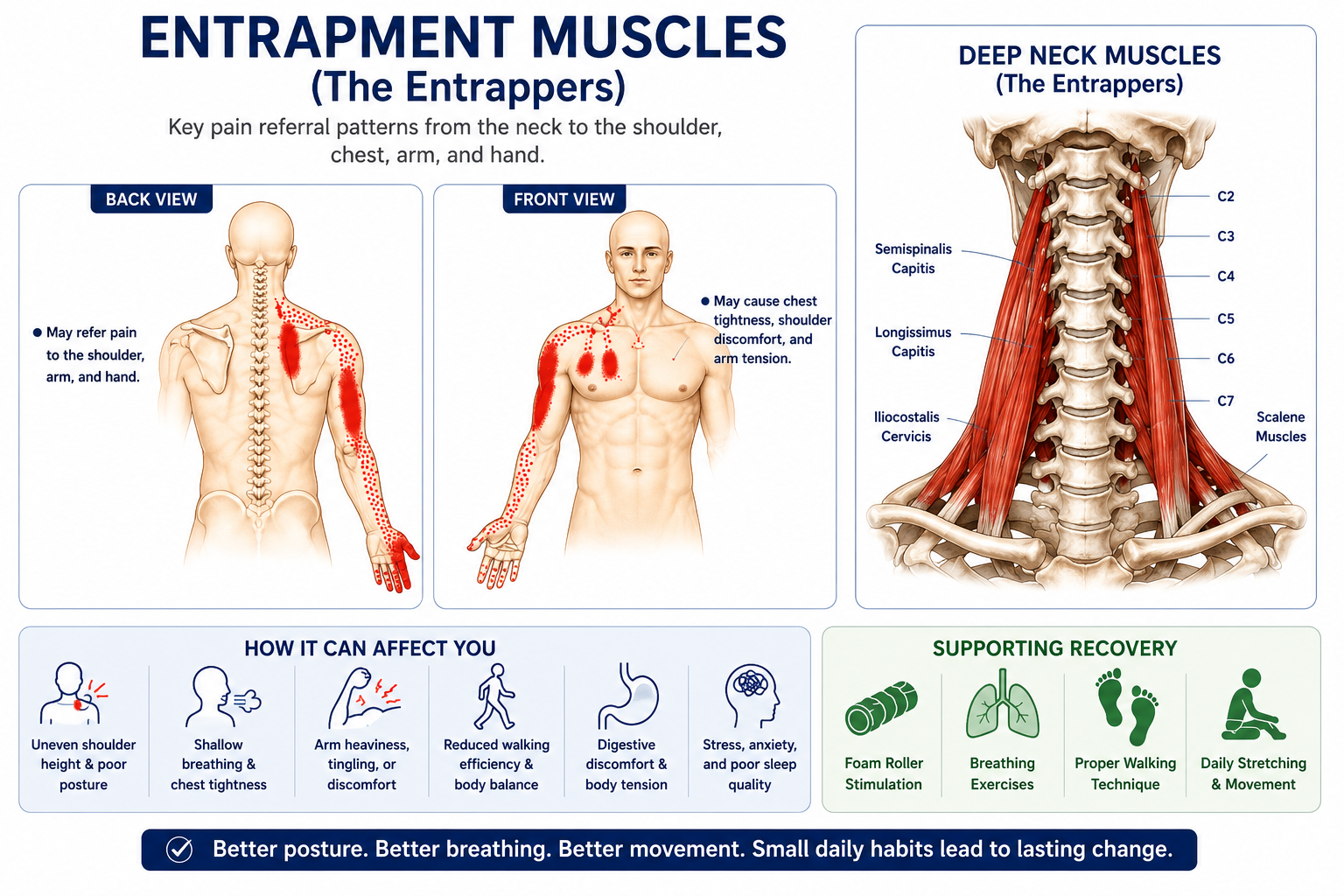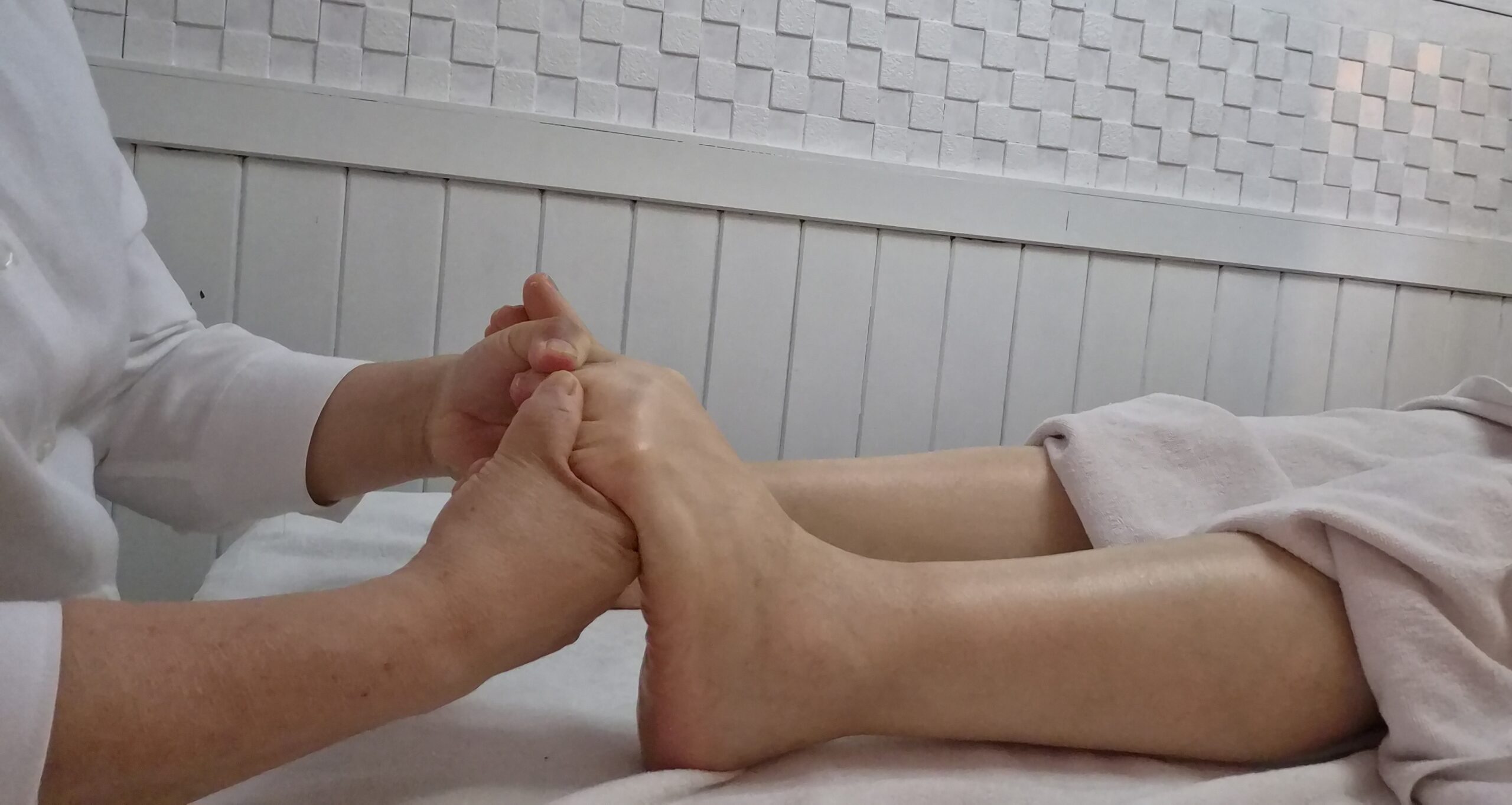
Tag: body balance

  • Why Do Your Legs Give Out Without Warning? 7 Causes

    Why Do Your Legs Give Out Without Warning? 7 Causes

    Have you ever been walking normally — then suddenly your legs give out without warning? It’s terrifying, and you’re not alone. Millions of people experience this frightening symptom every year, yet most never find out why it happens.

    In this guide, you’ll discover the 7 most common reasons your legs suddenly give way, what your nervous system is trying to tell you, and what you can do right now to protect yourself.

    What Does It Mean When Your Legs Give Out Without Warning?

    When your legs give out without warning, it usually means one thing: your muscles are not receiving the proper nerve signals they need to hold your body upright. This is not always a sign of a serious disease — but it is always a sign that something in your nervous system or musculoskeletal system needs attention.

    The medical term for this is sudden lower extremity weakness. It can happen while standing, walking, climbing stairs, or even just shifting your weight. The key word is without warning — there’s no pain, no dizziness beforehand. Your leg simply buckles.

    7 Reasons Your Legs Give Out Without Warning

    1. Compressed Spinal Nerves (Radiculopathy)

    compressed spinal nerve vs healthy nerve causing legs to give out without warning
    Spinal nerve compression is one of the leading causes of legs giving out without warning — proper alignment restores healthy nerve function

    One of the most common causes of legs giving out without warning is nerve compression in the lower spine. When a disc bulges or a vertebra shifts, it presses on the nerves that control your leg muscles. The result? Sudden, unpredictable leg weakness.

    Signs this is your cause:

    • Weakness happens more on one side
    • You may also feel tingling or numbness
    • Sitting for long periods makes it worse

    2. Unconscious Nerve Tension (The Hidden Cause Most Doctors Miss)

    Your body holds chronic tension in the nervous system — often without you realizing it. This is what specialists in body balance and nerve management call unconscious nerve tension.

    When your nervous system is constantly in a guarded, tight state, it begins to misfire signals to your leg muscles. The muscles don’t fail because they’re weak — they fail because the nerve commands are being disrupted before they even reach the leg.

    This is why many people with legs that give out without warning have completely normal MRI results. The problem isn’t structural — it’s functional nerve signal disruption.

    Watch how KSNS (unconscious nerve management) technique releases nerve tension that causes legs to give out without warning

    3. Hip and Pelvic Imbalance

    When your pelvis is tilted or rotated — even slightly — the muscles on one side of your body work much harder than the other. Over time, the overworked muscles become fatigued and simply give out under normal loads.

    Signs this is your cause:

    • One leg feels stronger than the other
    • You tend to lean to one side when standing
    • Lower back ache is common

    4. Foot Arch Collapse and Ankle Instability

    foot arch collapse vs normal arch illustration showing how flat feet cause leg weakness and instability
    Foot arch collapse disrupts body alignment and can cause your legs to give out without warning

    Your feet are the foundation of your entire body. When the arches collapse or the ankle rolls inward, the alignment chain from foot to knee to hip to spine is disrupted. This sends incorrect feedback signals up to your brain, which can cause sudden muscle inhibition — meaning your leg muscles temporarily “switch off.”

    This is especially common in people who stand for long hours or wear unsupportive footwear.

    5. Peripheral Neuropathy

    Peripheral neuropathy is damage to the nerves outside the brain and spinal cord. It’s common in people with diabetes, vitamin B12 deficiency, or chronic alcohol use. When these peripheral nerves are damaged, the signals between your brain and your leg muscles become slow and unreliable — causing sudden buckling.

    Signs this is your cause:

    • Burning or “pins and needles” in the feet
    • Weakness that gets worse at night
    • You’ve been diagnosed with diabetes or pre-diabetes

    6. Transient Ischemic Attack (TIA) — Mini Stroke

    A TIA causes a temporary loss of blood flow to the brain. One of its symptoms can be sudden leg weakness or buckling. Unlike the other causes on this list, a TIA is a medical emergency.

    Go to the emergency room immediately if your legs give out AND you also have:

    • Sudden facial drooping
    • Arm weakness on one side
    • Slurred speech
    • Sudden severe headache

    7. Chronic Stress and the Nervous System Overload

    This surprises many people — but chronic psychological stress directly affects muscle function. When your body is under prolonged stress, the nervous system stays in a constant state of “fight or flight.” This floods your muscles with tension signals, and eventually the system becomes so overloaded that it shuts down temporarily — causing your legs to give out.

    Research shows that stress-related muscle weakness is one of the most underdiagnosed causes of unexplained leg buckling in otherwise healthy adults.

    When Should You Be Worried?

    Not every episode of legs giving out without warning is an emergency — but some are. Use this quick guide:

    SymptomWhat to Do
    Legs give out, no other symptomsSee a specialist within 1–2 weeks
    Legs give out + numbness/tinglingSee a doctor within 48 hours
    Legs give out + loss of bladder/bowel controlEmergency — go to ER now
    Legs give out + face drooping + slurred speechEmergency — call 911 now

    How to Stop Your Legs From Giving Out: A Body Balance Approach

    At Haim Body Balance Center, we’ve worked with hundreds of patients whose legs gave out without warning — and whose MRI results showed nothing abnormal. In most cases, the root cause was a combination of:

    • Spinal nerve compression from postural imbalance
    • Foot arch dysfunction sending wrong feedback signals
    • Unconscious nervous system tension disrupting muscle control

    Our approach focuses on restoring the body’s balance from the ground up — starting with the feet, correcting spinal alignment, and releasing chronic nerve tension so that your leg muscles receive clear, consistent signals from your brain.

    The result: legs that hold you steady — even on uneven ground, even after long hours of standing.

    Frequently Asked Questions

    Can stress really cause my legs to give out?

    Yes. Chronic nervous system overload is a well-documented cause of sudden muscle weakness. When the stress response stays activated too long, it can disrupt the normal nerve-to-muscle signaling pathway in your legs.

    Is it normal for legs to give out as you age?

    It becomes more common with age, but it is never “normal.” Leg buckling at any age is a sign that your nervous system or musculoskeletal alignment needs attention.

    Can flat feet cause my legs to give out?

    Yes. Collapsed arches alter the entire alignment chain from foot to spine, which can disrupt nerve signals and cause sudden leg weakness.

    How long does it take to fix legs that give out?

    It depends on the cause. Postural and nerve-related causes often improve within 4–8 weeks of proper treatment. Structural nerve damage may take longer.

    Conclusion

    When your legs give out without warning, your body is sending a clear message: something in your nerve-muscle communication system needs attention. Whether the cause is spinal compression, foot imbalance, nerve tension, or chronic stress — there is a root cause, and there is a solution.

    Don’t accept “there’s nothing wrong on your MRI” as a final answer. The nervous system is complex, and functional imbalances don’t always show up on imaging. A body balance specialist can help you find and fix the real cause.

    Many patients who experience legs give out without warning find that the root cause is a combination of nerve tension and structural imbalance — not muscle weakness alone.

    If your legs give out without warning repeatedly, keeping a symptom diary can help your specialist identify patterns and triggers more quickly.

    The good news is that most people whose legs give out without warning respond well to a structured body balance and nerve rehabilitation program within 6 to 8 weeks.

    Have questions about your specific situation? Leave a comment below or contact Haim Body Balance Center for a consultation.
  • How to Fix Shoulder Imbalance in Teens: 4 Proven Steps

    How to Fix Shoulder Imbalance in Teens: 4 Proven Steps

    Do you ever glance in the mirror and notice one shoulder sitting higher than the other? You might dismiss it as nothing. But shoulder imbalance in teens is one of the most overlooked signs of long-term postural stress — and it is becoming increasingly common in teenagers and young adults.

    Many wellness professionals see this pattern daily. People who seek help for neck pain or back tension often share one thing in common: uneven shoulder height. And in many cases, their habits — not their age — are the root cause.

    This is how shoulder imbalance
    in teens begins unnoticed.

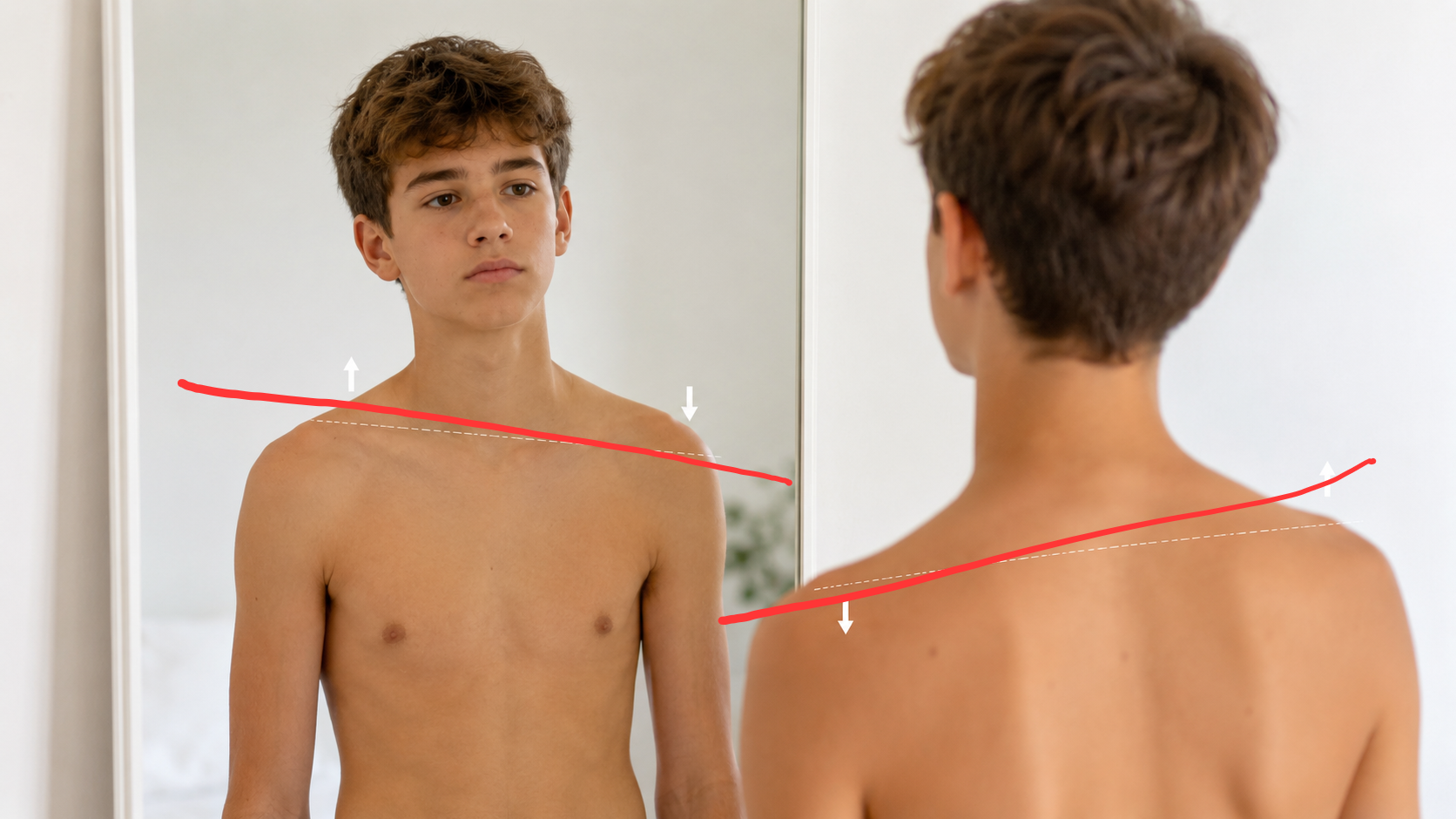
    shoulder imbalance in teens shown in mirror reflection with school uniform
    Shoulder imbalance in teens is often first noticed in a mirror — one side clearly higher than the other

    What Causes Shoulder Imbalance in Teens?

    Imagine a 17-year-old student — let’s call him Minjun. He spends over six hours a day looking at his phone, hunches over a laptop during class, and sits cross-legged on his bed while gaming at night.

    One day, his mother points it out: “Why is one of your shoulders higher than the other?”

    Minjun looks in the mirror. His right shoulder is clearly elevated. His response?

    “I’ve always been like this.”

    Shoulder imbalance in teens often
    develops silently, driven by everyday
    habits that nobody thinks twice about.

    That phrase — “I’ve always been like this” — is exactly how shoulder imbalance becomes permanent. Not overnight. But through hundreds of small, repeated movements that slowly retrain muscle memory.

    What Is Shoulder Imbalance in teens?

    Shoulder imbalance in teens occurs when one shoulder sits noticeably higher, more forward, or more internally rotated than the other. It may appear subtle at first — only visible in photographs or when someone else points it out.

    Over time, this imbalance places uneven load across the cervical spine, thoracic muscles, and shoulder girdle. The body compensates — and those compensations create tension, stiffness, and eventually pain.

    According to the National Institutes of Health (NIH), poor posture and prolonged static positions are primary contributors to musculoskeletal imbalance — especially in adolescents with high screen time.

    How 3 Common Habits Create Shoulder Imbalance

    Habit 1 — Looking Down at a Smartphone for Hours

    When you tilt your head just 15 degrees forward, the effective weight on your cervical spine increases to approximately 12 kilograms. At 60 degrees — a common angle for phone users — that load reaches 27 kilograms.

    The muscles that absorb this load — particularly the levator scapulae and upper trapezius — are forced to work constantly. If you hold the phone primarily in your right hand,shoulder your right side works harder. Over weeks and months, that side begins to tighten and elevate.

    The result: shoulder imbalance that looks like “a naturally higher shoulder” — but is actually a trained postural pattern.

    Early detection of shoulder imbalance
    in teens leads to faster recovery.

    Habit 2 — Carrying Bags on the Same Side Every Day

    Backpacks slung over one shoulder, heavy school bags, or gym totes carried daily on the same side create a chronic asymmetry. The shoulder-elevating muscles on the carrying side are in constant contraction, while the opposite side remains underused.

    This pattern is especially pronounced in students who carry heavy textbooks or equipment. The brain adapts by treating the elevated shoulder position as “normal” — which makes the imbalance progressively harder to correct without conscious effort.

    Stretching is essential for teens
    with shoulder imbalance in teens.

    shoulder imbalance in teens caused by bad posture habits
    shoulder imbalance in teens caused by bad posture habits

    Habit 3 — Sitting With the Same Leg Crossed or Body Tilted

    Sitting with one leg crossed over the other, or consistently leaning toward one side at a desk, shifts the pelvis and rotates the lumbar spine. The upper body compensates by adjusting the shoulder girdle — and one shoulder quietly rises to maintain balance.

    This connection between pelvic tilt and shoulder imbalance is why lower body posture habits directly affect upper body alignment. The body is one connected system.

    Over time, this worsens shoulder
    imbalance in teens significantly.

    Strengthening helps correct shoulder
    imbalance in teens over time.

    The Two Muscles Most Involved in Shoulder Imbalance

    Understanding which muscles drive shoulder imbalance helps explain why the problem persists even when people try to “stand up straight.”

    • Levator Scapulae: This muscle runs from the cervical spine (C1–C4) to the upper inner corner of the shoulder blade. Its primary job is to elevate the scapula. When chronically tight, it pulls the shoulder blade upward — creating visible shoulder height asymmetry.
    • Upper Trapezius: This broad muscle supports the neck and assists shoulder elevation. Emotional stress, prolonged forward-head posture, and shallow breathing all cause the upper trapezius to chronically contract — often on one side more than the other.

    For a deeper look at how these muscles interact with spinal alignment, the Spine-Health resource on trapezius muscle function provides a clear anatomical overview.

    Your Body Is Like a Car With Misaligned Wheels

    Imagine a car with wheels slightly out of alignment. It still drives — but one tire wears down far faster than the others. Eventually, the vehicle pulls to one side, the steering feels off, and the driver wonders why the car “just doesn’t feel right.”

    The human body with shoulder imbalance works the same way. Certain muscles are overworked while others become underactivated. Over time, this leads to:

    • Persistent neck tension and stiffness
    • Tension headaches, especially at the base of the skull
    • Reduced shoulder and arm range of motion
    • Upper back fatigue and general heaviness
    • Disrupted sleep due to discomfort

    How to Support Better Shoulder Balance Daily

    Correcting shoulder imbalance does not require dramatic intervention. Consistency with small habits creates meaningful change over time.

    • Raise your phone to eye level. A simple adjustment that immediately reduces cervical spine load.
    • Alternate bag shoulders daily. Prevents one-sided muscle dominance from developing.
    • Practice diaphragmatic breathing. Deep belly breathing reduces upper trapezius overactivation.
    • Perform gentle neck rolls and shoulder blade squeezes. 5 minutes before bed can release built-up tension.
    • Become aware of sitting asymmetry. Notice which leg you cross, which side you lean toward.
    • Take movement breaks every 45–60 minutes. Static positions are the primary driver of postural imbalance.

    Final Thought: The Body Whispers Before It Shouts

    Shoulder imbalance rarely announces itself with dramatic pain at first. It begins as a quiet, gradual shift — and that is exactly what makes it easy to ignore.

    But the body is always communicating. An elevated shoulder is a message. Neck tightness is a message. The key is learning to listen before the whisper becomes a shout.

    If you have noticed uneven shoulder height or persistent upper body tension, a professional assessment can help identify the root cause and create a path toward better balance and comfort.

    Sometimes the body whispers before it starts to shout. Are you listening?

    Many parents ask how to prevent
    shoulder imbalance in teens before
    it becomes a serious problem.

    If you suspect shoulder imbalance
    in teens, act early for best results.

  • ​How to Fix Uneven Shoulders Body Balance After Surgery

    ​How to Fix Uneven Shoulders Body Balance After Surgery

    Many people struggle with an uneven shoulders body, often overlooking that this can be a sign of deeper structural imbalance.

    If you are struggling with uneven shoulders body balance after surgery, you are not alone. It is a common pattern seen in clinical practice — and it is more connected to breathing, digestion, and daily movement than most people realize.

    Imagine this: the surgery goes well. The doctor is pleased. Your family is relieved. But a few weeks later, something still feels wrong. Your body feels tight. Breathing is shallow. You get tired just walking to the kitchen. And your right shoulder sits noticeably higher than your left.

    This is exactly what one client experienced — and it is far more common than most people expect.

    Why Uneven Shoulders Body Balance Affects More Than Your Posture

    uneven shoulders body balance posture comparison
    Small daily movements, like gentle foam rolling, are the key to releasing tension and supporting a healthy posture.”

    Most people treat shoulder imbalance as a local problem — something to stretch or massage. But the body works as a system, not in isolated parts.

    When one shoulder stays elevated for a long time, the surrounding muscles adapt. They shorten on one side and overstretch on the other. This tension then pulls on the chest wall, restricts the ribcage, and makes deep breathing difficult.

    Here is where it gets important: when breathing becomes shallow, the nervous system interprets this as a low-level threat. The body shifts into a protective state — muscles tighten, digestion slows, and energy drops. The body is essentially bracing, even when you are just sitting on the couch.

    Signs your body may be stuck in this pattern:

    • Visible difference in shoulder height
    • Shallow breathing that never feels satisfying
    • Persistent digestive discomfort or bloating
    • General body stiffness that does not improve with stretching
    • Difficulty walking with a smooth, balanced gait
    • Low energy even after rest

    A Real Recovery Story: Uneven Shoulders, Poor Breathing, and Knee Surgery

    shoulders body requires more than just stretching; it requires a holistic approach to body alignment

    This client had already undergone surgery on both knees but continued to experience discomfort. During movement assessment, several patterns appeared together: elevated right shoulder, tight chest and hip muscles, restricted breathing, stiff walking, and ongoing digestive discomfort.

    Rather than isolating the knees as the only problem, attention shifted to the whole body — how different regions were influencing each other, and what daily habits were keeping the body stuck in tension.

    This whole-body approach to uneven shoulders body balance — looking at how different regions influence each other — is often what makes the difference between temporary relief and lasting recovery.

    How to Improve Uneven Shoulders Body Balance at Home

    When you ignore an uneven shoulders body, it can eventually lead to chronic neck and back pain. For more detailed information on posture correction, please check out my other post on

    uneven shoulders body balance home rehabilitation foam roller
    Small daily movements, like gentle foam rolling, are the key to releasing tension and supporting a healthy posture.”

    Recovery does not require complex equipment or intense effort. Three simple daily practices made a real difference for this client.

    1. Gentle Foam Roller Stimulation

    Let this peaceful melody guide your nervous system into a state of relaxation. Soften your body and mind with the calming frequencies of ‘The Shepherd Never Leaves’.

    The goal is not to force tight muscles to release. Instead, gentle foam roller work helps the nervous system receive more accurate feedback from the body. When the brain gets clearer signals about where the body is in space, muscles can soften on their own — a more sustainable approach than aggressive stretching.

    2. Breathing Practice for Nervous System Reset

    Take a slow, relaxed inhalation. Pause briefly at the top. Then exhale slowly and completely. Do not force it.

    This simple practice signals safety to the nervous system. Over time, it helps shift the body out of its chronic protective state. Many clients also notice improved digestion — not a coincidence. The vagus nerve, which runs from the brainstem through the chest into the abdomen, is directly linked to breathing rhythm.

    3. Balanced Walking Habits

    Walking is one of the most underrated rehabilitation tools available. Small daily adjustments build new movement patterns over time:

    • Keep your gaze forward, not down — this naturally lifts the chest
    • Consciously relax your shoulders away from your ears
    • Pay equal attention to both feet with every step
    • Focus on consistency rather than speed or distance

    What Changed After Several Weeks of Consistent Practice

    Recovery rarely arrives in one dramatic moment. It comes quietly — in small improvements that are easy to miss until you look back.

    After several weeks of these daily practices, this client reported more level shoulders, easier breathing, improved walking comfort, reduced digestive discomfort, and less background tension throughout the day.

    None of it required anything dramatic. It came from small efforts, done consistently, with a clear understanding of why they mattered.

    Addressing uneven shoulders body balance through daily movement awareness — not just targeting the area that hurts — is often what makes the difference between temporary relief and lasting recovery.

    Final Thoughts

    https://www.healthline.com/health/posture

    Your body gives small signals long before larger problems appear. Tightness, shallow breathing, uneven posture, and post-surgical stiffness are not random. They are messages worth listening to.

    If these patterns feel familiar, consider looking not just at the area that hurts — but at the whole picture. Simple, consistent daily care is often more powerful than occasional intensive treatment.

    If you recognize these patterns in your own body, consider consulting a body balance or rehabilitation specialist who looks beyond the area that hurts — and at the whole picture.

    https://soletobody.com/postural-compensation-back-pain-relief/If you are ready to correct your uneven shoulders body, start by incorporating these simple daily routines into your life. You can find more tips on body balance and breathing techniques in my guide

  • How to Stay Active in Golf After Joint Surgery: 5 Things You Can Do at Home

    How to Stay Active in Golf After Joint Surgery: 5 Things You Can Do at Home

    You had joint surgery. You recovered. You tried to return to golf — and then something else started hurting.

    If this sounds familiar, you are not alone. Managing golf after joint surgery is one of the most common challenges active seniors face — and one of the least talked about.

    Many active seniors find that after hip replacement or ankle surgery, the body does not simply return to normal. New discomfort appears in unexpected places. Walking feels uneven. The legs feel heavy. And the golf game that was supposed to come back — stays just out of reach.

    The good news is that some of the most effective steps you can take do not require a clinic visit. They start at home, with simple awareness and daily habits that address how your whole body is balancing — not just the joint that was operated on.

    Here are five practical things you can do at home to support your return to golf after joint surgery.

    In This Article

    Why Golf After Joint Surgery Affects Your Whole Body

    After hip or ankle surgery, the body naturally begins to protect the operated area. Without realizing it, you start shifting weight to the other side, shortening your stride, or adjusting your posture to avoid discomfort.

    This is called compensatory movement — and it is the body’s way of coping. The problem is that over weeks and months, these compensations create new strain in areas that were never part of the original problem.

    Managing golf after joint surgery requires understanding this pattern. Common signs include:

    • One hip taking more load than the other
    • The pelvis tilting to one side during walking
    • The opposite ankle or knee absorbing uneven pressure
    • Persistent swelling in the lower leg, even after full surgical recovery
    • A golf swing that feels “off” without a clear reason

    Understanding this is the first step. The second step is noticing where your own body is currently compensating — and you can begin doing that right now.

    Check 1 — The Mirror Weight Test

    senior man doing hip stretch exercise at home for golf recovery
    senior man doing hip stretch exercise at home for golf recovery

    This is the simplest and most revealing check you can do for golf after joint surgery recovery.

    How to do it:

    1. Stand barefoot in front of a full-length mirror
    2. Stand naturally — do not try to correct your posture
    3. Close your eyes for five seconds, then open them
    4. Look at your shoulders: is one higher than the other?
    5. Look at your hips: does one side appear to jut out more?
    6. Notice your feet: is one foot turned outward more than the other?

    What it tells you: Visible asymmetry in the shoulders, hips, or feet is often a sign that your body is distributing weight unevenly. This uneven load is one of the main reasons why swelling and fatigue persist in the legs after surgery — and why golf feels unsteady.

    What to do: Practice standing with equal weight on both feet for 2–3 minutes each morning. Do not force it. Simply bring awareness to the sensation of both feet pressing into the floor equally.

    Check 2 — Read Your Shoe Soles

    Your shoes hold a record of how you have been walking for the past several months. This check is especially useful for seniors managing golf after joint surgery.

    How to do it:

    1. Take a pair of shoes you wear regularly
    2. Place them on a flat surface and look at the heel area from behind
    3. Compare the wear pattern on the left heel versus the right heel
    4. Also check whether the outer or inner edge of the sole is more worn down

    What it tells you:

    • One heel more worn than the other → You are loading one leg more heavily during walking
    • Outer edge worn down → Your foot is rolling outward (supination), which adds stress to the ankle and knee
    • Inner edge worn down → Your foot is rolling inward (overpronation), which affects hip and lower back alignment

    After hip or ankle surgery, asymmetrical wear patterns are extremely common. Recognizing the pattern helps you understand which direction your body has been compensating.

    Check 3 — The Seated Hip Level Check

    Many people do not realize their pelvis is uneven until they look for it. For anyone pursuing golf after joint surgery, pelvic balance is especially important because the golf swing depends on smooth hip rotation.

    How to do it:

    1. Sit on a firm, flat chair without a cushion
    2. Sit naturally without adjusting your posture
    3. Place one hand under each side of your sitting bones (the bony points at the bottom of your pelvis)
    4. Notice: does one side feel more pressure than the other?
    5. Alternatively, have someone look at your seated posture from behind and check whether one hip appears higher

    What it tells you: Uneven pressure under the sitting bones is a sign of pelvic tilt. When the pelvis is uneven, the entire chain of the lower body — hips, knees, ankles, feet — is working at a slight angle. For golfers, pelvic imbalance directly affects rotation quality and follow-through.

    What to do: Practice sitting with equal weight on both sitting bones for 5 minutes a day. This simple awareness practice, repeated consistently, begins to retrain the nervous system’s sense of “level.”

    Exercise 1 — Ankle Swelling Relief Routine

    Persistent leg and ankle swelling after surgery is one of the most frustrating symptoms for active seniors. This gentle routine supports circulation and lymphatic drainage — and is safe to begin early in your golf after joint surgery recovery.

    Do this once in the morning and once in the evening:

    1. Elevated rest (5 minutes) — Lie on your back and prop both legs up against a wall or on two pillows. Let gravity assist fluid drainage from the lower legs.
    2. Ankle circles (10 reps each direction, each foot) — While lying down or seated, slowly rotate each ankle in full circles. Move only the ankle, not the whole leg.
    3. Toe spreads (10 reps) — Spread all five toes apart as wide as possible, hold for 3 seconds, then relax. This activates the small muscles of the foot and promotes circulation.
    4. Calf pumps (15 reps) — While seated, press the balls of your feet into the floor and lift your heels, then lower them. This activates the calf muscle pump, which is the main driver of blood return from the lower legs.

    Important: If swelling is significant, warm, or accompanied by redness, consult your physician before beginning any exercise routine.

    Exercise 2 — Hip Mobility Warm-Up for Golf

    Before returning to the golf course, restoring hip mobility is essential. These three movements are specifically designed to help with golf after joint surgery — preparing the hips for the rotational demands of the swing without overloading the surgical joint.

    Do this daily, or at minimum before each round:

    1. Standing Hip Pendulum (10 reps each side)
      Stand beside a wall for balance. Slowly swing one leg forward and backward like a pendulum, keeping the movement relaxed and gravity-led. Do not force the range. Switch sides.
    2. Seated Figure-Four Stretch (30 seconds each side)
      Sit in a chair. Cross one ankle over the opposite knee, forming a figure-four shape. Gently lean forward from the hips (not the lower back) until you feel a mild stretch in the outer hip. Hold and breathe slowly.
    3. Standing Pelvic Rotation (10 reps each direction)
      Stand with feet shoulder-width apart and hands on hips. Slowly rotate your hips in a wide circle — forward, to the side, back, to the other side. Keep the movement smooth and controlled. This directly prepares the pelvis for golf swing rotation.

    Start with the smallest comfortable range of motion. Every senior recovering from golf after joint surgery has a different timeline — do not compare your pace to others. Over days and weeks, the range will naturally increase as the body gains confidence in the movement.

    When Home Work Is Not Enough

    The checks and exercises above are a meaningful starting point. For many seniors, consistent daily practice creates noticeable improvement in walking comfort, leg heaviness, and overall stability within two to four weeks.

    However, there are situations where professional support makes a significant difference in golf after joint surgery recovery:

    • Swelling that does not reduce with elevation and gentle movement
    • Pain that appears in a new joint — especially the opposite ankle or knee
    • A strong sense of imbalance that persists despite consistent effort
    • Difficulty returning to golf even after surgical clearance from your physician
    • Imaging that suggests a second joint may be developing problems

    In these cases, a body balance specialist — someone who looks at how the whole lower body is functioning together, not just the surgical site — can identify compensation patterns that are difficult to detect and correct on your own.

    One of our clients experienced exactly this situation. After hip surgery followed by ankle surgery, he struggled with persistent leg swelling and was facing the possibility of a third surgical intervention. Through consistent body balance work focused on his overall lower body alignment, he was eventually able to return to the golf course — more stably than he had walked in years.

    His story is not a guarantee. But it is a reminder that the body’s capacity to rebalance is often greater than we expect — when we look at the whole system, not just the part that hurts. Seniors who approach golf after joint surgery with a whole-body mindset tend to recover more confidently and sustainably.

    If you are interested in learning more about foot health and body alignment, read our guide on body balance and walking comfort.

    For more information on joint health and recovery, visit the Arthritis Foundation.


    Have you experienced new discomfort in a different area after joint surgery? Share in the comments — your experience may help someone else who is going through the same thing.

  • 5 Hidden Causes of Whole-Body Aches That Tests Never Catch

    5 Hidden Causes of Whole-Body Aches That Tests Never Catch

    You went to the doctor. You had the blood work done. Maybe even an X-ray or MRI.

    And the result? “Everything looks normal.”

    But your body still aches. Your legs feel heavy. Your shoulders never fully relax. And by the afternoon, you are exhausted in a way that sleep does not seem to fix.

    If this sounds familiar, you are not alone — and you are not imagining it.

    The truth is, some of the most common causes of whole-body aches simply do not show up on standard medical tests. They are hidden inside the way your body moves, balances, and compensates — day after day, without you ever noticing.

    Here are the 5 hidden causes of whole-body aches that tests never catch.

    1. Your Body Is Quietly Compensating for Hidden Instability

    Watch how the Sbonsdo method addresses unconscious nerve compensation to restore whole-body balance and relieve chronic aches.

    When one part of your body becomes unstable or weak, other muscles automatically step in to help. This is called compensatory tension — and it is one of the most overlooked causes of whole-body aches.

    For example, if your foot arch collapses slightly when you walk, your ankle, knee, and hip all adjust their movement patterns to keep you upright. Over time, those adjustments create chronic muscle overload — and that overload spreads upward through the entire body.

    The result is a dull, persistent ache that seems to have no single location. It moves around. It comes and goes. And no test will ever find it — because the problem is not in any one tissue. It is in the pattern.

    2. Poor Hip Stability Is Overloading Your Entire Body

    Experience 432Hz healing music designed to support body relaxation and nervous system balance.

    The hips are the body’s central powerhouse. They connect the upper and lower body, absorb the shock of every step, and distribute movement forces through the spine and legs.

    When hip stability decreases — often due to prolonged sitting, muscle imbalance, or years of poor posture — the surrounding muscles are forced to overwork. The lower back tightens. The thighs become chronically stiff. Even the neck and shoulders can feel the strain.

    This is one of the most common hidden causes of whole-body aches, especially in people who sit for long hours or feel that their legs “give out” easily.

    • Lower back ache that worsens after sitting
    • Heavy, tired legs by midday
    • Knee discomfort when climbing stairs
    • Stiffness that is worst in the morning

    3. Shallow Breathing Is Keeping Your Muscles Tense

    Man sitting on bed holding his neck due to muscle tension and whole-body aches from shallow breathing
    Chronic neck and shoulder tension is often a sign that your breathing pattern is keeping your nervous system on high alert.

    Most people never think of their breathing as a cause of whole-body aches. But shallow, upper-chest breathing is one of the hidden causes of whole-body aches that tests never catch — and it affects far more people than you might expect.

    When breathing becomes shallow, the body interprets it as a low-level stress signal. In response, the nervous system keeps muscle tension elevated throughout the body — particularly in the neck, shoulders, and upper back.

    This tension rarely causes sharp pain. Instead, it creates a constant background stiffness that feels like your body can never fully relax, no matter what you do.

    A simple test: Place one hand on your chest and one on your belly. Take a normal breath. If only your chest rises, your breathing pattern may be contributing to your whole-body aches.

    4. Foot Instability Is Disrupting Your Entire Body Chain

    The kinetic chain diagram showing how feet ankles knees hips and spine are connected causing whole-body aches
    The kinetic chain diagram showing how feet ankles knees hips and spine are connected causing whole-body aches

    The feet are the foundation of the entire body — yet they are almost always overlooked when people search for the cause of whole-body aches.

    Every time your foot makes contact with the ground, a chain of forces travels upward through the ankle, knee, hip, and spine. When the foot is unstable or poorly aligned, that chain becomes inefficient. Muscles throughout the entire body must work harder to maintain balance and posture.

    Over months and years, this constant extra effort accumulates — and shows up as general fatigue, stiffness, and aching that spreads throughout the body.

    If you notice that your feet tire quickly, that your shoes wear unevenly, or that you feel more comfortable in supportive footwear, foot instability may be one of your hidden causes.

    5. Long-Term Postural Habits Are Silently Loading Your Muscles

    The way you sit, stand, and move throughout the day creates patterns in your muscles and joints. Over time, these patterns become habits — and some of those habits place a continuous, low-grade load on the body that standard tests will never detect.

    Forward head posture, rounded shoulders, and a flattened lower back are among the most common postural habits that contribute to whole-body aches. Each of these positions shifts the body’s center of gravity and forces certain muscle groups to work constantly — even when you are at rest.

    The body adapts remarkably well to these demands. But adaptation has a limit. And when that limit is reached, the whole body begins to speak up through stiffness, fatigue, and aching that seems to have no clear cause.

    What You Can Do Starting Today

    Understanding that whole-body aches often come from hidden structural patterns — not from a single diagnosable condition — is the first and most important step.

    1. Walk daily with attention to how your feet land and how your hips move
    2. Practice slow belly breathing for 5 minutes each morning
    3. Avoid sitting for more than 45 minutes without standing or moving
    4. Stretch the chest and hip flexors gently every day
    5. Pay attention to foot comfort and balance throughout the day

    Small, consistent changes in how you move and hold your body often do more for whole-body aches than any single treatment — because they address the hidden patterns that tests never catch.

    This article is for general informational purposes only and does not replace professional medical advice. If you are experiencing persistent pain or weakness, please consult a qualified healthcare provider.

  • Personalized Exercise: Why It Leads to Better Outcomes

    Personalized Exercise: Why It Leads to Better Outcomes

    Personalized Exercise and Body Alignment Treatment at Haim Body Balance Center
    At Haim Body Balance Center, we combine manual nerve management with personalized exercise to improve movement patterns and overall body alignment.

    Personalized exercise is often the missing key for those who believe that general activities like cycling or swimming are the only answer to knee pain or hip discomfort. While these are commonly recommended as low-impact exercises, they may not yield the best results for everyone without a tailored approach.

    However, have you ever noticed that two people can do the same exercise and get completely different results?

    One person may feel stronger and healthier after cycling, while another may experience increased knee discomfort. One swimmer may enjoy improved mobility, while another may continue to feel stiffness in the hips.

    The answer may not be the exercise itself. Instead, it may be related to the condition of the body before the exercise begins. Personalized exercise helps people understand that every body has different movement habits, strengths, and limitations.

    Why Personalized Exercise Starts with the Foundation

    Imagine driving a car with misaligned wheels. Even if the engine works perfectly, the tires may wear unevenly over time. The human body works in a similar way.

    When the feet, ankles, knees, and hips are not working together efficiently, repetitive movements may reinforce existing movement patterns. Personalized exercise focuses on improving the foundation first, rather than simply increasing exercise intensity.

    Why Personalized Exercise Starts with the Foundation

    Imagine driving a car with misaligned wheels. Even if the engine works perfectly, the tires may wear unevenly over time.

    The human body works in a similar way.

    When the feet, ankles, knees, and hips are not working together efficiently, repetitive movements may reinforce existing movement patterns. This does not mean the activity is harmful. It simply means that different bodies may respond differently.

    Before focusing on exercise intensity, it may be helpful to pay attention to movement quality and body awareness.

    Understanding Movement Patterns

    Many people with knee discomfort also experience weakness in their feet or reduced toe mobility.

    Others may rely heavily on one side of the body while walking. Some may have limited ankle mobility without realizing it.

    When these movement habits continue for months or years, the body often adapts in ways that are not always efficient.

    This is why a single exercise program cannot guarantee the same outcome for everyone.

    Studies on biomechanics and movement efficiency show that individual physical foundations are critical. For more on scientific approaches to movement, you can refer to resources like the American Council on Exercise (ACE).

    Benefits of Personalized Exercise

    Personalized exercise helps people move more comfortably.
    It focuses on individual needs rather than a one-size-fits-all approach.
    Many people find that personalized exercise supports long-term consistency.

    Watch how personalized nerve management helps resolve chronic hip pain that has persisted for years.

    Why Personal Differences Matter

    Cycling and swimming are excellent forms of exercise for many individuals.

    Cycling can improve cardiovascular fitness and leg endurance.

    Swimming can reduce impact on joints while encouraging full-body movement.

    Yet every activity places unique demands on the body.

    For some individuals, certain movement patterns may need attention before increasing exercise volume. Others may benefit from strengthening, mobility work, balance training, or simply improving daily walking habits.

    The goal is not to avoid exercise but to choose the right approach for your current condition.

    Listening to Your Body

    One of the most valuable skills in health and fitness is learning to observe how your body responds.

    Does a particular activity help you move more comfortably?

    Do you feel stronger and more balanced afterward?

    Or does discomfort gradually increase over time?

    These questions are often more important than following a popular exercise trend.

    Health is rarely about finding a perfect exercise. It is about finding the right exercise for the right person at the right time.

    A More Personalized Approach

    Modern health and wellness discussions increasingly recognize that individual differences matter.

    Age, movement habits, flexibility, strength, balance, lifestyle, and daily activity levels can all influence how a person responds to exercise.

    Because of this, a personalized approach often produces better long-term results than simply copying what works for someone else.

    The most effective exercise plan is not necessarily the most intense one.

    It is the one that matches your body’s current needs and supports steady, sustainable progress.

    “Before choosing an exercise, it may be worth asking a deeper question.
    Has your nervous system learned to move efficiently?
    The body remembers every movement pattern — both good and bad.
    When the nervous system holds onto old, inefficient habits, even the best exercise may not deliver the results you expect.
    This is where body alignment awareness and unconscious nerve management become essential — not as a replacement for exercise, but as the foundation that makes exercise work.”

    Final Thoughts

    Cycling is not bad.

    Swimming is not bad.

    Walking is not automatically the best solution for everyone.

    Every exercise has benefits, and every person has unique needs.

    Rather than asking, “What is the best exercise?”

    A better question may be:

    “What is the best exercise for my body right now?”

    When we start with that mindset, we move closer to long-term health, better movement, and a more balanced lifestyle.

    Learning to monitor your body’s response is a fundamental skill in injury prevention. The National Institute of Arthritis and Musculoskeletal and Skin Diseases (NIAMS) provides comprehensive guides on maintaining healthy physical activity.

  • Can Thick Foot Calluses Really Destroy Your Walking Balance?

    Can Thick Foot Calluses Really Destroy Your Walking Balance?

    He almost gave up walking comfortably.

    A man in his 50s walked into our center looking defeated. His knees had been giving him trouble for months. Friends pushed him toward surgery. One doctor mentioned stem cell injections. Another suggested a knee replacement consultation.

    And that tesitation changeed everything

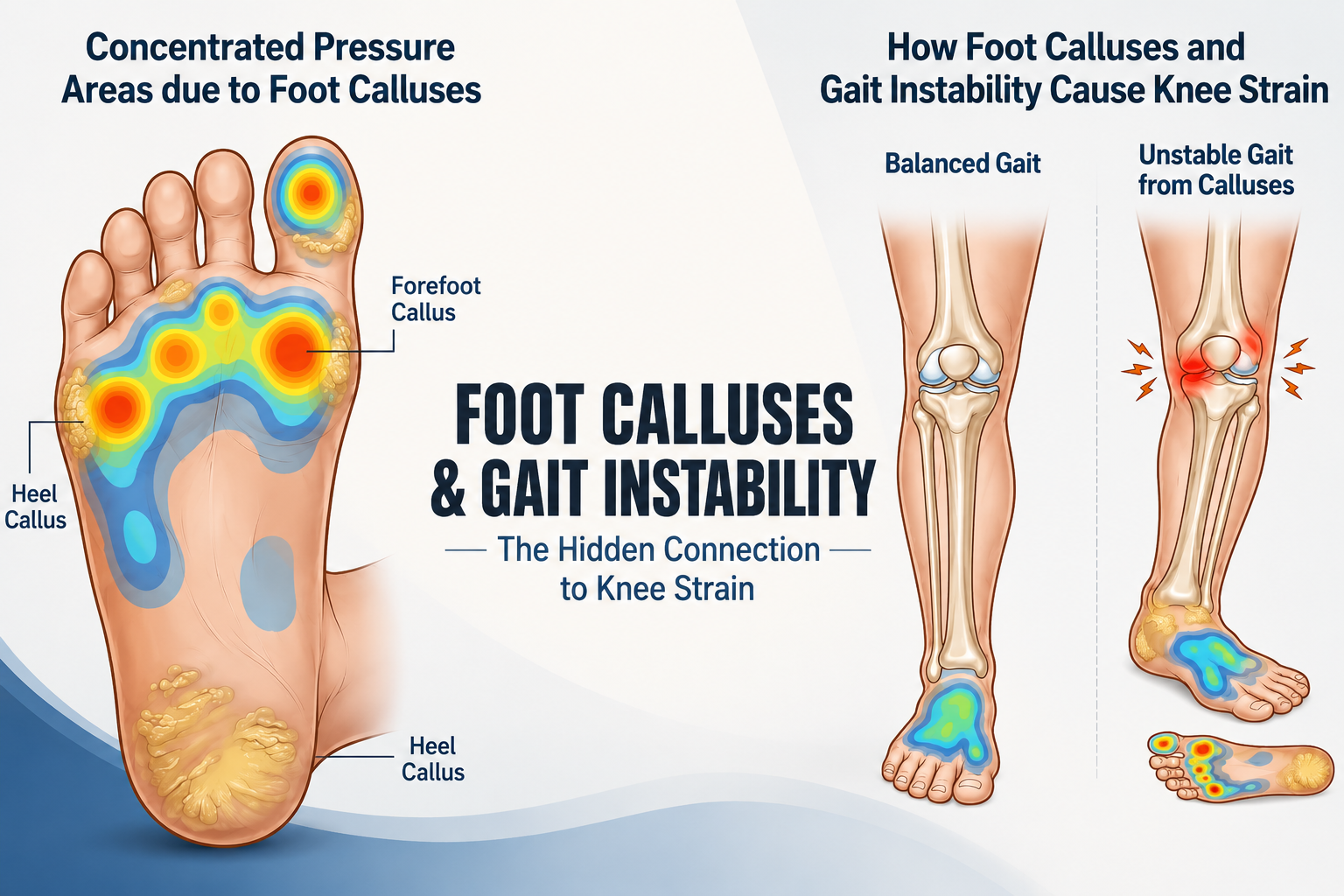
    Anatomical diagram showing how foot calluses cause gait instability and knee strain."
    Impact of persistent foot calluses on walking balance and knee joint health.
    A closer look at how foot conditions influence overall body alignment

    What Foot Calluses Do to Your Walking Balance

    When he walked across the room, we did not look at his knees first.

    We looked at his feet.

    The bottom of both feet told a story that years of medical appointments had missed. Thick, uneven foot calluses covered specific areas. The left foot looked completely different from the right. Certain zones had absorbed enormous pressure — day after day, year after year.

    He had spent decades in sales. Long hours. Hard floors. Dress shoes that offered almost nothing in support.

    His feet had adapted. Unfortunately, adaptation and health are not always the same thing.

    How Uneven Foot Calluses Destroy Walking Balance

    Most people treat foot calluses as a cosmetic issue.

    At our center, we see them differently.

    Calluses form where pressure repeats. When one area of the foot consistently absorbs more load than it should, the skin thickens as protection. The callus is not the enemy. It is the messenger.

    Think of a car with uneven tire pressure. The stressed tire wears faster. Eventually, the entire vehicle suffers.

    The same principle applies to the human body. Uneven foot pressure travels upward. The ankles adjust. The knees compensate. The hips shift. The spine responds.

    By the time a person feels knee discomfort, the pattern has usually been building for years.

    Rebuilding Walking Balance from the Ground Up

    Foot callus removal and improved walking balance with better leg alignment
    Foot pressure changes can influence leg alignment and overall walking balance.

    We did not promise quick results.

    We focused on awareness first. Footwear choices. Daily walking habits. How his feet contacted the ground with each step. Reducing tension in overworked muscles. Rebuilding movement confidence gradually.

    Week by week, something shifted.

    His steps became smoother. His legs felt less tired at the end of the day. Stairs that had felt uncertain began to feel manageable again.

    And then something unexpected happened.

    The thick foot calluses that had built up over many years began to soften. Not because we treated the skin. Because the pressure patterns underneath were finally changing.

    The Hidden Link Between Foot Calluses and Daily Life

    Most people spend years focusing on their knees, hips, and back.

    Very few people look down.

    Yet the feet carry every single step. They absorb impact. They communicate with the nervous system. They shape how the entire body moves.

    When the foundation is uneven, everything above it works harder than it should.

    We see similar patterns regularly at Haim Body Balance Center. People arrive focused on one painful area. When we examine the whole movement chain — starting from the feet — a different picture often emerges.

    “Experience soothing healing music as you focus on your foot health and balance improvement.”

    ​How Uneven Foot Calluses Destroy Your Walking Balance

    ​Most people treat foot calluses as a cosmetic issue. They grab a pumice stone, file them down, and go about their day. But if you have persistent, uneven foot calluses, your feet are telling a story about your mechanics.

    ​When your feet develop thick patches of hardened skin, it isn’t just about the skin—it’s about the pressure. These foot calluses often develop because your body is compensating for poor arch support or structural imbalances in your gait.

    ​The Hidden Connection: Calluses and Gait

    ​When you have an uneven gait, your foot doesn’t strike the ground uniformly. This creates “pressure hotspots.” Over time, the body builds thick foot calluses as a defense mechanism to protect those specific areas. By ignoring the cause, you aren’t just letting the foot calluses grow; you are allowing your body to continue walking in a way that puts unnecessary strain on your ankles, knees, and hips.

    ​What You Should Do

    1. Analyze your footwear: Wear shoes with proper arch support to distribute pressure evenly.
    2. Consult a specialist: If foot calluses are recurring, see a podiatrist to check for biomechanical issues.
    3. Stretch and Strengthen: Focus on foot intrinsic muscles to improve your overall walking stability.

    A Final Word

    This client did not need surgery.

    He needed someone to look at the right place.

    If you have been dealing with uneven shoe wear, tired legs, unstable walking, or unexplained knee discomfort, your feet may be worth a closer look.

    At Haim Body Balance Center, we specialize in reading the body’s signals — starting from the ground up.

    Sometimes the answer has been beneath your feet all along.

  • ​Tired eyes: It’s not your eyes, it’s your scalp.

    ​Tired eyes: It’s not your eyes, it’s your scalp.

    tired eyes from computer screen fatigue
    Tired eyes from prolonged screen time may signal deeper muscle tension in your scalp and neck.

    Tired eyes are one of the most common complaints we hear at our body balance center. Do you ever feel like something is stuck in your eye? That gritty, heavy, uncomfortable sensation that just won’t go away — even after a full night’s sleep?

    One client walked into our center with that exact complaint. He kept rubbing his tired eyes throughout the day. Sometimes his eyes felt heavy. Sometimes they felt dry. At other times, he described it as feeling like a tiny grain of sand was trapped inside.

    The surprising part? He had already visited an eye clinic. His examination showed no major problems. So, what was causing the persistent discomfort?

    While eye symptoms can stem from many sources — and only a qualified doctor can diagnose medical conditions — there is a common possibility that most people overlook: Muscle Tension.

    Why Tired Eyes Are Often a Body Problem

    Most people with tired eyes assume the problem starts and ends with the eye itself. But the muscles around your eyes, temples, forehead, scalp, and neck are all intricately connected. When we spend hours staring at computers, smartphones, or books, we focus only on the fatigue inside the eyes. However, the muscles surrounding them are never working in isolation.

    • The forehead becomes tense from deep concentration.
    • The temples become tight, restricting blood flow.
    • The back of the head and neck stiffen from poor posture.
    • The scalp loses its natural flexibility, acting like a tight, restrictive cap.

    Research by the American Optometric Association confirms that prolonged screen use contributes significantly to eye strain — and that postural tension in the neck and shoulders plays a key role in worsening symptoms.

    Two Real Cases: Tired Eyes Relieved by Body Work

    During our assessment, we noticed this client’s temples were unusually firm. The muscles around the side of his head were tight, and his neck showed significant tension. When we applied gentle relaxation techniques focused on the scalp and neck, he immediately reported feeling “lighter” and more comfortable. His tired eyes felt noticeably less strained after just one session.

    I recall another office worker who visited our center with chronic tired eyes. After just a few sessions focused on releasing his shoulder and neck tension, he told me that his “sand-in-the-eye” feeling had decreased by more than half — simply because he was no longer carrying that constant physical strain in his upper body.

    Think of Tired Eyes Like Wearing a Tight Hat

    Imagine wearing a hat two sizes too small all day long. Even if your vision is perfect, the constant pressure around your head would make you feel uncomfortable, fatigued, and mentally drained. Modern life — long screen time, stress, poor posture, and lack of sleep — creates this exact “tight hat” effect on your skull and neck muscles.

    This is why so many people experience tired eyes not from vision problems, but from accumulated physical tension they are not even aware of.

    3 Simple Ways to Relieve Tired Eyes

    If you find yourself rubbing your eyes repeatedly, try these simple habits to see if the fatigue subsides:

    1. Scalp Massage: Use your fingertips to gently massage your scalp in circular motions. Focus on the area right above your ears. Even 2–3 minutes can noticeably reduce tension.
    2. Neck Release: Slowly tilt your head from side to side, holding for 10 seconds on each side to release the trapezius muscles. Repeat 3 times daily.
    3. The “Look Away” Rule: Every 30 minutes, look at something at least 20 feet away for 20 seconds. While doing this, consciously drop your shoulders and unclench your jaw. This follows the 20-20-20 rule recommended by eye care professionals.

    For additional support,explore our related guide on why your body still feels unsafe after rehabilitation— because tension rarely exists in isolation.

    Important Note on Wellness Care

    tired eyes scalp tension neck massage relief
    Gentle scalp and neck care at Haim Body Balance Center —
    helping clients find relief from tired eyes and chronic tension.

    In our practice, we help clients improve body balance through gentle care focused on the scalp, neck, and shoulders. However, always understand the limits of wellness care. If you experience severe symptoms like blurred vision, double vision, sudden eye pain, or unusual headaches, please consult an eye specialist immediately. Professional medical evaluation is the safest choice for serious conditions.

    Is Your Body Asking for Rest?

    Take a moment to relax your eyes and breathe.
    This 432Hz healing music may help release
    the tension you’ve been carrying all day.

    Sometimes, tired eyes aren’t just about the eyes. They are a signal that your neck is carrying too much tension and your head has been working overtime.

    How many hours a day do you spend looking at a screen? Take a moment right now to roll your shoulders back and take a deep breath. You might be surprised by how much tension you are holding without even realizing it.

    The first step toward feeling better is simply paying attention to the signals your body has been sending all along.

    Are you ready to let go of that tension?

  • How to Heal Your Body’s Jenga Tower: 5 Shocking Secrets of Instant Balance

    How to Heal Your Body’s Jenga Tower: 5 Shocking Secrets of Instant Balance

    ​Do you know that your body behaves exactly like a giant Jenga Tower? Imagine you are piloting a giant, state-of-the-art robot suit. It’s sleek, fast, and incredibly powerful.

    ​Suddenly, BAM! A red warning light flashes on the control panel: KNEE JOINT FAILURE!

    A stacked wooden Jenga tower being carefully adjusted by hands, illustrating body balance and alignment.
    Your body behaves exactly like a giant Jenga Tower.

    ​What do you do?

    • ​Option A: Spray paint over the warning light so you don’t have to look at it.
    • ​Option B: Slap a piece of duct tape on the outside of the robot’s knee and keep running.
    • ​Option C: Open the blueprint, find the actual electrical glitch, and fix it from the roots.

    ​If you chose Option A or B, congratulations—you are doing exactly what most people do when they feel pain!

    ​Whenever we get a headache, we pop a pill. When our knee feels stiff, we slide on a tight brace. But what if your pain is actually a giant liar? What if the real culprit is hiding somewhere else entirely, quietly stabilizing your body’s Jenga Tower?

    ​Let’s dive into the ultimate body detective story to find out why your pain isn’t healing, and how a secret superhero inside you holds the key to saving the day!

    ​1. Stop Chasing the Alarm: Why Your Pain is a Big Liar

    ​We’ve all been there. You play a match of soccer, scroll on your phone for three hours, or sit at your school desk, and suddenly… Ouch! Your shoulder hurts.

    ​Naturally, we react with our Mindless Habits:

    • ​The Pill Pop: Swallowing painkillers to mute the alarm.
    • ​The Patch Slap: Sticking icy-hot patches on our skin like stickers.
    • ​The Compression Squeeze: Wearing braces to force the joint to stay still.

    ​These might make you feel better for an hour or two. But here is the shocking truth: the pain always comes back. Treating only where it hurts is like trying to fix a sinking ship by scooping out water with a teacup. You aren’t plugging the actual hole!

    ​2. The Jenga Tower Effect: How Your Foot Controls Your Jaw

    ​Your body is not a collection of random, separate Lego bricks. It is a highly connected chain—just like a giant Jenga Tower.

    ​If you pull out a block from the very bottom of a Jenga Tower, what happens? The top of the tower starts to wobble, tilt, and eventually… CRASH!

    ​In your body, the bottom of your Jenga Tower is your feet.

    ​[ Your Jaw & Neck ]  <– Complains and hurts!

    [ Your Shoulders ]   <– Tilts to compensate

    [ Your Spine ]     <– Curves under pressure

    [ Your Hips ]     <– Shifts out of alignment

    [ Your Knees ]     <– Absorbs the weird angles

    [ Your Feet ]     <– THE FOUNDATION (The Glitch starts here!)

    ​If your left foot is slightly tilted or weak, your knee has to bend weirdly to keep you upright. Because your knee is bending weirdly, your hip rotates. To make up for the crooked hip, your spine curves, your shoulder drops, and suddenly… you have a massive headache!

    ​So, when your neck hurts, the actual “criminal” might be your left pinky toe. This bottom-up connection is what we call the Jenga Tower effect.

    ​3. Wake Up Your Autopilot: The Unconscious Nervous System

    Watch how activating the foot’s reflexive nerves restores the body’s natural balance mechanism.

    ​If you had to consciously tell your heart to beat, your lungs to breathe, and every single muscle in your leg to contract just to take one step, your brain would literally explode from overload.

    ​Thanks to our body’s built-in wisdom, we have a superhero: The Unconscious Nervous System. Think of this as your body’s Autopilot.

    A person adjusting a wooden block in a tall Jenga tower, focusing on delicate nerve and structural balance.
    Your body’s autopilot relies on perfect nerve alignment to stay balanced.

    ​When you step on a sharp pebble, you don’t think: “Hmm, a sharp object. I should lift my foot.” No! Your Autopilot yanks your foot away before you even realize what happened. This is an automatic reflex controlled by your nervous system.

    ​Check out this scientific guide on Proprioception and Reflexes to learn more about how your body senses balance and movement.

    ​When this Autopilot glitches, it stops realigning the Jenga Tower automatically, leading to chronic muscle tightness.

    ​4. Calibrate Your Left-Right Balance (The 50/50 Rule)

    ​For your Autopilot to run smoothly, your left side and right side must be perfectly balanced. They need to share the load 50/50.

    ​But what if your Autopilot gets a “glitch” due to an uneven foundation?

    If one side of your nervous system becomes lazy or unresponsive, your other side has to work twice as hard to keep you from falling over. Over time, this constant, unconscious muscle tension accumulates.

    ​If you don’t reboot this nervous system Autopilot, your body’s Jenga Tower will remain crooked, and no massage or stretching will ever cure the pain permanently.

    ​5. Rebuilding the Jenga Tower: The Haim Method Audit

    ​At Haim Body Balance Center, we don’t play the guessing game. We don’t just put a hot pack where you point. Instead, we put on our detective hats and examine your body from the ground up, rebuilding your Jenga Tower from the foundation!

    ​Through specialized neural response patterns (the KSNS method), we investigate:

    • ​The Foot Blueprint: Finding why your foundation is tilted.
    • ​The Postural Alignment: Checking how the wobble travels up to your neck.
    • ​The Autopilot Reflex: Verifying if your nerves are reacting at lightning speed.

    ​By waking up those sleepy, unconscious nerves, we help your body heal itself and restore the Jenga Tower to its upright alignment.

    ​Conclusion: Start Listening to Your Body’s True Language!

    ​Pain is not your enemy. Pain is just your body’s way of waving a flag and saying, “Hey! My Jenga Tower is falling!”

    ​The next time you feel a pinch or a stiff joint, don’t just try to silence it with mindless habits. Stop, look down at your feet, and realize that your body is a beautiful, connected masterpiece.

    ​Are you ready to stop treating the symptoms and finally fix the root cause?

    ​Read more on our About page to see how we help you achieve instant, lasting balance.

    ​Let’s get your Jenga Tower perfectly stacked again!

    ​Let’s get your Jenga Tower perfectly stacked again!

    A perfectly stacked and stable wooden Jenga tower on a table, representing ideal body posture and spinal alignment.
    Let’s get your Jenga Tower perfectly stacked again!
    A body balance expert adjusting a patient's posture next to a medical chart, and a man stretching on a mat.
    Professional alignment and active calibration restore your body’s natural balance.
  • Struggling with Unexplained Headaches? Unlock This 1 Core Muscle Now

    Struggling with Unexplained Headaches? Unlock This 1 Core Muscle Now

    Have you ever sat in a doctor’s office, holding a stack of “perfectly normal” test results, while still dealing with a throbbing skull?
    If you are reading this, you might know the frustration of unexplained headaches all too well:

    • A tight, invisible band wrapped around your forehead.
    • A heavy, dull pressure anchoring on one side of your head.
    • One ear that constantly feels like it’s underwater.
    • A strange, floating dizziness that intensifies when you are tired or stressed.
      You’ve probably had the MRIs. You’ve seen the ENT specialists. They look at the scans, smile, and tell you, “Everything is fine. There is nothing wrong.”
      But you don’t feel fine. You feel it every single day.
      Here is the story of a client who walked into our center with these exact symptoms—and how unlocking one core muscle can finally relieve unexplained headaches.

    The Gap Between “Normal Scans” and Living Without Unexplained Headaches

    When medical tests come back clear, most people feel a brief moment of relief, followed by deep confusion. If there is nothing wrong, why do I keep getting these unexplained headaches?
    The answer is simple: Scans show structure, not function.
    An MRI can detect tumors or neurological diseases, but it cannot see:

    • Chronic muscle guarding
    • Functional tension patterns
    • An overworked, hyper-vigilant nervous system
      These are not structural diseases; they are states of imbalance. Yet, they can cause very real, persistent, and distressing physical symptoms. To find real relief from unexplained headaches, we must look beyond the skull and investigate how the rest of our body functions as a whole.
      According to clinical research on unexplained headaches, muscle tightness and dysfunction in the neck and shoulder region are major contributors to persistent head pressure. But what causes this muscle tightness in the first place?

    The Core Muscle You Need to Unlock: The Diaphragm

    During our initial assessment of this client, we didn’t start with his head. We looked at his whole body as an interconnected system.
    While his standing posture looked fine at a glance, we noticed something unexpected during the physical assessment: the tissue just below his left ribcage was incredibly rigid. The area around his diaphragm—the primary core muscle of respiration—was hard, almost locked in place.
    When we gently pressed it, he winced.

    “I didn’t even know that was tight,” he said.

    unexplained headaches and diaphragm tension
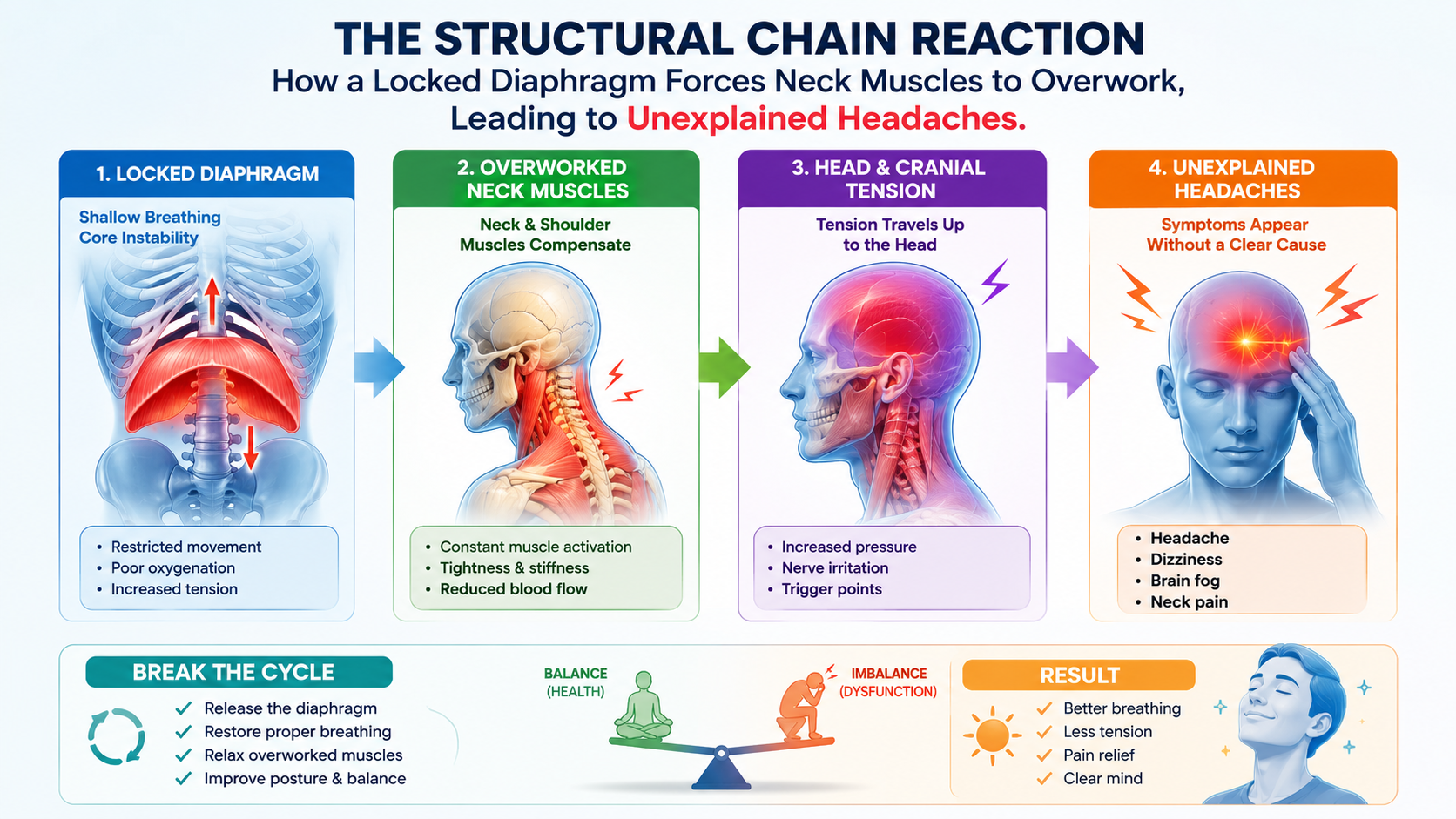
    How a locked diaphragm triggers muscular imbalance, leading to neck tension and unexplained headaches.
       [ Locked Diaphragm ]  -->  Limits deep diaphragmatic breathing
                │
                ▼
       [ Overworked Neck Muscles ]  -->  Step in to lift the ribcage (Scalenes, Suboccipitals)
                │
                ▼
       [ Head & Cranial Tension ]  -->  Triggers unexplained headaches, forehead heaviness & dizziness

    How a Tight Diaphragm Triggers Unexplained Headaches

    When your diaphragm stops doing its job, your body doesn’t stop breathing. Instead, it adapts. It recruits “helper” muscles in your neck and shoulders—specifically the scalenes and suboccipitals—to manually pull your ribcage up with every single breath.
    These small neck muscles were never designed for 24/7 labor. Over time, they become exhausted, shorten, harden, and pull relentlessly on the base of your skull.
    This structural chain reaction is the hidden root cause of your chronic and unexplained headaches:

    • Temple Tension: Caused by overworked neck and jaw muscles pulling on the facial fascia.
    • Forehead Heaviness: Triggered by restricted blood flow and tight cranial tissue.
    • Ear Fullness: Caused by tension radiating near the jaw, compressing the eustachian tubes.
    • Dizziness: Triggered when tight muscles at the base of the skull send confused, hyper-tense signals to your brain’s balance centers.
      Often misdiagnosed as standard migraines, these unexplained headaches are actually biomechanical alarms telling you that your breathing mechanics are completely out of order.
    unexplained headaches mechanism and neck tension
    The structural chain reaction: How a locked diaphragm forces neck muscles to overwork, leading to unexplained headaches.

    Letting the Body Breathe Again

    Our sessions are slow, quiet, and gentle. We don’t crack joints or force the tissue with heavy pressure.
    Instead, we focus on helping the diaphragm soften, guiding the nervous system out of “fight-or-flight” and into safety. As that deep, core tension began to melt, we worked our way up the ribcage, eased the overworked muscles of the neck, and finally addressed the forehead.
    About twenty minutes into the session, the client took a long, deep, audible sigh. His shoulders visibly dropped, and his history of chronic, unexplained headaches began to make perfect sense to him.

    “Something just let go,” he whispered.

    When he stood up at the end of the session, his face looked entirely different. The heavy, exhausted cloud had lifted from his eyes.
    “How did you know exactly where it hurt?” he asked. “I never even told you my forehead was tight.”
    “Your body told us,” was the honest answer.

    Self-Check: Are Unexplained Headaches Stemming from Your Respiration?

    If you are experiencing unexplained headaches, try this simple, two-step check at home to see if your breathing pattern might be contributing to your symptoms.

    1. The Hand-on-Chest Test

    Place one hand on your chest and one hand on your belly. Take a deep breath.

    • Does the hand on your chest rise first and highest? * Do your shoulders shrug upward toward your ears?
    • If yes, your neck muscles are working overtime to pull air in, bypassing your diaphragm.

    2. The Rib Release Breath (A Daily Practice)

    To help invite your diaphragm back into the conversation and find relief from unexplained headaches, try this gentle reset:

    • Sit comfortably and wrap your hands gently around the sides of your lower ribcage.
    • Inhale slowly through your nose, focusing on pushing your ribs outward into your hands (like an umbrella opening), rather than lifting your chest upward.
    • Exhale slowly through your mouth, letting your ribs sink back inward.
    • Practice this for 2 to 3 minutes when you feel head pressure rising.

    Listen to the Whispers of Your Body

    Watch this self-care guide to release deep physical tension and find natural relief from unexplained headaches.

    Your body rarely starts by shouting. It whispers first.
    It whispers with a slight neck stiffness in the morning, a mild ear fullness that comes and goes, or unexplained headaches at the end of a long workday. These are not imaginary complaints, and they are not “all in your head.” They are physical signals that your breathing, posture, and nervous system have drifted out of balance.
    If your symptoms are new, sudden, or worsening, always consult a medical doctor first. Ruling out underlying medical conditions is an essential step.
    But if you have done that, and you are still searching for answers, it might be time to stop looking at the scans and start listening to your body. Treating unexplained headaches requires an integrated approach that addresses the root muscular imbalances, not just the symptoms.
    If you are ready to stop managing symptoms and start restoring your posture, explore our Sole to Body balancing services to find the root cause of your tension and reclaim your daily comfort.